- New legislative report on PERS says the state retirement system’s active membership has continued to decline even as the national average plan’s membership has grown in eight of the last ten fiscal years.
The executive director of the Public Employees’ Retirement System told lawmakers in May that PERS needs additional funding, in some manner, more in line with actuarial recommendations.
Ray Higgins’ comments came upon review of the latest report from the Joint Legislative Committee on Performance Evaluation and Expenditure Review, or PEER, looking at the financial soundness of the state retirement system.
“As noted in the report, the actuarially determined contribution (ADC) was last calculated at 25.98% of payroll, which the PERS Board recommended to the legislature” Higgins told the lawmakers on the PEER committee. “Any assistance you all can provide in reiterating the importance of significant and/or recurring funding for PERS with your committee would be greatly appreciated.”
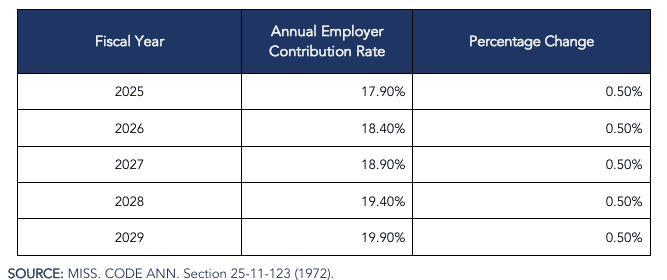
The PERS actuary recommended the 25.98% ADC for Fiscal 2025, but the Legislature mandated the employer contribution rate at 18.40% for Fiscal Year 2026. Lawmakers mandated a 0.5% increase over a five-year period, which will bring the employer contribution rate to 19.90% in Fiscal year 2029. The employee contribution rate is 9%.
As a result, PEER notes in the report that it is possible that the PERS plan will require additional funding in future periods if the actuary opines that a higher ADC is required.
Employer groups in the PERS System, namely counties, municipalities, and school districts, have made comments related to the prospective impacts that increases to the employer contribution rate will have on their entities.
“If funding increases become necessary in the future, decisions will have to be made on what employers will bear these costs increases,” PEER stated. “The Legislature could consider future appropriations to PERS to potentially reduce the need for increases in the employer’s share paid per covered position. The impact of providing a set sum could be reviewed annually by the PERS actuary to determine the amount needed to influence growth in the employer’s contribution rate.”
PEER also noted that “significant” changes have been made to PERS over the last two legislative sessions, with a new Tier Five now in place.
“Currently, actuarial projections show promising potential for reducing plan liabilities over time,” PEER opined. “Reports PEER will produce over the next two years will provide a clearer picture of the impact these changes are having. This promise is predicated upon the plan(s) meeting all actuarial assumptions, including investment returns, which are not under the control of PERS or state policy makers.”
PERS has reported nearly $26 billion in unfunded liabilities which is exacerbated by the fact that PERS active membership has continued to decline even as the national average plan’s membership has grown in eight of the last ten fiscal years. PEER reported Monday that the ratio of active to retiree members in the PERS plan has decreased from 1.52/1 in Fiscal Year 2016 to 1.20/1 in Fiscal Year 2025, or approximately 21.05% over the last decade.
This means fewer active PERS members are funding future pension obligations, “a factor made more important because contributions from active members and their employers comprise approximately 37% of PERS revenues.”
“In addition, the Public Fund Survey observed that a lower ratio of active members to retiree members results in funding future obligations over a smaller payroll base, although a declining active member to retiree member ratio does not automatically pose an actuarial or financial problem,” PEER reported. “However, when combined with an unfunded liability, a low or declining ratio of active members to retirees can cause financial distress for a pension system provider.”
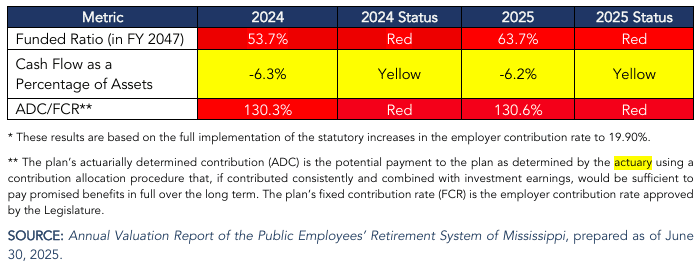
Another concern reported by PEER was in their evaluation of three metrics that track the plan’s sustainability. The metrics are evaluated using a “signal-light approach.”
“Based on the results of the evaluation metrics in the funding policy as of June 30, 2025, two of the plan’s metrics are at the red signal-light status and one the of the plan’s metrics is at yellow signal-light status,” the reported stated. “All three funding policy metric results increased from June 30, 2024, to June 30, 2025. For the fiscal year ended on June 30, 2025, the plan’s projected funding level was 63.7%, an increase from 53.7% for the year ended on June 30, 2024. The cash flow as a percentage of assets increased from -6.3% to -6.2%. The ADC/FCR ratio changed from 130.3% to 130.6%.”
You can read the full PEER report titled 2025 Update on Financial Soundness of the Public Employees’ Retirement System here.

Frank Corder