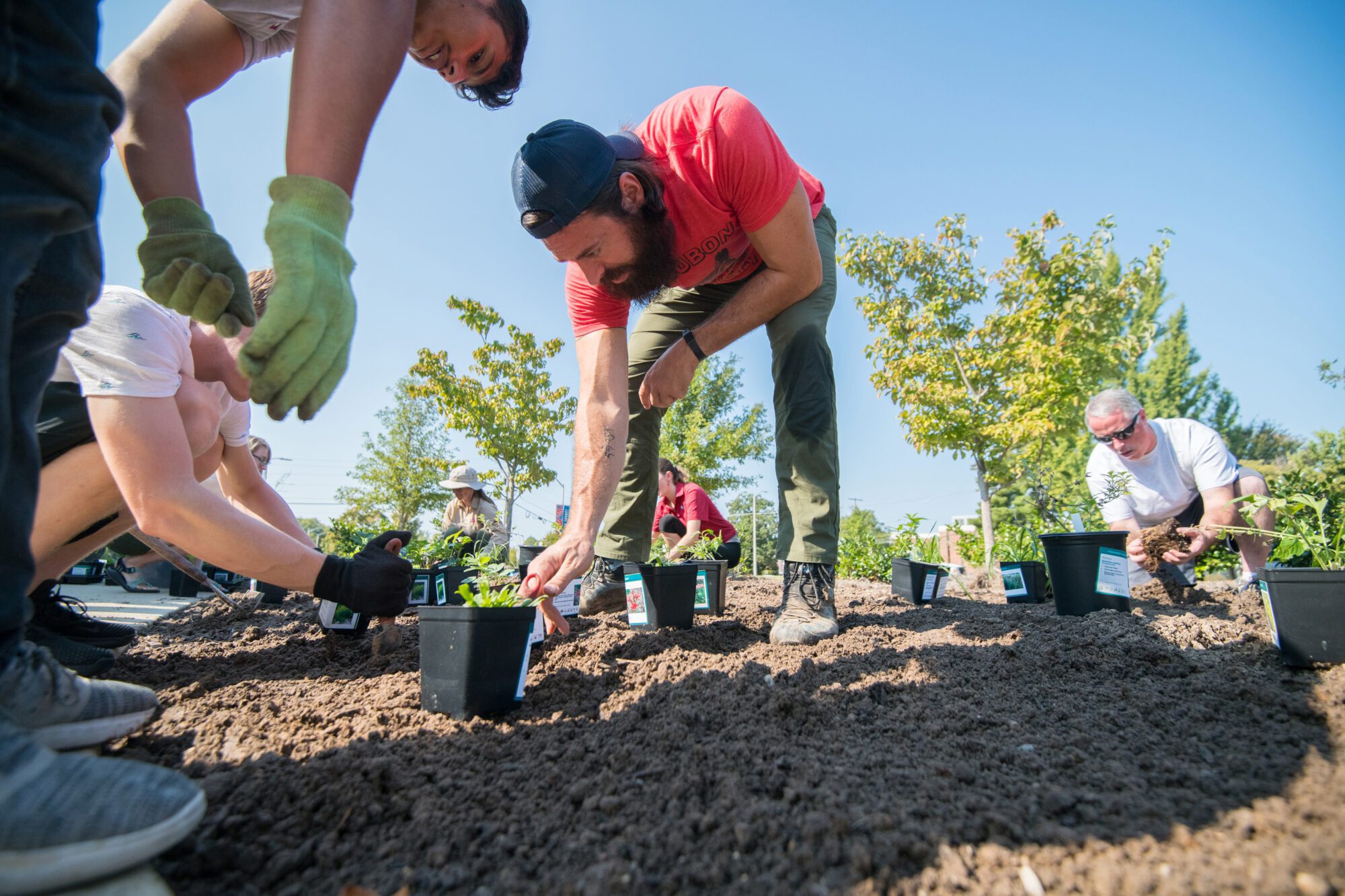
Biologists, farmers and leaders need to work together to improve farming to feed a growing world population. A University of Mississippi team of biologists has conducted a review that highlights many ways in which farming and agricultural practices could be streamlined to meet that need. (Photo by Kevin Bain/Ole Miss Digital Imaging Services)
- Biologists study ways to increase food production for a growing world.
With the world population expected to approach 10 billion by 2050, scientists are searching for ways to feed that many people with fewer resources. A new review outlines scientific advances that could help make food production more sustainable and resilient.
Sixue Chen, University of Mississippi chair and professor in the Department of Biology, Hajra Maqsood, a biology research associate, and a team of student researchers reviewed innovations that could transform how food is produced in the coming decades. They published their findings in the journal Food and Energy Security.
Feeding a population of 9.8 billion would require a nearly 50% increase in crop and farming production. For the agricultural industry, which is already struggling with the impacts of environment change, this increase represents a severe burden, Chen said.
“These are challenges that humanity is going to face,” Chen said. “If we don’t start thinking about this now, there are a lot of people who are going to go hungry.
“In this paper, we wanted to ask, ‘What are the new, state-of-the-art technologies that can help us solve food insecurity?'”
The review examines emerging technologies that can help increase crop yield while reducing the agricultural industry’s climate impact. They include cultured meat, hydroponic farming, gene-editing and AI-powered agriculture, among other strategies.
A water-saving strategy using crassulacean acid metabolism could help crops retain water, Chen said. This is a type of photosynthesis that is common in many desert and drought-tolerant plants such as cacti and pineapples.
“Plants have pores in the leaves for gas exchange called stomata,” Chen said. “Many crops open these stomata during the day, taking in carbon dioxide for photosynthesis and releasing oxygen and water, but desert plants open the stomata at night to conserve water.”
Chen’s work focuses on transferring some of the traits of desert and drought-resistant plants into crops such as soybeans, rice and wheat.
“My lab has for many years tried to learn from these cacti,” he said. “What if we could teach a soybean plant to act like a desert plant during a drought?”
Using gene-editing technologies such as CRISPR and multi-gene engineering, Chen’s research team is working to “teach” crops to reduce the amount of water they lose each day through the stomata by acting more like desert plants.
Beyond changing the plants themselves, researchers also explored technologies that can monitor and improve growing conditions while reducing land and water use.
Machine learning algorithms can monitor a plants environment – checking the humidity, temperature, carbon dioxide concentration and other factors – and make changes to the greenhouse to keep the plant in optimal growing conditions.
Hydroponic gardening offers ways to reduce land and water use while maintaining crop yields.
“One of the most important constraints to the agricultural industry is land,” Maqsood said. “Hydroponic gardening uses no soil. Instead, the plants get nutrients from water-based solutions.”
Using water mixed with the different nutrients that plants need to grow, hydroponic gardens offer increased output, quicker growth rates and easier pest control. These gardens also use up to 90% less water than traditional farming, the researchers found.
“The system is actually more efficient because it has only the specific nutrients the plants need,” Maqsood said. “So, we’re using less and less water and actually cutting down on waste and runoff.”
Livestock production accounts for more than 14% of worldwide greenhouse gas emissions and 32% of methane gas emissions. The factory farming industry also uses vast amounts of freshwater, both for livestock and to grow the feed the animals eat.
Cultured meat, which is grown from animal cells in a controlled environment, offers an alternative to the global demand for protein that lowers greenhouse gas emissions, water usage and production costs.
“This is a technology that has already been used in other places,” Chen said. “Places like Singapore, they are already doing this.”
Seven states, including Mississippi, have banned the sale, manufacture or distribution of cultured meat.
“We are excited about the prospect of cultured meats,” Chen said. “But the biggest hurdle for implementing it is public acceptance.”
While meeting population needs in the future is important, food scarcity is an issue now, he said.
“In Mississippi, one-fourth of children go to bed hungry,” Chen said. “So, this is a future problem, but this is a problem now, too.”
This article is republished courtesy of Ole Miss.

Clara Turnage