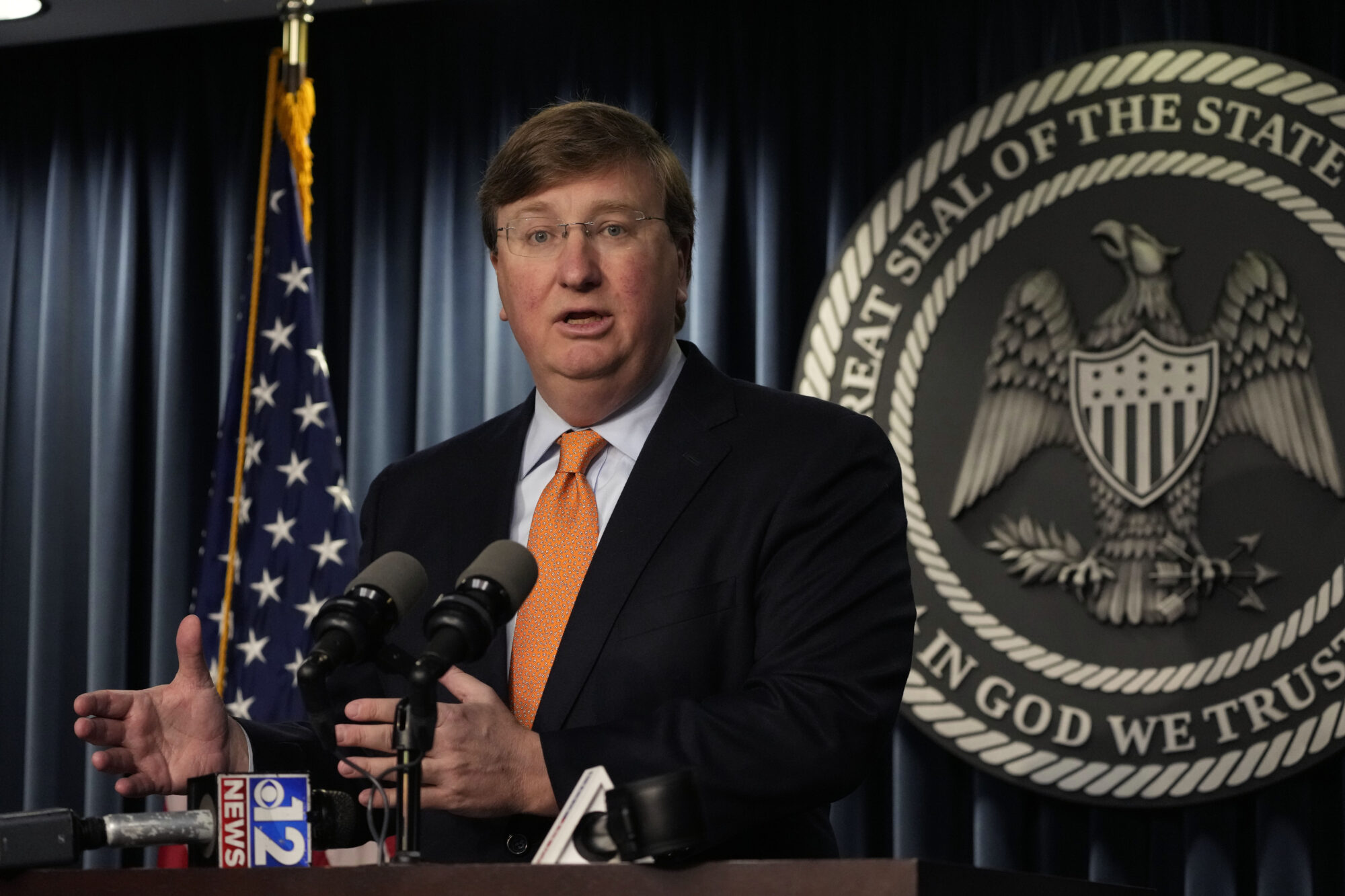
Mississippi Republican Gov. Tate Reeves answers a reporter's question on his announcement of a tech company expected to invest $10 billion to build two data processing centers that will create 1,000 jobs in central Mississippi, during a Wednesday, Jan. 24, 2024, news conference in Jackson, Miss. (AP Photo/Rogelio V. Solis)
- Governor Tate Reeves downplayed any “pressure” from the White House to attempt congressional redistricting at this point. He said no one is working closer with the White House on what a congressional redistricting plan would look like than him.
Governor Tate Reeves (R) is rescinding his special session call intended to redistrict state Supreme Court lines.
“The plaintiffs have stipulated that they are not going to seek any new elections in 2026 on judicial races in Mississippi,” Reeves said in an interview on SuperTalk Radio Wednesday morning. “Because of that, there is no longer any reason for the Legislature to come in on next Wednesday for judicial redistricting and so I do not expect that the Legislature will come in next Wednesday because there is no reason to do so.”
Reeves said he plans to rescind the special session call for judicial redistricting later Wednesday. The special session was to be held next week, 21 days after the U.S. Supreme Court’s ruling in Louisiana v. Callais.
The governor’s move comes after the Fifth Circuit Court of Appeals vacated the liability order in Mississippi’s state Supreme Court judicial redistricting case earlier this week.
The federal appeals court’s actions followed the recent U.S. Supreme Court ruling in Louisiana v. Callais where the nation’s highest court struck down Louisiana’s congressional redistricting that added a new majority-minority district, saying that lawmakers relied too heavily on race. The high court’s 6-3 ruling deemed racial gerrymandering unconstitutional as it had been practiced under Section 2 of the Voting Rights Act.
Section 2 was being used as the justification for U.S. District Judge Sharion Aycock’s order that mandated the redrawing of Mississippi’s Supreme Court district lines set in 1987 to accommodate greater black voting strength. The case has now been remanded back to Aycock’s court. She has given the parties in the lawsuit 14 days to enter filings on next steps in the case. Governor Reeves believes the case should be dismissed at this juncture.
Many in Republican circles have voiced their desire for the governor to add congressional redistricting to a special session call ahead of the November midterms. However, given that Mississippi has already held its primary elections, unlike in other states, such a move would be complicated.
Governor Reeves downplayed any “pressure” or “encouragement” from the White House to attempt congressional redistricting at this point in the cycle. He said no one is working closer with the White House on what a congressional redistricting plan would look like than him.
“Understand something, that maybe while it may be in the best interest of some individual politicians in Mississippi to talk about congressional redistricting, what happens in Mississippi doesn’t happen in a vacuum,” Reeves said. “I’m going to do what’s in the best interest of Mississippi and I’m going to do what’s in the best interest of America and I’m going work very closely with the Trump administration to accomplish both of those goals.”
While Reeves did not commit to calling a special session to redistrict congressional districts, he did express his support for having the maps redrawn by the Legislature, between “now” and the 2027 legislative session.
“The tenure of Congressman Bennie Thompson’s reign of terror over the 2nd Congressional District is over. It is not a question of if; it’s a question of when,” Reeves said, noting that congressional redistricting will continue to be considered. “It is fair to say that we are looking at every potential option as to what that may look like and when is the best time to look at it.”
A similar push has arisen for legislative redistricting ahead of next year’s state elections, after Section 2 was used to force special elections in 2025 to accommodate greater racial quotas in certain Senate and House districts. Those special elections resulted in Republicans losing their supermajority in the state Senate.
Governor Reeves said the calendar would create issues for local election officials if legislative redistricting were to occur now. Instead, he foresees new legislative lines being drawn by the Legislature between “now” and the 2027 elections.

Frank Corder