- The 2026 Education Scorecard held Mississippi up as an example, saying, “The progress in Mississippi has inspired state leaders around the country to take more significant action to improve student achievement.”
Mississippi is being heralded as an example for other states when it comes to adopting sound education policy and then implementing those policies to produce positive gains in reading and math.
The 2026 Education Scorecard released on Wednesday showed Mississippi is among only 7 states that improved in reading achievement in the three years following the COVID pandemic.
The Education Scorecard is a collaboration between the Center for Education Policy Research at Harvard University, the Educational Opportunity Project at Stanford University, and faculty at Dartmouth College. The Scorecard provides high-resolution, district-level analyses of academic recovery across the United States, using state test results for roughly 35 million grade 3–8 students in 2022–2025 linked to a nationally comparable scale.
The other states that showed advances in reading achievement between 2022 and 2025 were Louisiana, Maryland, Tennessee, Kentucky, Indiana, and Minnesota.
The Scorecard used an ExcelinEd report from 2024 on the implementation of 18 “science of reading” policy elements in every state, whether “full implementation,” “partial implementation,” “future implementation,” or “not adopted.”
Based on the ExcelinEd report, the Scorecard created an index, counting each element in full or partial implementation. The Scoreboard then plotted the change in state reading achievement between 2022 and 2025 against the sum of the number of policy elements that had been implemented or partially implemented as of January 2024. The graph is shown below.
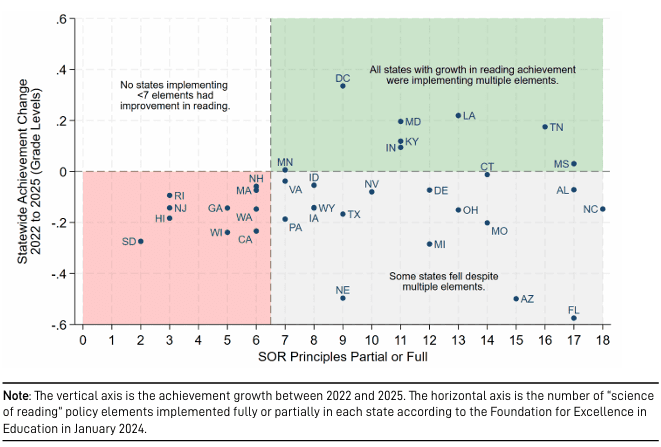
The Scorecard noted that there is not a strong correlation between the magnitude of state reading improvement and the number of science of reading policy elements adopted.
“However, we did note a striking pattern: none of the states which had implemented fewer than seven of the science of reading policy elements as of January 2024 (South Dakota, Hawaii, Rhode Island, New Jersey, New Hampshire, Georgia, Wisconsin, California, Washington and Massachusetts) saw achievement growth in reading. (The upper left quadrant in Figure 12 is empty.) Reading achievement in these states continued to fall following the pandemic,” the Scorecard explained. “Meanwhile, all of the states (plus the District of Columbia) with any improvement in reading following the pandemic (the District of Columbia, Maryland, Louisiana, Kentucky, Tennessee, Indiana, Mississippi, and Minnesota) had implemented more than seven of the policy elements tracked by ExcelinEd. However, there were some states which had implemented more than 7 of the policy elements who still had not improved in reading (notably, Florida, Arizona, and Nebraska). While we see evidence suggesting that implementation of a comprehensive literacy strategy may be a necessary condition for improvement, mere adoption is apparently not sufficient.”
Patricia Levesque, CEO of ExcelinEd, said the Scorecard “gives policymakers and advocates the information they need to help them understand where students are struggling and where things are improving.”
“This kind of granular, actionable data is the foundation of meaningful education interventions and growth, providing an opportunity to partner with states to provide literacy, math and accountability reforms where they are needed most,” Levesque said, adding, “Policy matters, and so does implementation.”
Mississippi Governor Tate Reeves made a similar point Wednesday night at the Mississippi Top 100 event in Jackson.
When speaking about the state’s education gains, the governor told the nearly 500 attendees that while passing good policy was key, so too was the implementation of that policy at the state and local level.
Reeves praised former State Superintendent Dr. Carey Wright for effectively implementing the education standards passed by lawmakers and expressed our proud he was of teacher and students who rose to the challenge. Reeves also said having strong accountability models that were routinely readjusted to raise the bar was important in continuing Mississippi’s success.
Mississippi’s education gains have been highly touted across the nation, with some calling it the “Mississippi Miracle,” a term the governor has used but says, “It’s really not a miracle. It’s good policy, implementation and accountability.”
The Scorecard held Mississippi up as an example, saying, “The progress in Mississippi has inspired state leaders around the country to take more significant action to improve student achievement. Using Mississippi as our example, we identify 108 ‘districts on the rise’ (108 Mississippis, if you will) that have shown unusual progress in both math and reading relative to similar districts in their own states.”
The Scorecard then goes on to outline these “districts on the rise” across the nation.
You can read the full Education Scorecard below.