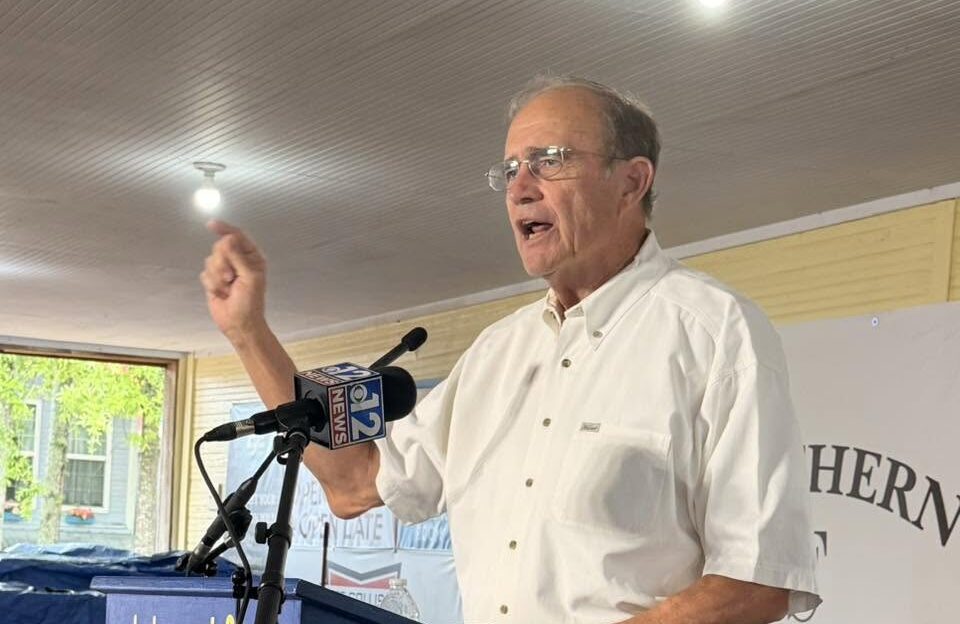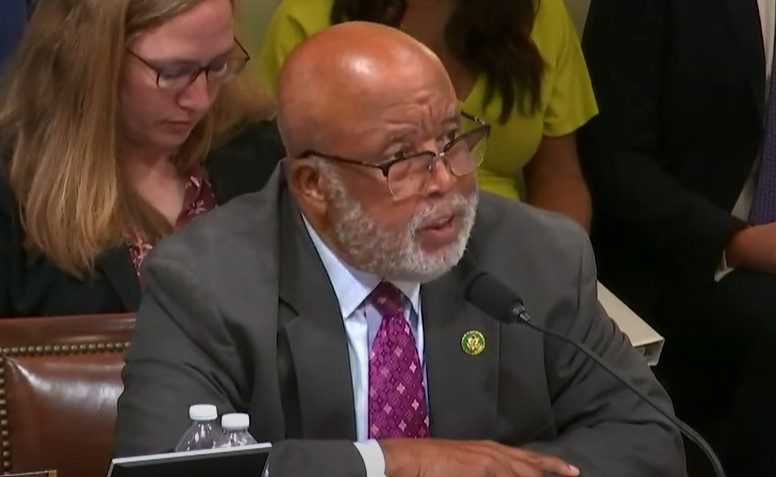
Congressman Bennie Thompson (D-MS 2)
Listen to the audio version of this article (generated by AI).
- Republicans aren’t racists or white supremacists for wanting to elect more Republicans. That doesn’t mean Mississippi should ignore its racial history in redistricting considerations.
The first rule of unsuccessful politics is to try and see all sides. Worse still, perhaps, is to call out both sides’ excesses. Americans like teams. They hate referees. Our own team never commits fouls. The other team is dirty. It is with that somber acknowledgement that I present this turd in a punch bowl.
A few years ago I had a conversation with a young friend. He was once a libertarian, but had become pretty aggressively tied to a sort of “might makes right” nationalism. I lamented to him that there was no longer a real political movement fighting for limited government — that “new conservatives” weren’t all that different on big government policy, or with respect to over-the-top rhetoric, than the progressives they claimed as “enemies.” Horseshoe theory or something like that.
I lamented, too, that Americans increasingly saw people as enemies just because of political disagreement.
He told me that conservatives were in a room with people who want us dead and there’s only one gun in the room. His take, “we” have to get to the gun first and use it. Basically, he told me I was a naive boomer (I was born in 1981, dagnabbit).
My young friend’s argument was a metaphor for political power, not political violence, but it gnawed at me. I’ve heard similar from friends on the left. We’ve seen actual political violence arise out of an “my opponent is my enemy” mindset.
I share this story to say I find myself in odd spots these days. I’d prefer not to have a scrum over the gun. I’d prefer there not be a gun. I largely want government to protect my natural rights, and otherwise, to be left alone.(You’re welcome to join the “I don’t need another daddy caucus.” It’s lonely, but there’s self respect.)
You Said There’d be Something about Redistricting
Redistricting is no different. There’s a race to the bottom underway. Everyone is scrambling for the gun.
I’m not convinced the Legislature should commit to congressional redistricting in Mississippi for the 2026 cycle. This is not because of any great affinity for Congressman Bennie Thompson. I think he contributes, as much as anyone in D.C., to the purposeful polarization of our country. He benefits from it.
Thompson’s built a nice fiefdom while his voters’ lot in life has improved very little, possibly not at all. (Don’t tell me this is because of evil conservatives that starve widows and orphans. The government has spent nearly $30 trillion on social welfare since President Johnson started his “war on poverty.” All it’s done is to contribute to the disintegration of family and community. Poor people are every bit as poor as before. They now lack the motivation and agency to make life better for themselves.)
I’m just not convinced it’s actually smart political strategy long-term to commit to congressional redistricting. If you’re a Republican champing at the bit, understand that creating a fourth Republican district means weakening the three you already firmly hold.
I’m not convinced it can actually be done post-primaries in Mississippi, either. Nor am I convinced that it should be done post-primaries, when both candidates and voters have completed the most important phase of the election in Mississippi. It’s never been tried as near as my research tells.
Finally, I’m not convinced it’s “right.” Is there an argument that Thompson’s district drawn to ensure a black Democrat gets elected? Uh, yeah. Is drawing a district with that intent constitutional? No. It violates the 14th Amendment, which prohibits race-based decision making by government.
But Thompson’s district was also drawn to represent a region of the state (the Delta) and Mississippi has long divided congressional districts by region. That is to say there is a plausible justification for it unrelated to race. It just so happens that the Delta contains the greatest concentration of black voters and that “just so happened” because it’s where the crops that slaves and sharecroppers picked were grown.
My conservative friends are right that the “looks like me” standard is a bad way to elect politicians. I wish our disagreements were policy centric and that race was not used as a weapon in modern debates. Societally, we’ve made great progress. There should be values alignment, assessment of competency and decency, in picking candidates.
But I also struggle with the idea that we’re fully “post-racial.” To boot, I am not personally within a generation or two of being denied any political voice because of the color of my skin. I have to ponder the possibility that it hits different for someone who is.
There’s a fair amount of grandstanding right now, including from Thompson, but it’s naive and dismissive to think getting rid of him through redistricting won’t be seen as taking something away from a large chunk of the population — for whom the state’s history is more than just pages in a book.
A fair amount of caution and introspection are warranted.
A Soggy Sweat Style “On the Other Hand”
On the flip side, if I see one more twenty-something white kid, who wouldn’t know discrimination if it snuck up and bit him on the ass, talk about how the Supreme Court “dismantled” or “gutted” the Voting Rights Act, how justices are part of a “white supremacist” agenda, or how this is the second coming of Jim Crow, I might personally go picket for redistricting. Not really, but it does make me roll my eyes.
The majority in Callais v. Louisiana did not gut anything. Heck, Clarence Thomas, one of two black justices on the Court, wanted to go even further than the majority in limiting the application of Section 2.
The Fifteenth Amendment guaranteed that the right of citizens to vote would not be denied “on account of race, color, or previous condition of servitude.” That’s it. It promised access to a ballot. It did not promise that new districts would be created that group people together by race to ensure electoral success.
When the Voting Rights Act passed in 1965, it did so because of authority granted to Congress by the Fifteenth Amendment and is limited by the purpose of the amendment. Nothing in the text of the Voting Rights Act mandated the creation of districts that cloistered people of color together.
When Section 2 was amended in 1982, it maintained that the purpose was access to ballots, but included an evidentiary standard for assessing voting rights’ cases. The standard, that minorities “have less opportunity than other members of the electorate to participate in the political process and to elect representatives of their choice,” gave birth to a lot of judicial interpretations and expanded judicial intervention in redistricting cases.
But even then, Section 2 explicitly said, “nothing in this section establishes a right to have members of a protected class elected in numbers equal to their proportion in the population.” Congress knew there were reasons other than race used by states in drawing lines, including the partisan alignment of the state.
There also is the matter of overlap between race and partisan affiliation. 87-92 percent of black voters vote Democrat. 57-62 percent of white voters vote Republican. With those overlaps, particularly among black voters, it becomes hard to distinguish if race or ideology primarily drives voter behavior. There are indicators it’s the latter, though. And that’s a good thing.
Rodney Hall was elected in DeSoto County to serve in the Mississippi House of Representatives. Thomas Tuggle was elected countywide in DeSoto as sheriff. Both are black men. Both are Republicans. Tim Scott was elected to represent the entire state of South Carolina as a U.S. Senator. Byron Donalds will very likely be the next governor of Florida. Both are black men. Both are Republicans.
All three places are in the South, where our history is complicated. All three places are very conservative.
Now contrast that with Winsome Sears and John James. Both black. Both Republican. Sears won the Republican primary for Governor in Virginia, but was defeated by a white Democrat. James won the Republican primary for U.S. Senate in Michigan twice, but was twice defeated by white Democrat candidates.
Does this mean that the Democrats that dominate those states’ elections are racist? No. It means that Democratic voters support Democratic candidates.
Long before redistricting was a gleam in the eye of Greg Abbott in Texas or Ron DeSantis in Florida, partisan gerrymandering was not only permitted but embraced in Democrat controlled states.
Forty-plus percent of Massachusetts, Maryland, Illinois, and Connecticut vote Republican. Massachusetts and Connecticut have no Republicans in Congress. Maryland has a 7 to 1 split. Illinois, a 14 to 3 split. California passed a new map to add 5 Democratic seats last year. Virginia, a state with 46 percent Republican vote, proposed one to add 4 Democratic seats and move their ratio to 10 to 1.
Only one side gets accused of being white supremacists for these maneuvers.
At the end of the day, Republicans want to elect more Republicans and Democrats want to elect more Democrats. They are both positioning themselves to do that in states where they have political power. The rest is largely theatrics.
People framing this in hyperbolic moral terms are overselling. There is no good or bad side here. Just people trying to gain and maintain power on both sides.
Short Version: There are reasons to be cautious about redistricting in Mississippi. There are considerations legislators should make about our history and how it will impact racial progress in the state. But being empathetic doesn’t mean surrendering fact or logic, or conceding to hyperbolic, painfully irresponsible charges.

Russ Latino