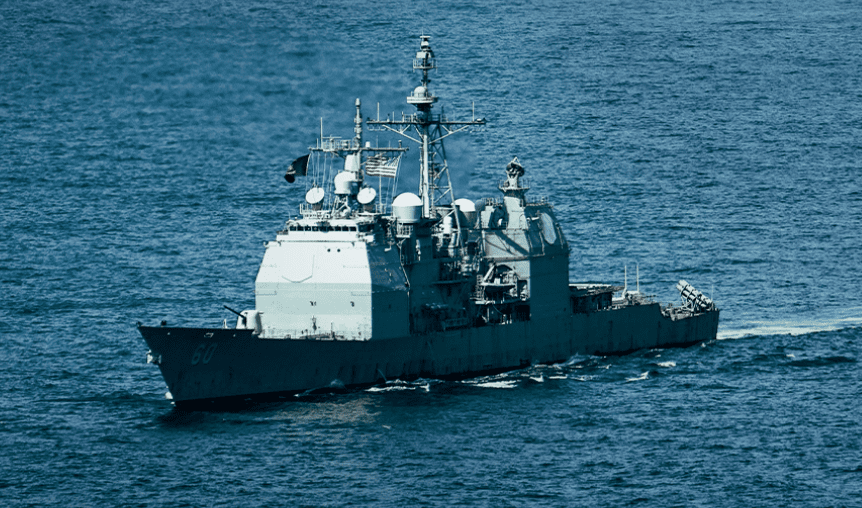
USS Normandy (CG 60) (Photo from US Navy on Facebook)
- The Golden Fleet provides a target in ship orders, and Congress appears on track to provide the resources. But institutional discipline to stay the course for many years on the shipbuilding plan is less assured.
America’s victory in World War II was a military success enabled by private industry: “freedom’s forge,” as it’s been called. That forge, however, cannot build the Navy we need today, at least not in a timely fashion, due to decades of post-Cold War neglect and mismanagement.
The good news is that this is starting to change for the better. Thanks to a national maritime awakening, investment is flowing and audacious shipbuilding plans like the Navy’s Golden Fleet are underway.
But more than money is needed to deliver the Navy that our nation requires. We also need an industrial strategic plan that lays out how government can better signal what it needs to fulfill our defense orders, and how investments in infrastructure, labor, and new shipyards can help us successfully complete these orders.
The details of Golden Fleet have become more visible recently with the release of the Navy’s shipbuilding plan and associated fiscal year 2027 budget. Realizing the fleet as envisioned will take more than the $65.8 billion (a 39% increase over the FY26 budget) that’s been earmarked. It will take a long-term industrial plan that builds and delivers warships on a meaningful timeline to deal with today’s chief threats – most notably, China.
Hung Cao, the acting Navy Secretary, understands this. In recent testimony to Congress, he detailed how he has challenged his department to “change how we do business” and “revitalize our industrial base.” The Golden Fleet provides a target in ship orders, and Congress appears on track to provide the resources.
But institutional discipline to stay the course for many years on the shipbuilding plan is less assured. Winning early successes can build momentum and set the direction for critical infrastructure investments, thereby sustaining congressional support… for a time. Focusing early actions that lead to an enduring naval buildup requires a roadmap.
Case in point, the former Secretary of the Navy cancelled the Constellation-class frigate over design creep with associated delays and cost overruns. But the shift to a different shipyard – Ingalls – to restart a dormant Coast Guard National Security Cutter program fail to account for reassigning labor and necessary modest design modifications that will likely result in delays and higher costs. Without a clear focus on increasing shipbuilding capacity and competition, such decisions run the risk of failing both to deliver a needed frigate as well as to reduce shipbuilding capacity.
Additionally, the proposed prolonged aircraft carrier procurement periodicity risks the continued viability of Newport News Shipbuilding to build these complex nuclear powered capital ships. As for the proposed battleship, current naval shipyards are overloaded or cannot build a ship of the size and timelines necessary.
Expanding naval shipbuilding capacity requires balancing current workload amongst existing shipyards, making strategic capital investments, while fostering new shipbuilders to enter the market to meet increased demand for warships and their lifetime sustainment. This is a generational endeavor that current plans don’t address… yet.
To make matters more challenging, the U.S. Coast Guard has also been funded $25 billion to build up its fleet – further taxing limited shipyards to take on these orders. This and the Navy’s shipbuilding efforts must also complement a national commercial maritime industrial revival directed by the president and detailed in the Maritime Action Plan. Leveraging treaty allies’ latent shipbuilding capacity is one way to mitigate these competing pressures.
However, meeting urgent delivery of warships of allied design/built warships is no panacea. This will require careful consideration of the impact on training and maintenance needs of these ships. But critically, it must be done in parallel with investment to build these ships at new shipyards in the U.S. Only in this way can the effort be sustainable, grow domestic shipbuilding capacity.
The approach taken for icebreakers is instructive: The ICE PACT agreement involves placing initial orders of a proven design at a shipyard in Finland currently building them, while investing in an American shipyard to be able to build the fourth and onward icebreakers in the U.S. without a gap in delivery schedule.
Australia is currently dabbling in a similar approach, ordering Japan’s Mogami-class frigate and will be a bellwether of how allies like Japan and South Korea can help meet urgent American naval shipbuilding needs.
Connecting all the players involved with needed resources to deliver warships on time is a tall order. It will require ensuring the millions of decisions made daily in the near-term contribute to a generational national maritime revival.
An associated national industrial strategic shipbuilding plan is needed to map out how increased shipbuilding orders will be complemented by industry investment in infrastructure and labor, how new shipyards will be built, and how the government plans to deliver long-term demand signals to industry by increasing orders in destroyers, carriers, frigates, submarines and unmanned vessels.
This article was originally published by RealClearDefense and made available via RealClearWire.

Brent Sadler