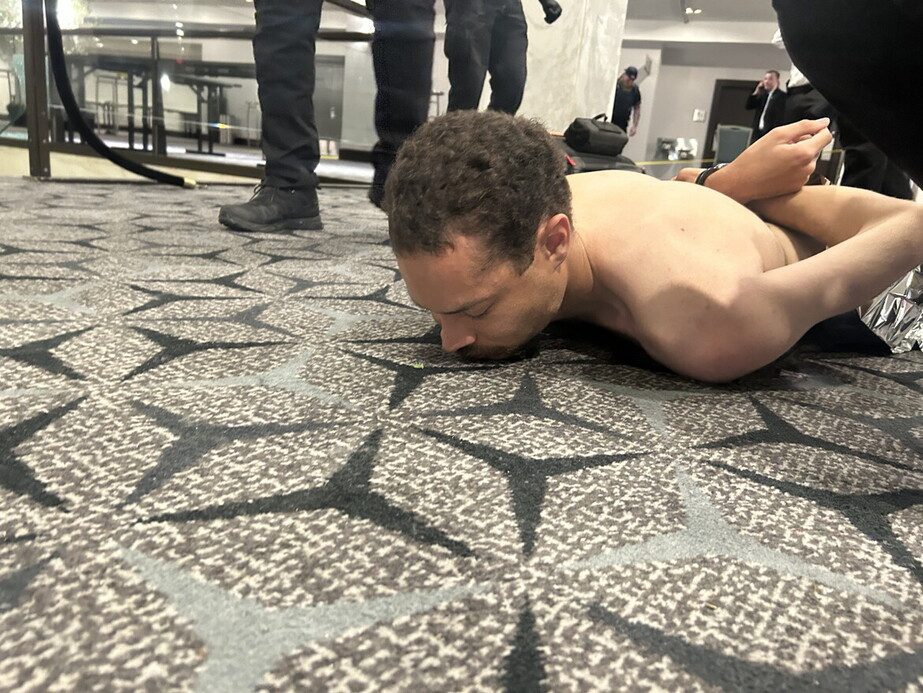
Cole Tomas Allen detained by Secret Service at White House Correspondents' Dinner, April 2026 (Photo shared by President Donald Trump on Truth Social)
- The close call that terrorized the entire ballroom at the White House Correspondents’ Association Dinner is spurring more questions about Secret Service Director Sean Curran’s leadership.
The head of the U.S. Secret Service is defending security arrangements at last Saturday’s White House Correspondents’ Association dinner, saying he would not change a thing about the security plan, even as questions continue to swirl around the shooting and his leadership of the agency.
“The site was set up perfectly, I will tell you I would not change the site again,” Secret Service Director Sean Curran told Fox News host Will Cain Thursday.
Curran said one agent was shot at “point-blank range” by suspect Cole Tomas Allen as he dashed through a security checkpoint inside the Washington Hilton hotel, where President Donald Trump and thousands of guests had gathered for the annual dinner.
“Our officer heroically returned fire while being shot [at] point blank range in the chest with a shotgun,” Curran asserted. “[The officer] was able to get off five shots. It’s great training.”
The suspect was not struck by the agent’s return fire, Curran explained, alleging that Allen, 31, fell after hitting his knee and was subdued by other federal agents near the top of the stairs from the ballroom where Trump, the first lady, and top administration officials were dining.
Curran tried to stress that the actual place where Allen fell and was subdued was nearly 120 yards away from the podium where Trump and Vice President JD Vance were seated, along with top officers of the White House Press Corps Association. Curran argued that 120 yards is “a long distance to get to.” But Allen was just yards away from a short stairwell leading to a jam-packed ballroom filled with 2,600 guests, including numerous congressional leaders and Cabinet officials.
“If he had gotten through those ballroom doors, it would have been a catastrophic,” Rich Staropoli, a former Secret Service agent who protected four presidents and served as a senior official in the Department of Homeland Security, told RealClearPolitics.
Former agents and other sources in the Secret Service community also noted that Thomas Crooks, the would-be assassin who nearly killed Trump in July 2024 at a campaign rally in Butler, Pennsylvania, was shooting from a distance of roughly 130 to 150 yards away from Trump and managed to strike his ear before a Secret Service counter-sniper shot and killed him.
Curran also pushed back on reports that the officer who was shot and saved by his bullet-proof vest may have been hit by friendly fire. He pointedly added that agents “who weren’t in the game when they were agents” were criticizing the security plan and execution.
On Thursday Trump said Secret Service leadership has relayed the same message to him.
“They said it wasn’t friendly fire. It wasn’t us,” Trump told reporters in the Oval Office.
Curran also repeated the same assertion – that this was not a friendly-fire incident – to a lawmaker in response to questions during a congressional briefing convened by Oversight Committee Chairman James Comer, a source familiar with the briefing told RCP.
His account, however, differs in some respects from court documents filed Wednesday by prosecutors. Those filings reference an officer firing five times but make no mention of that officer or any other being shot, and do not accuse the suspect of aiming at or striking a Secret Service officer.
Released Video Raises New Questions, Criticism
Newly released surveillance footage from U.S. Attorney Jeanine Pirro shows Allen methodically casing the Washington Hilton in the hours before the attack – strolling hallways, peering into doorways, and scoping potential escape routes the day before the shooting.
On Friday, Allen appeared unhurried, even relaxed. He wandered through the hotel, at one point stopping to chat and smile with a Hilton staffer and later spending time in the hotel gym.
Saturday night’s video, however, reveals a more sinister story. Allen is seen lurking behind a doorway in the upper left of the frame – and in what may be one of the most striking images in the footage, a Secret Service dog appears to zero in on him. The handler, however, pulls the animal back.
Moments later, Allen emerges with a shotgun, fires at least one round, and sprints past agents, apparently tripping and falling directly into the hands of responding officers – somehow escaping the hail of gunfire directed at him unscathed.
The video has revived concerns about the night’s security and whether the Secret Service was up to the task of preventing an attack. Critics maintain that the agency was simply lucky that Allen was working alone and that the security team seemed unprepared for a more professional organized threat with multiple assailants.
After viewing the video, Fox News’ Laura Ingraham also questioned Curran’s “set-up perfectly” narrative.
“Perimeter maintenance? Officers standing around, a few seemingly run away and falling into each other, K-9 sense not followed, officers only noticing Allen holding long gun when he was already through the magnetometer,” she said. “Thank God only one shooter and no bombs.”
Conservative commentator Clay Travis was equally unsparing.
“10 of the 11 guards weren’t paying attention when the guy with the gun came running at them attempting to kill the president,” he remarked on X.com. “And the one guy who was watching fired multiple shots from this close without hitting the would be assassin.”
Three federal officers lined up against the back wall appear to be Transportation Security Administration employees who likely helped with bag screening, according to federal law enforcement sources. When they saw Allen running with a shotgun, the trio crunched down and crawled around the corner.
Earlier in the day, reporters asked Trump if he believed he needs to wear a bulletproof vest to protect himself. Trump appeared reluctant. “I don’t know if I can handle looking 20 pounds heavier,” he quipped, adding more seriously: “I guess it’s something you consider. In one way you don’t like to do it because you’re giving in to a bad element.”
Trump has stood by the Secret Service leadership, even praising the agents who subdued Allen for doing an “outstanding job.” But the White House also released a statement Monday stating that Chief of Staff Susie Wiles would meet with Secret Service and Department of Homeland Security leaders this week to review security protocols for major events involving Trump.
“We’re always ?looking for ways to improve security,” White House press secretary Karoline Leavitt told reporters. “I think if you just sit here and say everything is perfect all the time, â??that’s not a good way to operate.”
Several former and current Secret Service agents contacted for this article said suggestions that Trump should be forced to take the extreme measure of wearing a bullet-proof vest are only being considered because the agency failed in securing the White House Correspondents’ dinner. The security plan appeared very similar to past dinners when then-Presidents Joe Biden and Barack Obama attended, but was completely outdated for the obvious high threat-level Trump currently faces after two assassination attempts and explicit threats from Iranian officials, the sources argued.
“The Secret Service got incredibly lucky again, and luck isn’t a security strategy,” Staropoli said. “What if it had been multiple attackers or an explosive device, so how do you counter that? The obvious nature of the deficiencies here is ridiculous.”
Staropoli argues that Curran took a “big gamble unnecessarily” in allowing Trump, Vance, and many other Cabinet secretaries to attend the dinner.
He and other sources in the Secret Service community interviewed for this article argued that Curran should have informed Trump that the Washington Hilton was not a suitable venue. Instead, the agents in charge of devising the security plan for the night left many aspects of the hotel unsecured, including the staircase Allen used to access the checkpoint.
The close call that terrorized the entire ballroom is spurring more questions about Curran’s leadership, including whether his decisions to remove experienced senior leaders from both the Presidential Protective Division and its counterpart that secures the vice president contributed to poor planning for the dinner.
For decades, leadership of the Presidential Protective Division and Vice Presidential Protective Division was the capstone of a career trajectory that ran through the Senior Executive Service – the federal government’s elite management corps. Agents who rose to Special Agent in Charge or Deputy Special Agent in Charge of these divisions had typically accumulated years of varied leadership assignments, accumulated SES credentials, and been vetted through a rigorous internal pipeline.
Under Curran, multiple sources say, that pipeline has been dismantled. The director changed internal requirements so that SES experience is no longer mandatory for those top leadership roles – clearing the way for the promotion of agents who had not gone through the SES pipeline.
The starkest example, sources say, is the forced departure of David Yamin, who served as the last SES-credentialed Deputy Special Agent in Charge on PPD. Sources describe Yamin’s exit as effectively engineered by Curran to open the position for Matt Piant, a Curran loyalist, and others in the director’s trusted circle.
“David Yamin was exactly the kind of person you want in that role,” said one veteran agent. “SES, deep experience, knows how to run a detail. He didn’t leave voluntarily.”
The concern is not merely bureaucratic. Senior agents say the leadership gaps may have contributed to operational missteps, including the reported use of an outdated security model for the WHCA event at the Washington Hilton.
Curran Gave Himself and His Friends ‘Valor Awards’
In late March, Curran made waves across the agency by giving himself and several of his friends and senior Secret Service officials he placed in key leadership roles “valor awards,” announced through email to all employees of the Secret Service. The valor awards are just some of those the director designates each year while others include a Life-Saving Award for agents and officers who perform heroic actions on or off duty.
Agency employees are nominated for the awards by peers and supervisors, but the director has the final say. A source familiar with this year’s process said Piant nominated Curran for the award. Despite the failures that nearly resulted in Trump’s assassination at the Butler rally, Curran also gave Piant the award, along with all of the agents who helped Trump off the stage after he was shot in the ear, along with two counter-assault team members who worked the event.
Butler, the Iranian Threat, and a Junior Staffer’s Demand
Another illustration of what critics describe as a leadership culture afraid to say no to Trump’s team dates back to the Butler rally.
According to multiple Secret Service sources familiar with the security planning for Butler, a junior Trump campaign official raised an objection: The campaign did not want farm equipment visible in the camera shot behind the stage. The Secret Service, these sources say, had positioned that equipment in part because of intelligence indicating the potential of a long-range shooter, possibly of Iranian origin, in Butler.
Curran, sources say, agreed to remove the farm equipment – eliminating a line-of-sight barrier – at the request of a campaign aide, despite having been briefed on the threat.
“A director who will tell the president what he needs to hear, who will hold the line on a security call, is the whole job,” said one former senior DHS official. “That moment in Butler should have been a line in the sand. It wasn’t.”
The gunman at Butler fired from an unsecured rooftop with a direct line of sight to the stage.
Two months after Trump was nearly killed at Butler, a Secret Service agent discovered would-be assassin Ryan Routh armed and hiding in the bushes on the perimeter of a Florida golf course with his rifle pointing at Trump. The agent fired several rounds that didn’t hit Routh, who was later stopped and arrested while driving on the interstate.
Neither Curran nor Piant or any other GS-15 level agent was assigned to lead the detail that day. (GS-15 is the highest rung of the federal government’s pay scale before an employee enters the SES level.
“Curran has a pattern of being complacent and taking care of his buddies instead of doing the right thing,” a source in the Secret Service community told RCP.
The Secret Service did not respond to a repeated queries from RCP this week.
No Accountability After Two Attempts
Despite two assassination attempts on Trump – Butler in July and his golf course in September – no one in the Secret Service has been held accountable for the security lapses. Those involved in failures received 11- to 42-day suspensions. As the detail leader, Curran himself signed off on the flawed security plan, according to multiple Secret Service sources.
Meanwhile, Curran promoted two supervisors who oversaw the Butler detail, Nick Menster and Nick Olszerski. Menster was a supervisor for the Butler rally on the Donald Trump detail, while Olszewski was an inspector acting in a supervisory role.
After Butler, Menster became the No. 2 on the Lara and Eric Trump detail, and Olszewski was put in charge of the Inspections Division, which falls under the Office of Professional Responsibility and is charged with maintaining accountability and integrity for all Secret Service operations. Earlier this year, Olszewski was promoted to the leadership post of assistant director of the Office of Professional Responsibility, sources told RCP.
Some rank-and-file agents have been incensed over the decision not to hold these supervisors accountable, further sinking already low morale and exacerbating retention problems throughout the agency.
A Recruitment Crisis – and a Standards Crisis
Behind the leadership turmoil is a broader personnel crisis. Recruitment bonuses, which once ranged from $45,000 to $50,000, have been increased to $75,000 in an attempt to hasten recruitment and hiring. The agency also utilizes retention bonuses, often up to 10%-25% of base salary, but senior agents are still leaving in significant numbers, sources say, exhausted by the dysfunction and diminished by an agency culture in free fall.
The Secret Service’s use of TSA agents to supplement screening is a telltale sign that the agency is undermanned, according to a Secret Service agent who recently left. In the past, TSA screeners only joined Secret Service security screenings during times that required extreme manpower needs, such as during the campaign conventions.
The rush to fill the ranks, some say, has come with an erosion of standards – a dangerous combination for an agency whose core mission is protecting the most targeted person on earth.
A Cascade of Misconduct
Curran’s leadership tenure has coincided with a striking accumulation of scandals, mishaps, and security lapses, many of which RCP first reported.
- In recent weeks, Secret Service agent Tristan William Hale was charged criminally with sending explicit material to a 16-year-old Pennsylvania girl.
- Two agents became ensnared in separate sex-related scandals within the span of two months, including one involving an OnlyFans account and another in a recorded honey-pot sting operation organized by James O’Keefe.
- In late March, a U.S. Secret Service special agent assigned to former first lady Jill Biden’s protective detail accidentally shot himself in the leg at Philadelphia International Airport.
- Special Agent Miyo Perez – who was responsible for Butler site security – secretly married a foreign national suspected of being an undocumented immigrant, without informing the agency until January.
- In January, a man allegedly broke windows at Vance’s Ohio home while Vance and his family were in D.C., but his parents were on the property. Secret Service agents were parked outside when it occurred and didn’t stop him.
- Two female Uniformed Division officers were recorded in a physical altercation outside former President Obama’s Washington, D.C., residence last year.
- Last autumn, an overweight male agent fell asleep at a public security post at the United Nations, then left his M4 rifle in a folding chair while he went to the restroom.
- Uniformed Division officers failed to detect a Glock handgun during a screening at Trump’s Virginia golf course.
- A Secret Service agent publicly celebrated the assassination of Charlie Kirk on Facebook, writing on Facebook that it was “karma.”
- Richard Giuditta,the agency’s chief counsel, was forced to resign following a road rage incident in which he impersonated a federal officer.
- Chief of Staff Tyler McQuiston admitted an unauthorized visitor – a former Citigroup colleague – to the White House for a meeting the visitor had not been cleared to attend. In an unprecedented response, the White House urged the Secret Service to ensure it never happened again. A top official decided to revoke the security badges of numerous top Secret Service officials to limit their own agency’s access to the building they are charged with protecting.
- Secret Service agents failed to prevent Code Pink protesters from aggressively confronting Trump and senior Cabinet members at a Washington restaurant.
- The FBI late last year raided a Secret Service agent’s home in connection with an alleged large-scale tax fraud scheme, potentially involving dozens of additional agents.
- A newly sworn Secret Service agent was charged with killing his brother over the Christmas holiday.
This article was originally published by RealClearPolitics and made available via RealClearWire.