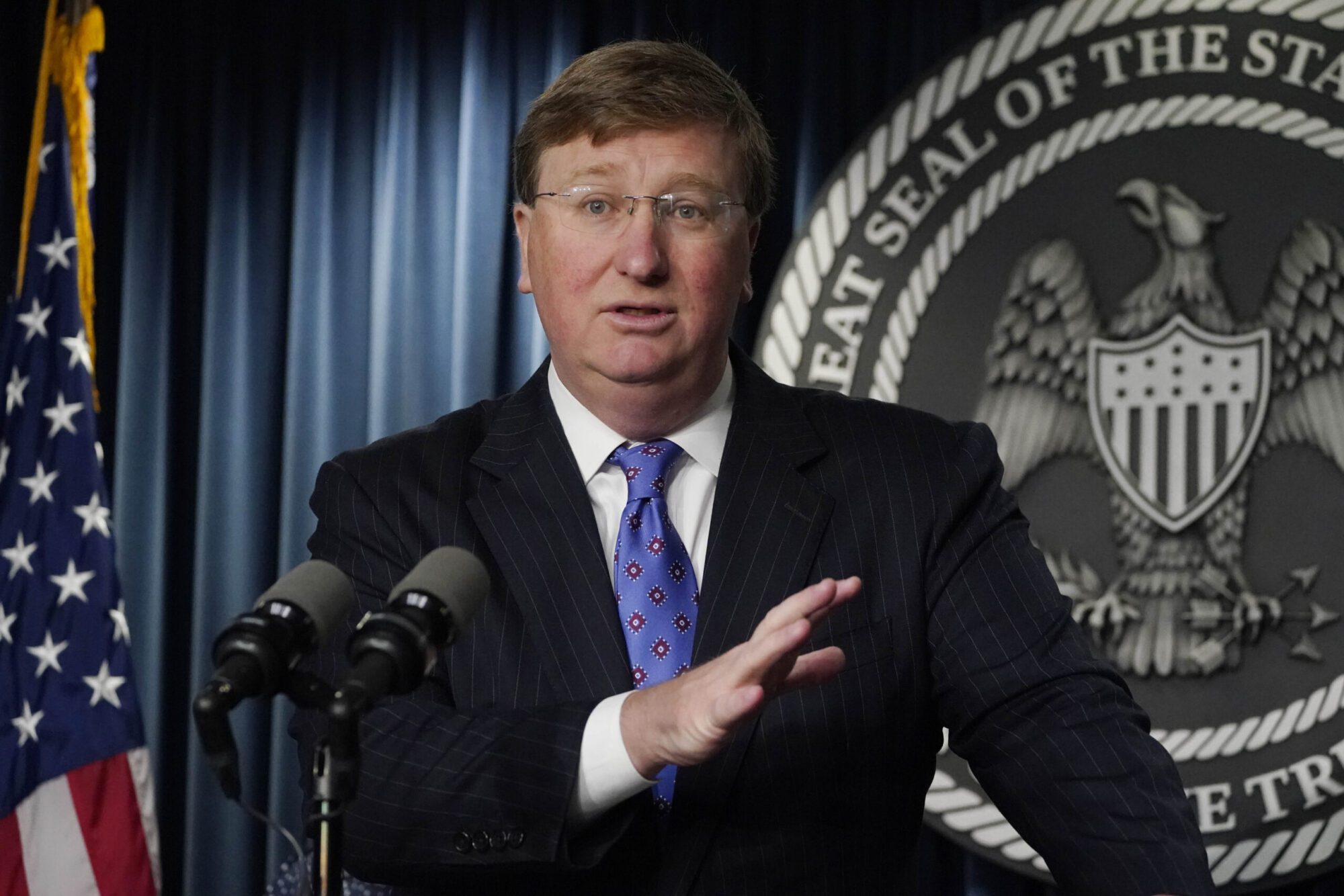
Mississippi Gov. Tate Reeves (AP Photo/Rogelio V. Solis - Copyright 2023 The Associated Press. All rights reserved.)
- COVID money masked the true cost of Mississippi’s Medicaid program. Now reserves are depleted and the budget is exploding. Mississippi dodged a bullet when Medicaid expansion efforts failed.
Mississippi lawmakers scrambled this session to plug a Medicaid budget hole. The Division of Medicaid sought $390 million more from the state for FY2027 to cover the existing population of recipients.
When the dust settled, appropriators gave a more than $200 million bump to the program. That pushed the state-funded portion of the program to well over a billion dollars and the total cost of the program to over $8.5 billion, when accounting for a huge federal contribution and separately collected provider taxes.
Had the state expanded Medicaid, the budget hole would be much deeper in coming years. Governor Tate Reeves faced a constant barrage of pressure, both under the Capitol Dome and externally, two years ago. He deserves credit for putting his foot down on firm policy ground.
In 2024, both chambers of the Legislature proposed and passed Medicaid expansion packages. They faltered on detail differences and a withering, nearly one-man assault from the Governor’s office.
Cartoons aplenty were drawn depicting Reeves as hapless, and maybe even a bit evil. In reality, he was just right.
The COVID Illusion That Hid True Cost
Certain advocacy organizations in Mississippi have suggested that the Medicaid overages this year resulted from President Trump’s signature “One Big Beautiful Bill.” Those people have not a clue what they are talking about. The OBBB sought to control Medicaid costs primarily through implementation of work requirements on Medicaid expansion populations, which for obvious reasons is not applicable in Mississippi.
The truth is the cost increases exposed this session aren’t new. They’ve just been hidden.
During the pandemic, Congress passed the Families First Coronavirus Response Act, which offered states a 6.2 percentage point increase in the federal match rate (FMAP) in exchange for one key condition. States could not remove ineligible individuals from Medicaid rolls.
This “continuous coverage” policy dramatically expanded enrollment.
At its peak, Mississippi Medicaid enrollment climbed to roughly 1 million beneficiaries.
Today, enrollment numbers are back near pre-pandemic levels.
The additional federal dollars flowing from the FMAP bump allowed the state to build up substantial reserves. The Division has been spending those reserves over the last several years, masking the true long-term cost of the program even after eligibility checks resumed.
Healthcare inflation and ever increasing utilization rates are real. The state just hasn’t directly felt those things thanks to the artificial bump in federal dollars. That COVID reserve is now depleted and the true modern-day cost of the program is in front of us.
What Expansion Would Have Added
Based on prior estimates, expansion could have added 200,000 to 300,000 Mississippians to the program, pushing total enrollment near 1 million beneficiaries permanently.
It’s important to recognize that initial estimates, for both enrollment and costs, in every state that has expanded Medicaid have been wildly errant. Actual enrollment and costs have exceeded estimates by as much as 50 percent in some states.
While an expansion population draws down a higher FMAP (federal contribution) than the standard Medicaid population, expansion would have added hundreds of millions annually in new state expense. That’s on top of the already exploding Medicaid budget.
And while the “One Big Beautiful Bill” did not cause our existing tab to go up, it would impact the state’s ability to fund its portion of the expansion expense.
Right now, states, including Mississippi, defer some of their portion of Medicaid’s cost through what are called “provider taxes.” Federal policy makers have decried this funding mechanism for years as a shell game.
It allows providers to accept federal Medicaid dollars and then pay those back to the state in the form of a provider tax, which the state then counts as its required portion of Medicaid funding. Essentially, the argument goes that states are actually using federal dollars to pay their state share through sleight of hand.
In 2024, I argued that if President Trump was elected the provider tax game might be curtailed so that Mississippi taxpayers might end up having to carry the full freight of expansion.
This prediction was not any special clairvoyance. Both Republican and Democrat administrations, including former President Biden, had railed against provider taxes as an end-run around state contributions. I happened to know the healthcare policy experts advising the President and that they were pushing him to do something about it.
The OBBB did, in fact, place considerable restrictions on the use of provider taxes to cover the state portion of Medicaid for expansion populations. That came to fruition.
So not only would expansion have added hundreds of millions in annual expenditures in Mississippi, but that cost could not easily be pushed onto providers and would have to be eaten by everyday Mississippi workers.
A Contained ‘Crisis’
Mississippi is now facing a difficult Medicaid reality. The truth is that the 16 percent increase to the Medicaid budget this year is likely not enough. That liability will continue to grow, though there also is fat in the program.
But it is currently a contained problem, relatively speaking. Had the state expanded Medicaid, lawmakers would be facing something much bigger.
Governor Reeves didn’t win many headlines for opposing Medicaid expansion.
What he did was reject a policy built on temporary federal funding, overly optimistic projections and unstable federal rules.
Simultaneously, his administration pulled more than $700 million in federal funds down for Mississippi hospitals by negotiating with federal regulators to increase Medicaid reimbursement rates to hospitals — a sum far larger than the net revenue impact of Medicaid expansion would have been to hospitals.
His fight against the policy is now looking less like political stubbornness and more like sound judgment.
Mississippi’s Medicaid situation is serious.
But it could have been far worse long-term.
And the difference between a budget challenge and a budget disaster may come down to one decision — the one the state didn’t make.

Russ Latino