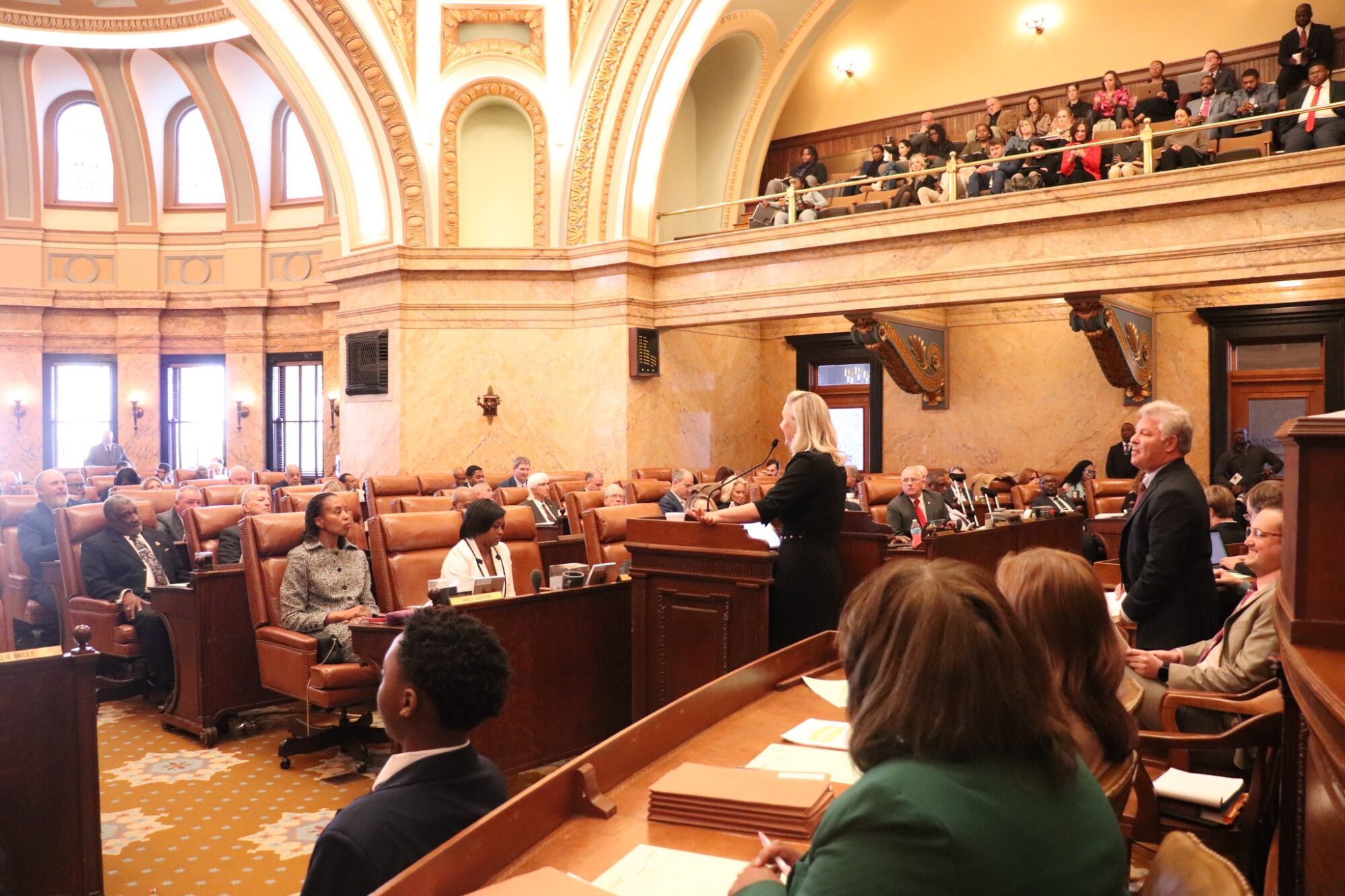
Mississippi House of Representatives (Photo from Speaker Jason White on Facebook)
- House Speaker Jason White and State Senator Brice Wiggins wasted little time in directing legislative attorneys to prepare analysis on the ruling’s impact on state Supreme Court redistricting in Mississippi. Other items could be added to a special session call by Governor Tate Reeves.
After the news broke Wednesday that the U.S. Supreme Court had issued a ruling in the Louisiana v. Callais case, House Speaker Jason White (R) and State Senator Brice Wiggins (R) wasted little time in directing legislative attorneys to prepare analysis on the ruling’s impact on state Supreme Court redistricting in Mississippi.
The U.S. Supreme Court on Wednesday struck down Louisiana’s congressional redistricting that added a new majority-minority district, saying that lawmakers relied too heavily on race. The 6-3 ruling deemed racial gerrymandering unconstitutional as it had been practiced under Section 2 of the Voting Rights Act.
Governor Tate Reeves (R) announced last Friday that he would call lawmakers into a special session 21 days after the U.S. Supreme Court ruled on Callais to address state Supreme Court redistricting.
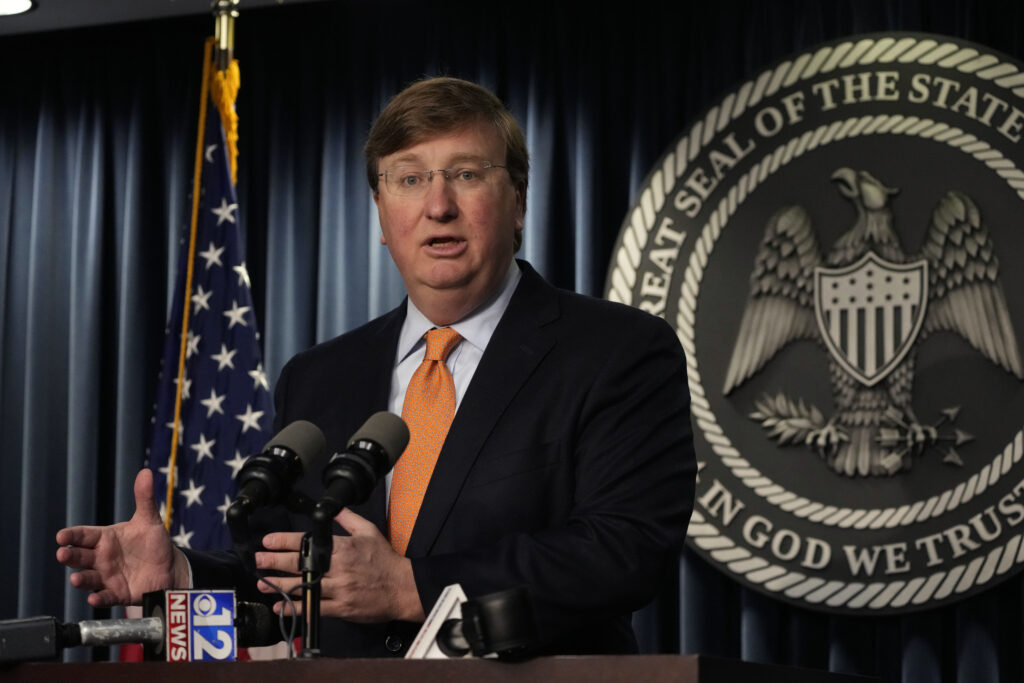
The move by the governor sought to address U.S. District Judge Sharion Aycock’s order that district lines set in 1987 used for the election of the Mississippi Supreme Court be redrawn to accommodate greater black voting strength. Three judges are elected to the court from the Northern, Central and Southern districts. The challenge was brought in 2022 by the ACLU, the Southern Poverty Law Center and a group of black Mississippians, including state Senate Minority Leader Derrick Simmons (D). The state has since sought to overturn the ruling, filing an appeal with the 5th Circuit U.S. Court of Appeals.
Given that lawmakers did not comply with Judge Aycock’s order to redraw the state Supreme Court districts during the regular session, attorneys for the state and those challenging the current districts were required to notify the judge within seven days of the legislative sine die, informing the court that lawmakers did not redraw the boundaries this session.
Governor Reeves said Friday that it is his belief “and federal law requires” that the Mississippi Legislature be given the first opportunity to draw these maps, “and the fact is, they haven’t had a fair opportunity to do that because of the pending Callais decision.”
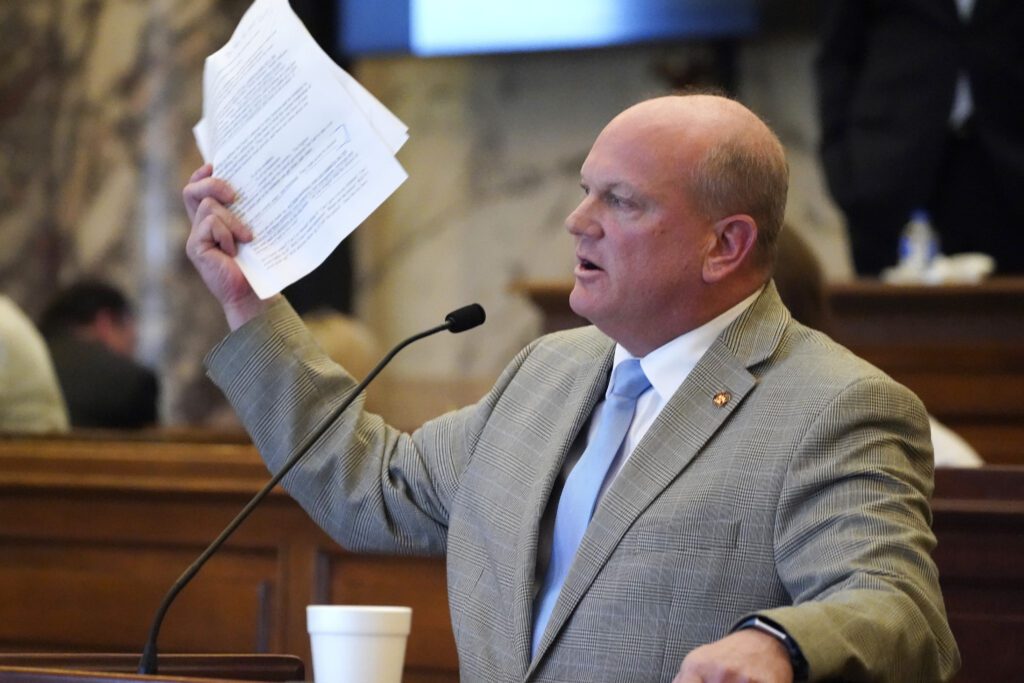
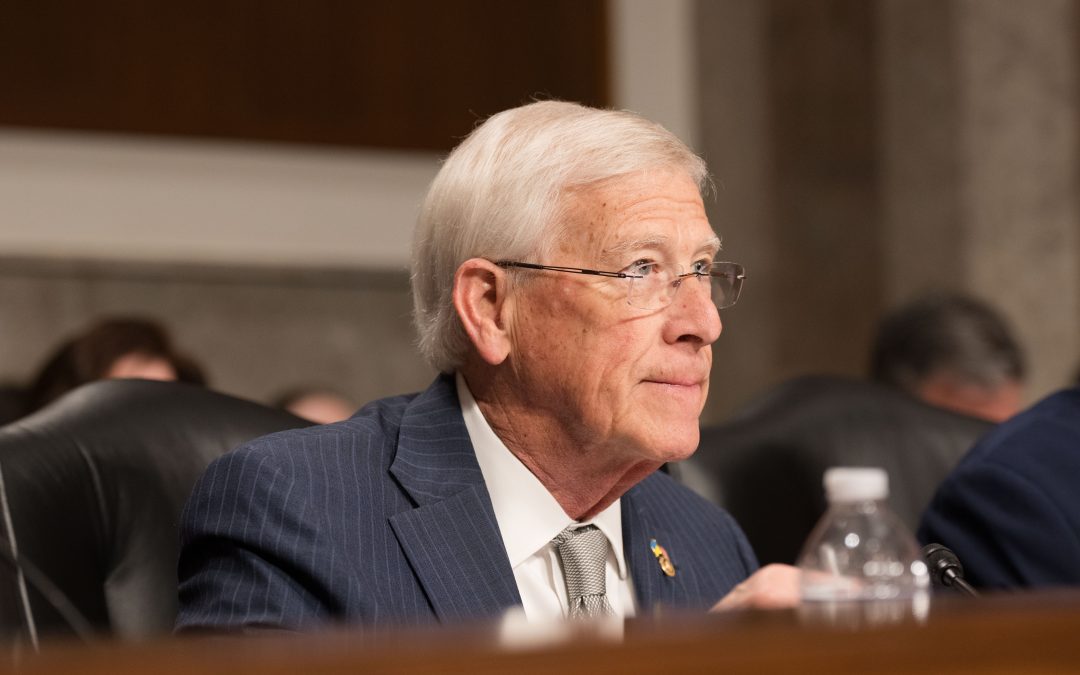
Senator Wiggins, who has been the lead on judicial redistricting in the Senate as the chairman of the Judiciary A Committee, said the decision on Wednesday does provide lawmakers with guidance for the special session.
“As soon as the news broke I directed the Senate attorneys to prepare an analysis of how, and to what degree, it relates to redistricting our [state] Supreme Court districts,” he told Magnolia Tribune, adding that the ruling was a “huge win.”
“To be clear, the decision is a huge win. Fairness and real numbers should rule the day when it comes to apportioning representation,” Wiggins added.

Speaker White said Wednesday afternoon that the House legal team is analyzing the Court’s decision “and exactly how that impacts the court ordered ‘redraw’ in our current Mississippi case.”
“We will be looking closely at the Supreme Court districts as they currently exist as well as what changes should or could be made in light of the Callais decision,” White told Magnolia Tribune.
The impact of the ruling could have far-reaching implications, especially in southern states like Mississippi where racially motivated groups such as the NAACP, SPLC, and ACLU, supported by the state Democratic Party, have for decades challenged redistricting efforts, forcing multiple rounds of redrawing district maps to elevate black populations in select areas. The Court now says there must be proof of intentional racial discrimination in the drawing of these district maps, raising the bar for such challenges.
Other states, from Texas to Virginia, have taken up redistricting efforts this year ahead of the federal midterm elections. The ruling on Wednesday could motivate others like Mississippi to join that lot.
Speaker White said if the governor adds congressional or legislative redistricting to his special session call after the day’s ruling, “we will be anticipating those additional items” along with other issues that the House believes should be addressed such as Pharmacy Benefit Manager (PBM) reform.
Senator Wiggins noted that the Callais decision “upheld compliance with Section 2 is still required.”
“It’s just that the how it is applied is the issue,” Wiggins said. “So, that raises a number of considerations that must be taken in account.
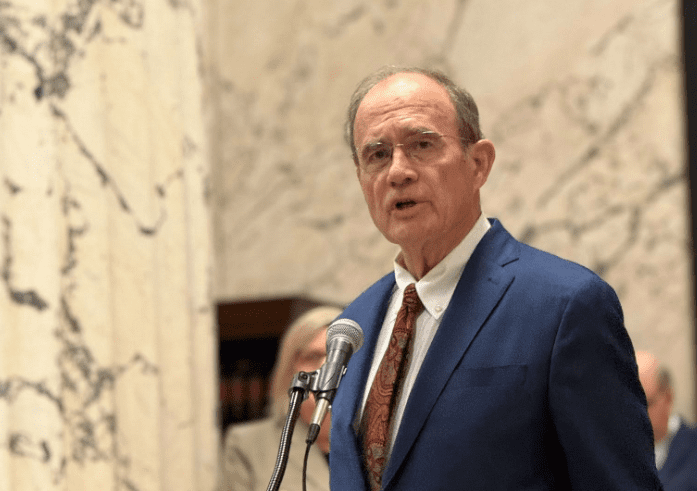
Following a request for comment from Lt. Governor Delbert Hosemann (R), the Senate leader shared a post on social media that said, “Redistricting based on race has always been wrong. Today’s Supreme Court ruling reaffirms one of Mississippi’s fundamental states’ rights and puts an end to years of federal overreach from Washington, D.C.”
“Redistricting should be accomplished by the legislators Mississippians elect to represent them, and we have consistently proven we are more than capable of managing our own elections (e.g. Voter ID),” Hosemann said. “I am grateful to President Trump for appointing judges with common sense and the ability to read the Constitution.”
Hosemann had previously urged the state to appeal the ruling by Judge Aycock.
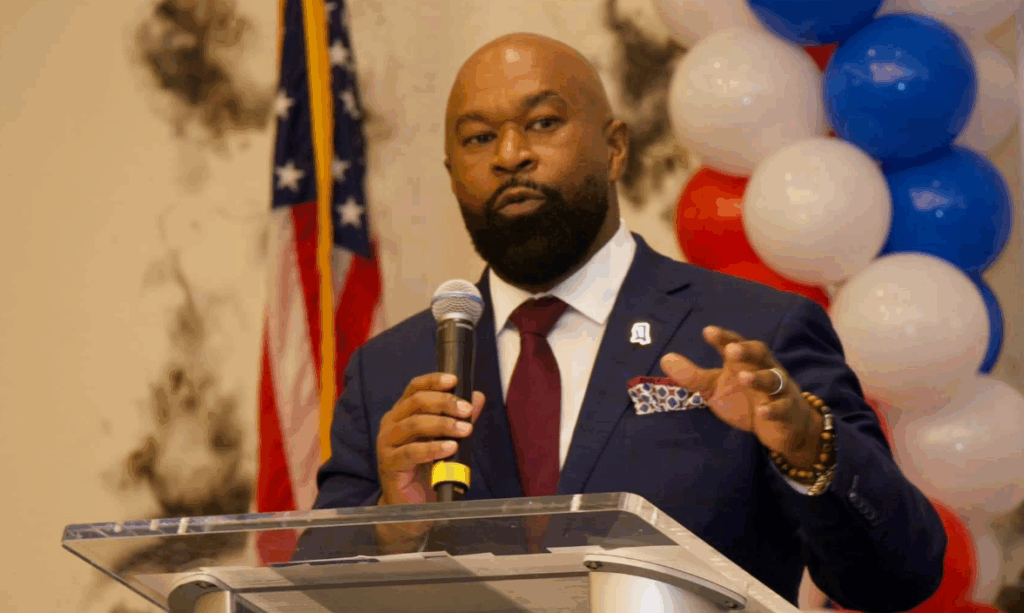
On the other side of the aisle, the Mississippi Democratic Party condemned the Callais ruling, saying that it “sharply limits how race may be considered in redistricting and invites state leaders to weaken districts where Black voters have been able to elect candidates of their choice.”
“Mississippi barely climbed out from under federal oversight, and the first chance our leadership gets to start testing the boundaries of Black voting power, they take it. They don’t even pretend otherwise,” said Mississippi Democratic Party Chairman and State Rep. Cheikh Taylor.
Taylor said Governor Reeves had a special session tied to this ruling ready before the ruling was even handed down.
“Governor Reeves told Mississippi he would govern for every one of us,” Taylor added. “He has confirmed yet again that when he says all Mississippians, he does not mean all Mississippians. Some Mississippians get a special session. Others get pushed out of the maps. That is not leadership. That is the same playbook this state was put under federal supervision to stop, dressed up in 21st-century language.”
The Mississippi Democratic Party said they will fight every effort to use the Callais decision “as cover for racial gerrymandering in this state, whether those efforts target judicial districts, congressional districts, legislative districts or any other map that determines whose voices count.”
For his part, Governor Reeves told Magnolia Tribune that the Callais decision was “a win for our Constitution and a tremendous win for our republic.”
“It was long past time to end racial redistricting. The United States will be better off because of it,” Reeves said. “Today’s decision reaffirms what we knew all along – that all Americans, regardless of race, are equal.”