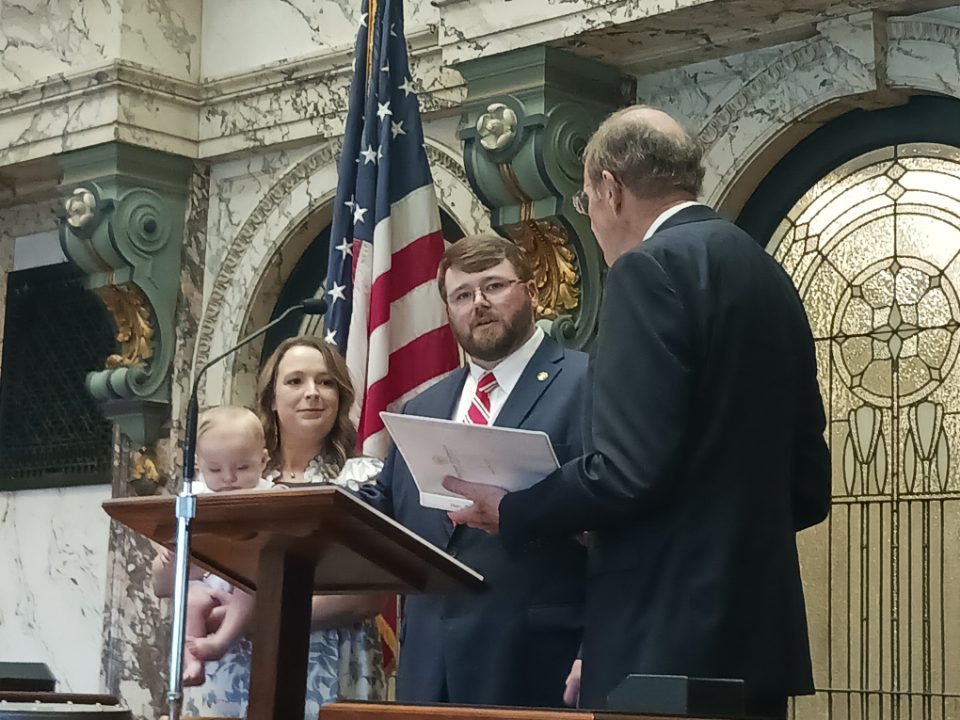
New State Senator Lane Taylor is sworn in by Lt. Governor Delbert Hosemann, April 29, 2025 (Photo by Daniel Tyson | Magnolia Tribune)
- State Senator Lane Taylor believes the bill could help struggling rural hospitals as many are facing risk of closure.
Help could be on the way for rural hospitals after the Mississippi Senate unanimously passed a strike-all amendment to a House bill Tuesday morning.
The bill, HB 4032 originally authored by State Rep. Trey Lamar (R), would allow tax deductions to those who contribute to rural public hospitals.
“Many of our rural hospitals don’t have a foundation where the public can donate to to build and help maintain our hospitals,” said State Senator Lane Taylor (R), who authored a similar bill and is now guiding the House bill through the Senate.
A rural hospital is defined in the Senate amendment as a hospital that is located in a county
that does not contain a municipality or a portion of a municipality whose population exceeds
15,000 according to the 2020 decennial census. A hospital located in Washington County is specifically noted as also being considered a rural hospital.
Taylor believes the bill could help struggling rural hospitals as many are facing risk of closure.
The Greenwood Leflore Hospital has asked the state’s permission to file for bankruptcy after saying in December it was on the cusp of closure. SB 3230 allowing the action became law without the governor’s signature on Monday.
Under the bill, the amount of tax credit that may be utilized by a taxpayer in a tax year is limited to an amount not to exceed the lesser of the amount contributed during a tax year or
50% of the total tax liability of the taxpayer for the tax year. An alternative credit is allowed against ad valorem taxes assessed and levied on real property for voluntary cash contributions made by an individual taxpayer during the tax year to a rural hospital. However, taxpayers cannot utilize both.
Tax credits would also be available to various businesses, including partnerships, limited liability companies, S corporations, and similar pass-through entities for contributions made to a rural hospital.
“The tax credit goes to the entity,” said Taylor when asked to clarify who receives the tax write-off.
Contributions to any single rural hospital during a calendar year is not exceed $100,000 with the aggregate amount of credits that may be allocated during a calendar year set at $1 million.
The bill is also an economic development bill, said Taylor, who represents a rural district. When businesses are exploring relocating to his district, one question that is always asked is about hospitals, he said.
“Hospitals are important to our communities,” Taylor added.
The bill now goes back to the House and will likely go to conference.