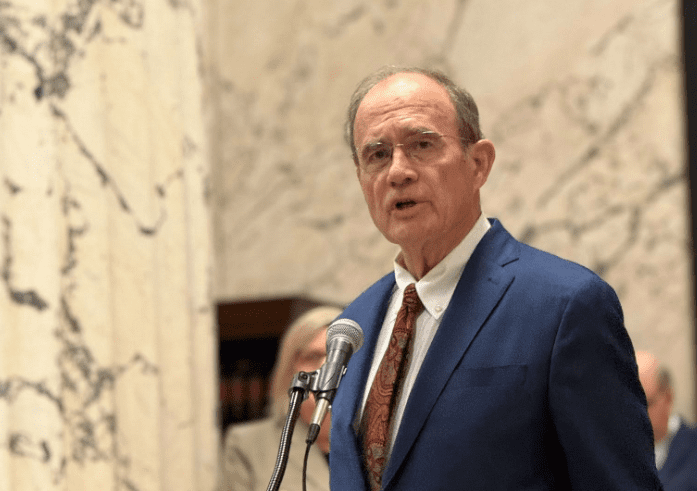
Lt. Governor Delbert Hosemann speaks to city leaders at the Capitol, January 13, 2026. (Photo from MML on Facebook)
Listen to the audio version of this article (generated by AI).
- “Republicans should know better than to believe that miracles only happen when the government runs something.” In a stinging rebuke of the Senate’s decision to kill the popular conservative policy, The Wall Street Journal’s Editorial Board said Hosemann got the issue “exactly wrong.”
On Tuesday, The Wall Street Journal’s Editorial Board took aim at Lieutenant Governor Delbert Hosemann and Senate Republicans for killing a Trump-backed proposal to create Education Savings Accounts for Mississippi children:
Mississippi Republicans can take credit for the 2013 reforms that wrought the state’s education “miracle,” bumping fourth-grade reading scores from 49th to 9th in the nation in 2024. So why are they now threatening further education progress by blocking school choice?
In a 90-second—yes, second—meeting last week, the GOP-led state Senate Education Committee voted to kill a school choice bill passed by the state House in January. The legislation, championed by House Speaker Jason White and supported by GOP Gov. Tate Reeves, would have created the first substantial education savings account (ESA) program in the state. Some 12,500 students could have received scholarships in 2027, and more in future years. The bill also would have expanded the districts where charter schools can open.
But Lt. Gov. Delbert Hosemann, who leads the Senate, took orders from the public school monopoly. “Our focus must remain on strengthening public education,” he told the Commercial Dispatch after he killed the bill. He cited the state’s recent rise in education rankings as reason to invest more in the status quo.
That gets the issue exactly wrong. Some of the state’s status quo education interest groups resisted the 2013 legislation that created the state’s literacy reforms. Hard work, accountability and innovative thinking produced Mississippi’s education success. The competition created by school choice encourages more of the same.
The benefits go beyond test scores. “School choice will lead to a more dynamic, better-prepared workforce,” wrote more than 100 state business leaders in a January letter to the Legislature supporting the bill. They warned that Mississippi could “fall behind” as its neighboring states have expansive school choice.
Many of Mississippi’s students are poor, and ESAs might be their only route to private education that better meets their needs. Seventy-five percent of Mississippi voters told a Yes. Every Kid. poll in October that every family should have access to an ESA.
Lawmakers may still have a chance to heed these constituents. Gov. Reeves could call a special session to push the ESAs. That’s what Texas Gov. Greg Abbott did in 2023, and though the sessions didn’t get his ESA proposal across the line, they created a political wedge that he later drove to victory.
The House could also attach the ESAs to other legislation. The ESAs were part of an omnibus bill that included provisions to raise teacher pay and extend the state’s literacy reforms to other grades. The Senate has introduced separate legislation for some of these. The House could tell Senators their priorities are dead if ESAs aren’t included. “I think all options are on the table,” Speaker White told Mississippi Today last week.
It’s not a good sign that even the House, with a Republican supermajority, passed ESAs by a mere two votes. President Trump could add his voice in support. The President has long supported school choice, and Education Secretary Linda McMahon backed the Mississippi bill in a social-media post.
Republicans should know better than to believe that miracles only happen when the government runs something. Mississippi students will stay in public schools if they’re successful. But they deserve competitive options when public schools fail.