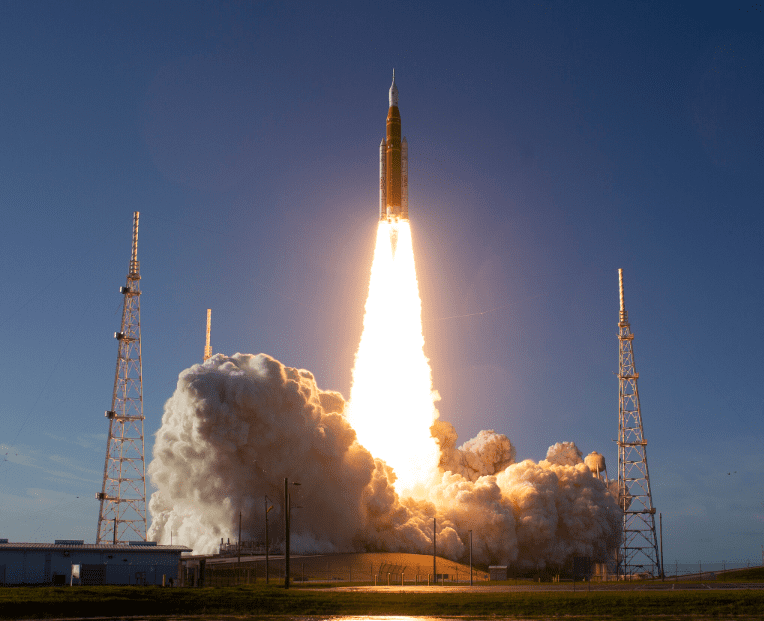
Launch of Artemis, April 2026 (Photo from NASA HQ on X)
- Before Artemis II could launch astronauts around the moon, the RS-25 engines and the propulsion systems were extensively tested right here in Mississippi.
My wife and I went to see Project Hail Mary last week. The film was nothing short of incredible, truly one of the most inspiring and hopeful movies I’ve seen in a long time. Its depictions of space are beautiful and deserve to be seen on the big screen. And its emotional roller coaster of a story draws the viewer in until the very end. The film’s techno-optimism will undoubtedly stir the souls of all who have ever looked up at the stars and dreamed of seeing humanity’s place among them.
But the future of space travel is not just Hollywood magic. It is a reemerging reality. This last week, four astronauts were launched off into deep space, further than any man had ever gone before. They sailed around the moon (another first) and have now just returned to Earth in a moment of triumphal heroism that is well deserved.
Altogether, the astronauts were over 250,000 miles from Earth. Now, this number is so absurdly large that it might feel inaccessible. Consider that Earth itself is only 25,000 miles all the way around. Thus, at their furthest point, these four astronauts found themselves at a distance from home that would equal ten trips around our own planet. That’s a long flight.
To venture into the dangers of the unknown takes a degree of bravery and bravado that few can muster in their best moments, let alone while on a hunk of metal hurtling towards the moon. But space travel perfectly encapsulates the American spirit and is inherent to the American idea.
Thus, through their journey, these astronauts carried on an enduring American tradition. For our people’s entire history, we have expanded West, explored new territories, conquered the wilderness, built civilization up out of unforgiving lands, explored the depths of the ocean, and landed men on the moon.
Space is truly the final frontier. And this mission was the first major step towards establishing a long-term American presence on the moon through a potential base. That base would then lay the groundwork for our future travels deeper into space.
But what many don’t know about man’s return to the moon is that it’s powered by Mississippi.
Before Artemis II could launch astronauts around the moon, the RS-25 engines and the propulsion systems were extensively tested……right here in Mississippi. That work happened at John C. Stennis Space Center, one of NASA’s premier rocket test facilities.
On top of this, it was at Stennis that key pre-launch technical issues were also addressed. Artemis II was delayed by hydrogen fuel leaks, and it was Stennis engineers who tested the repaired systems again shortly before launch, helping to confirm that the rocket was ready to fly.
So, Mississippi wasn’t just part of early development but was directly tied to the very success of the launch.
Many may not know that Stennis has long been a key part of America’s space history. In fact, the center helped test engines for the Apollo missions and the Space Shuttle as well. This is a rich legacy for our state and its people to be proud of.
Man’s return to the moon is powered by Mississippi. So, as America returns to deep space for the first time in 50 years and sets our eyes and hearts further out into the unknown depths of the solar system and beyond, Mississippians should take great pride in the role our state has played to help make these amazing adventures possible.

Hunter Estes