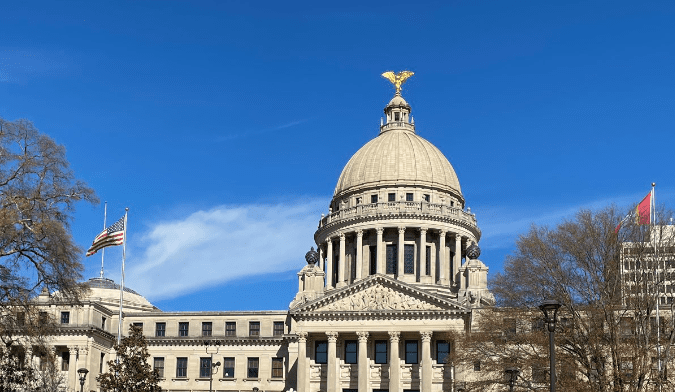
Mississippi Capitol (Photo: Sarah Ulmer/Magnolia Tribune)
- The Senate Government Structure Committee is looking at ways to optimize office space, use shared services to reduce costs, and subsequently lower licensure fees.
Efforts are underway to consider methods for licensure boards in Mississippi to save money through the consolidation of office space and the use of shared services.
Working out of a state-owned building would provide cost savings in rent and in turn provide a means to lower licensure fees, enticing more people to enter the careers overseen by the licensure boards.
Senate Government Structure Committee Chair state Senator Tyler McCaughn (R) advised those in attendance that it was his intent not to delete any board or government office, but rather see if legal, financial, IT work, and human relations needs could be consolidated.
In Mississippi, there are separate licensure boards for the various professional fields working in the state, such as doctors and nurses, even though they are both in the medical field. While there is no intent to combine those licenses under one board, the two could share services as described by McCaughn.
Available Space
Ted Booth, Deputy Director of the Mississippi Joint Legislative PEER Committee, said there are states like Texas that combine all licensures under one board in one building, while Georgia combines all independent boards in one building but continues to use independent investigation, licensure and disciplinary personnel. Booth said the Georgia model is best suited for Mississippi.
“There are benefits from government operating more efficiently,” Booth said.
Across Jackson’s Capitol Complex consolidation of board offices into existing state-owned buildings is a possibility. By Booth’s estimate, there is about 124,000 square feet of office space that could optimized, saving the state the $74 million cost of a new structure with comparable space.
“We can renovate what we have for less than that,” Booth explained. “But not only can we, but we’re going to have to renovate these buildings regardless of whether we increase the occupancy.”
The regulatory agency boards occupy about 118,000 square feet across the state, with 8,500 square feet of office space currently available. Spending $60 million over five years to renovate the available state buildings could save $3.5 million annually and provide workspace for 500 people.
However, there would be issues with consolidating office spaces into state-owned buildings, mostly centered around how offices would be shuffled while renovations took place due to the lack of a spare building, Booth said.
The Mississippi State Board of Architecture found it a challenge in moving to a centralized state-owned building. John Cothron, director of the architecture board, said they would need a larger space to accommodate the printouts they work with daily.
Outsourced Savings
Five boards, including chiropractors, massage therapy, and optometry, are currently using third party contractor J-Bar and Associates to provide executive director services.
Yvonne Laird, President of J-Bar and Associates, said those boards also have offices in a building her company owns. Several of the services provided include internet, cybersecurity and fax services.
Representatives with each of the boards that contract with her business said they are receiving stellar service at a reduced cost of hiring their own executive director, with one saying their contract with J-Bar and Associates is a third of the cost of their previous executive director’s compensation. Additionally, some boards noticed essential tasks were not being completed by their executive directors, but that is not the case with Laird’s company.
Reserves on Hand
During the Senate committee meeting, the issue of boards maintaining large sums of funds in reserve was also discussed.
While that is not the case with every board, those with larger sums said they plan to reduce their licensing fees.
One example is the Mississippi State Board of Medical Licensure, which handles medical doctors, doctors of osteopathic medicine, podiatrists, physician assistants and X-ray technicians, to name a few. Deputy Agency Director Adrianne Brantley said the current licensure fees are growing the reserve balance by about $1.2 million annually. Their plan is to cut some fees from the current $550 to $150, reducing that growth to $800,000 annually. The board has about $13 million on hand, which equates to three years of operational costs.
Committee members asked that the agency to consider ways to use those reserve funds to entice more people to take medical roles in rural areas of the state through scholarships or other programs.
The Mississippi of State Board of Dental Examiners has only $802,000 in its reserves. The agency licenses general dentists, dental hygienists, specialty dental licenses and permits, such as for dental assistants to be able to perform radiographs. Facility inspections are performed at no cost to the dental professional but costs the board on average $600 per inspection.
Denny Hydrick, director of that dental board, said not charging for the inspections is one way the board is giving back to the field it oversees.
State Board of Health
State Health Officer Dr. Daniel Edney agreed that there is a need to consolidate services.
“This is my second hearing on government efficiency and I am just begging that something will come out of it because state government is horribly inefficient and it’s incredibly expensive, and it need not be,” Edney said.
However, most of Edney’s time was used to make requests to the committee, such as seeking the ability to control how much his employees are paid, the funds to cover that cost, and the ability to use his allocated positions to meet the changing needs of the Mississippi State Department of Health.
Currently, the personal identification numbers, or actual positions, allocated to his office have specific job descriptions.
“There are days that I need more public health nurses, I have the PINS but I don’t have public health nurse PINS,” Edney explained.
He also asked lawmakers to consider more stringent regulations on kratom products, more specifically banning the sale of those products within certain businesses.
“The main thing I would plead in relation to kratom is can we not just agree that even if we need to provide access to this, it doesn’t need to be in a gas station,” Edney said. “I think we’re all in agreement there.”
In terms of consolidating services, Edney said his agency’s current IT protections, which are extensive, can benefit more agencies.
“We have the IT infrastructure for a large agency,” Edney said. “There’s capacity there to bring more people under one umbrella.”
Cybersecurity
All boards and agencies were also asked about their cybersecurity confidence during the Senate hearing. Most said they are up to date on their security and training methods, but not every agency uses the same database or website provider.
The boards receiving services from J-Bar Associates were recently hit by a cyberattack that has left two of the five boards without some essential services. Between the five boards, there are three different databases, three different website providers, and four different computer maintenance contracts.
Laird said all of the boards are not under a singular data base contract because the individual boards make that decision.