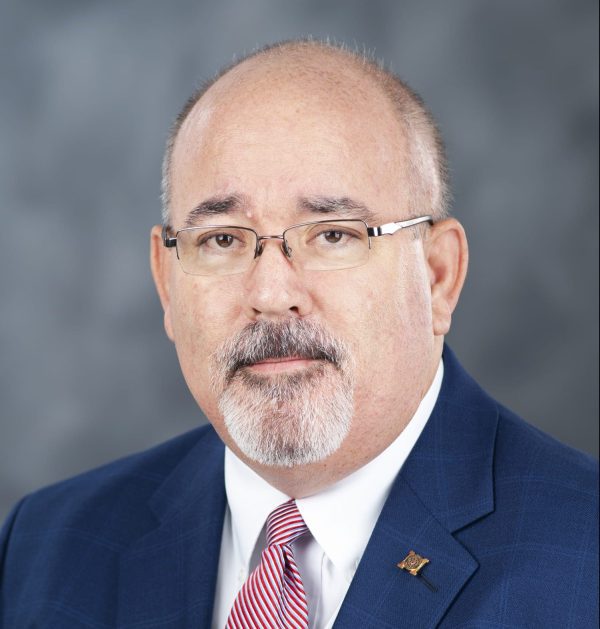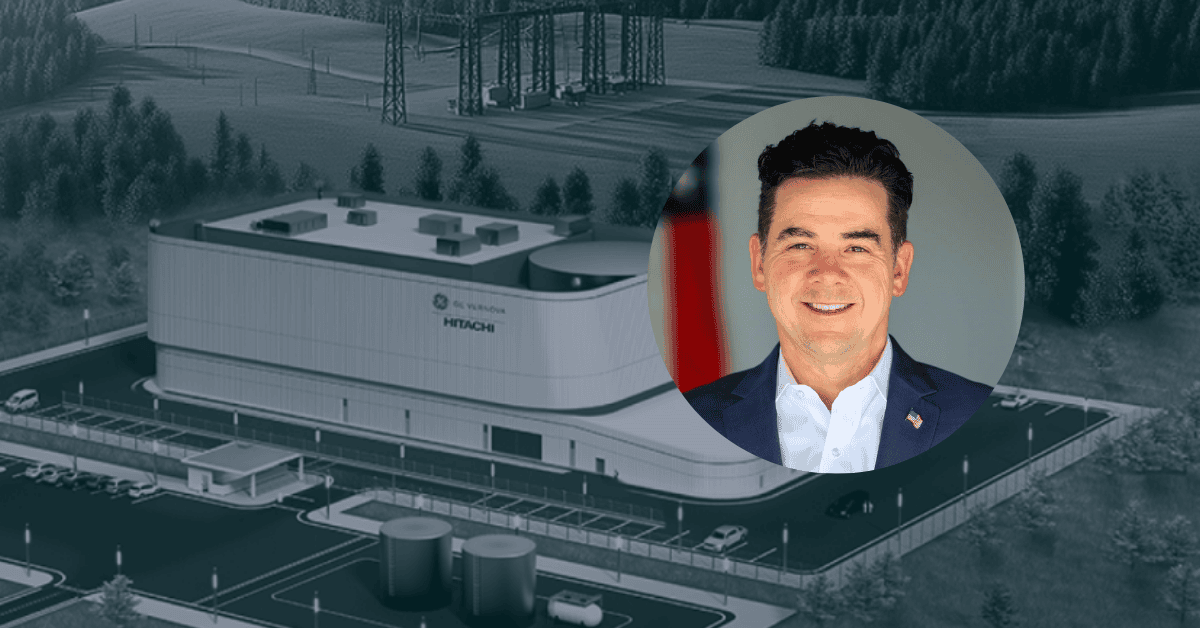
Northern District Public Service Commissioner Chris Brown (Photo of GE Vernova Hitachi’s BWRX-300 from U.S. Dept. of Energy)
- Commissioner Chris Brown is working to establish a partnership between the University of Mississippi and Mississippi State University to pursue a nuclear research reactor. He said the facility could support both universities’ research programs.
The Tennessee Valley Authority (TVA) recently received regulatory approval to move forward with construction of a BWRX-300 small modular nuclear reactor. TVA was the first utility applying to build the GE Vernova Hitachi’s BWRX-300 design in the United States.
Mississippi’s Northern District Public Service Commissioner Chris Brown (R) praised the development, calling the project a “milestone” for the thousands of North Mississippi families and businesses served by TVA. He pledged that “Mississippi intends to be part of what comes next.”
Brown expanded on his comments with Magnolia Tribune this week, describing the current period as “the most transformative time in the energy industry since Edison discovered the lightbulb.” The commissioner believes nuclear energy can provide reliable power while helping bring electricity costs down for Mississippians.
“We need reliable, resilient energy. To address inflation, you have to have innovation,” Brown said. “Innovation is being unlocked, and nuclear is the way to get that energy we need and the innovation is going to get the price where we can afford it.”
Addressing concerns about nuclear energy’s safety, Brown pointed to the history of nuclear power in the United States.
“We have had zero civilian nuclear fatalities in this country, and we’ve had nuclear since the ‘50s,” Brown said. “It’s extremely safe, and that’s old technology.”
Commissioner Brown also cited a microreactor project at the University of Illinois, saying the reactor would be located across the street from a dormitory as an example of confidence in the technology’s safety.
“Plus, it’s home grown,” Brown said. “We’ll be building [reactors] here. It’s an American energy source. We don’t have to rely on China or other countries to supply those solar panels or wind turbines that we’re getting from overseas.”
Brown contends that wind and solar power cannot match nuclear energy’s capacity to provide consistent electricity.
“Wind is only 35% efficient, and solar is down to 25% efficient. Nuclear is over 90% efficient,” he said.
Brown is working to establish a partnership between the University of Mississippi and Mississippi State University to pursue a nuclear research reactor. He said the facility could support both universities’ research programs.
“Mississippi State can use it for their nuclear engineering program, which they just reintroduced this semester. Then Ole Miss can use it for medical research,” Brown said.
Further, the commissioner is working with U.S. Senator Roger Wicker (R), 1st District Congressman Trent Kelly (R), the U.S. Department of Energy, and the U.S. Department of War to pursue a microreactor near Columbus Air Force Base.
Brown described a microreactor as a nuclear reactor capable of producing 50 megawatts or less and being roughly the size of a shipping container. He said the proposed installation could help protect the base against cyberattacks.
“If you can generate power closer to the people, you can, in theory, lower costs,” Brown said. “The only way we’re going to control the increasing costs of power, power generation, and electricity itself, is having that innovation.”
About the BWRX-300
The U.S. Department of Energy said in a statement last year that the BWRX-300 is the only boiling water SMR design under development in the United States.
The 300-megawatt-electric advanced light water system is a smaller, simplified version of GE Vernova Hitachi’s licensed Economic Simplified Boiling Water Reactor and will leverage established supply chains that could accelerate its deployment.
In 2023, TVA joined a global collaboration with Ontario Power Generation to expedite technology development of the SMR for use in the United States and Canada. Four BWRX-300 reactors have been cleared for construction in Clarington, Ontario, with commercial operation expected by the end of 2029.
The U.S. Nuclear Regulatory Commission has now issued a construction permit to the Tennessee Valley Authority for the BWRX-300 small modular reactor at its Clinch River site in Oak Ridge, Tennessee.
“This is a milestone for TVA and GE Vernova Hitachi Nuclear Energy, and an important moment for new nuclear in the United States,” said Eric Gray, CEO of GE Vernova Power Segment. “TVA has shown strong leadership in advancing new nuclear, a commitment bolstered by the collaborative efforts of the NRC and Department of Energy. Together, and in alignment with federal Executive Orders aimed at accelerating advanced reactors, we are grateful for this collaboration as we work to support the deployment of the first BWRX-300 in the country.”