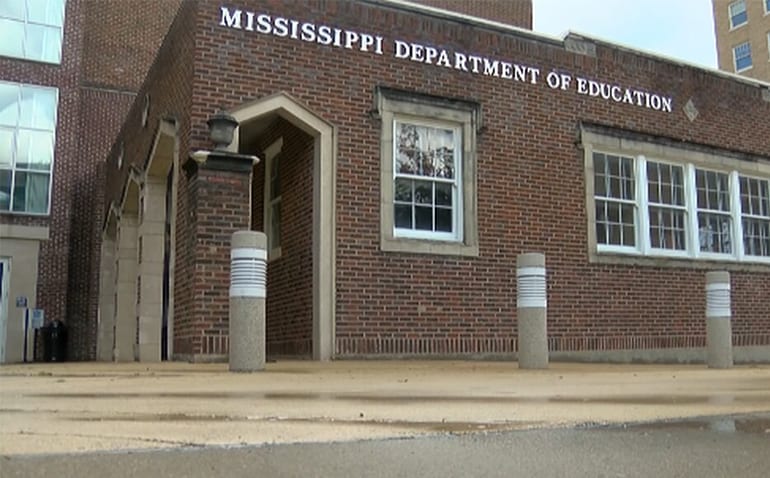
- In other business, the State Board of Education was told that the Mississippi Department of Education is working with districts regarding the expiring hold harmless period under the new funding formula. They are also seeking clarification on the additional pay raise for special education teachers.
Nearly 76% of third graders in Mississippi’s public schools passed their first attempt at the state’s reading assessment, demonstrating a slight dip from the prior year’s initial pass rate but still in line with the state’s four-year average.
The results of the annual third grade reading assessment were presented during Thursday’s meeting of the State Board of Education, where Chief Accountability Officer Paula Vanderford noted that there have been slight fluctuations in the Literacy Based Promotion Act pass rate over the past several years.
Students who fail to pass the literacy test on the first try are given two additional attempts to achieve a passing grade.
For the 2025-2026 school year, 75.6% of third graders, or 24,118 students passed on the first attempt, with 84.6% passing after all retests were administered. That meant that 7,769 students, or 24.4% of the total 31,887 test takers failed on their first try.
There are instances where a child who failed the reading assessment can be promoted through good cause exemptions. Those include if the student has had less than two years of English language learner instruction, and if the child has a disability combined with other criteria, such as being retained in a previous academic year or grade level.
Vanderford noted that slight fluctuations in the pass rate have occurred since 2023. That year, there were 31,623 third grade test takers in the public school system, of which 76.3% (24,134) met the LBPA requirements, while 23.7% did not (7,489).
Then, in 2024, the state had 31,787 test takers, of which 75.7% passed (20,065) leaving 24.3%, or 7,722, not passing.
In 2025, the number of test takers rose to 32,839, of which 77.3% passed (25,399) and 22.7% failed (7,440).
Across the state, 51 districts reported that 80% or more of their third grade student body met LBPA promotion requirements, while 12 districts reported 90% of their students met the threshold.
Some districts fell far short of the state’s average. Vanderford said nine districts in the state reported more than 50% of the third grade student body did not meet the LBPA promotion bar.
To ensure districts have the tools they need to achieve the highest promotion rates, the Mississippi Department of Education offers schools several training options that provide methods for intervention and remediation, which includes the utilization of high quality instructional materials.
“Part of the implementation of the material is that are they using internal assessments, where they are assessing students formatively, to find out what do they know and understand what they might need remediation on,” said Chief Academic Officer Wendy Clemmons. “We believe it is all about having the right materials, but also helping teachers understand how to implement those materials.”
However, not all districts take advantage of all training options, Clemmons added. State Superintendent Dr. Lance Evans said that during the last school year, MDE spent about $17.5 million in providing coaching support to districts statewide, so the option is there for those districts that seek the assistance.
At the end of the presentation, Board President Matt Miller asked if there was a correlation between districts not engaging in the educator training and less than half of their student body failing to reach promotion requirements. Clemmons said she could not say off the top of her head, but there is data to back up the belief that districts who seek help from MDE show improvement.
“It seems to me that those who are not participating are doing a great disservice to their students because this is available help, all they have to do is ask for it,” Miller said.
Other Business Before the Board
In other business, another form of support MDE is working to provide focuses on helping local districts currently under the hold harmless provision become financially stable, Evans told the Board during Thursday’s meeting.
The hold harmless provision, which expires this year, allows districts with dwindling student populations to receive the same amount of state funding as when enrollment was higher in previous years. The deadline on the provision was added as part of the creation of the current Mississippi Student Funding Formula during the 2024 legislative session. MSFF replaced the previous Mississippi Adequate Education Program.
“I’m not trying to create anxiety here, but there is a financial cliff some districts are going to have to deal with,” Evans said.
He added that MDE’s aim is to ensure those districts stand on strong financial grounds. Evans is concerned for those districts that are not putting financial plans in place.
“Because we all know without money, bills don’t get paid, teachers don’t get paid. You’re not able to operate your schools and your districts,” Evans explained.
Evans also said that MDE has reached out to lawmakers for clarification on the Special Education Teacher supplement passed this past legislative session. He said the wording in the provision has led to some questions concerning which special education teachers qualify. That supplement, which totals $2,000 annually, is intended to be added on top of the $2,000 pay raises given to all educators as part of the passage of a compromise bill passed by both legislative bodies this year.
Evans clarified that MDE is seeking clarification due to the fact there are only “so many dollars” allotted for that purpose.