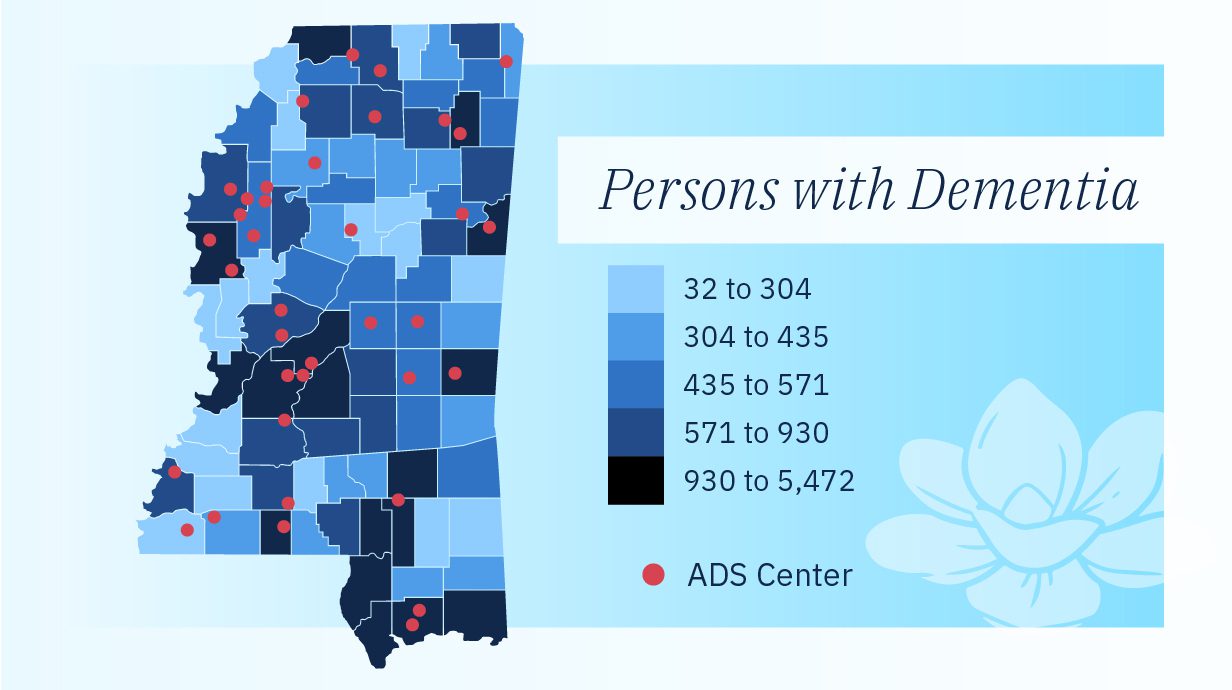
Many counties in Mississippi lack adult day services, including several that have large numbers of residents with dementia. A new University of Mississippi-led study found that all Mississippi counties are underserved in such services, which are critical care programs for people with dementia and other cognitive issues. Graphic by Cole Russell/University Marketing and Communications
- All counties are underserved in adult day services, Ole Miss researchers find.
Some 80% of Mississippi counties have no adult day service centers, and even counties that do have centers cannot meet the needs of people with dementia and their caregivers, a new University of Mississippi-led study indicates.
This shortage leaves thousands of people with dementia – and their caregivers – without daily support.
Keith Anderson, professor and chair of the Department of Social Work, and Ruaa Al-Juboori, assistant professor of public health, published their findings in the Journal of Applied Gerontology. They estimate that the state would need an additional 910 adult day services running at full capacity to meet the demand.
“It’s largely known or theorized that there’s a shortage of adult day services nationally,” Anderson said. “Yet it’s really hard to quantify the shortage and also to identify areas of the country where those shortages exist.”
The researchers chose to begin their work close to home.
“I live in Mississippi, I’m employed by the University of Mississippi and it’s a calling to serve the state,” he said. “But also, Mississippi is typically an underserved region across the health care spectrum.
“I thought this could possibly serve as a starting point and a really clear illustration of the severity of the shortages that may exist in adult day services for persons with dementia nationally.”
Adult day services provide health care, nutrition services, socialization and daytime programs in a safe and monitored environment for seniors or adults with cognitive or physical impairments. They also allow caregivers to go to work, shop for groceries or simply have a break from caring for their loved one, Al-Juboori said.
“Adult day services is one of the largest community services for persons with dementia,” she said. “It’s also, unfortunately, one of the least known options within home- and community-based services.
“A lot of people have never heard of adult day services or have the misconception that it’s just day care. It’s so much more than that.”
At least 63,000 people are living with Alzheimer’s – a form of dementia – in Mississippi, according to the Alzheimer’s Association. The association also estimates that 92,000 people in the state provide primary support to a person with dementia.
If only a tenth of Mississippians with dementia wanted to use adult day services, the state would need 91 more centers, the researchers found.
“We found that there’s a shortage across the state of Mississippi, whether that was in a populous area like the Jackson area, or in rural communities where there’s a general lack of health care access to not only adult day services, but to primary care providers, to hospitals, to any health care provider,” Anderson said.
“It’s important because (the lack of these services) places an undue burden primarily on family caregivers, but it’s also a disservice to the older adults who are remaining often alone and isolated, without that opportunity to socialize or to gather together with other people. So, it’s important not only to the family caregivers, but to these older adults, as well.”
Adult day services can be run by either private organizations or government agencies, but funding opportunities for either structure are lacking, Anderson said.
“Adult day services do not have access to the wider array of government funding that’s available for other programs that serve older adults,” he said. “So, funding is a primary cause of shortages.
“If we could open access to additional funding streams, whether that’s through Medicaid, Medicare or another way, that would make a big difference for adult day centers.”

Clara Turnage