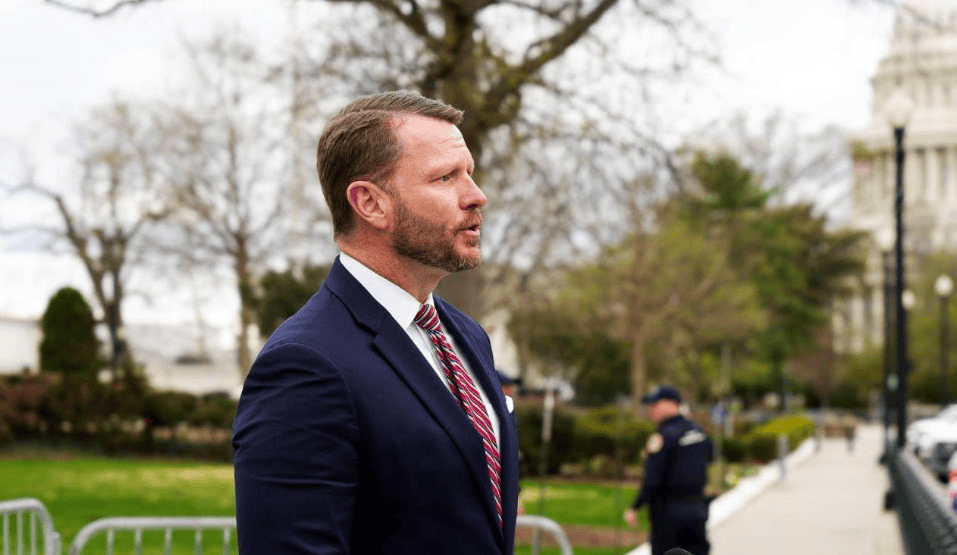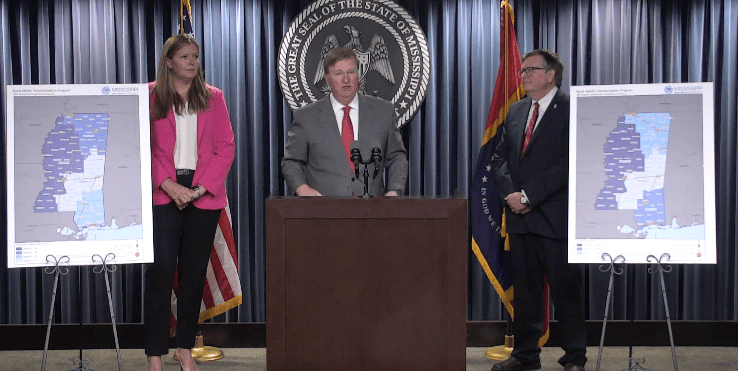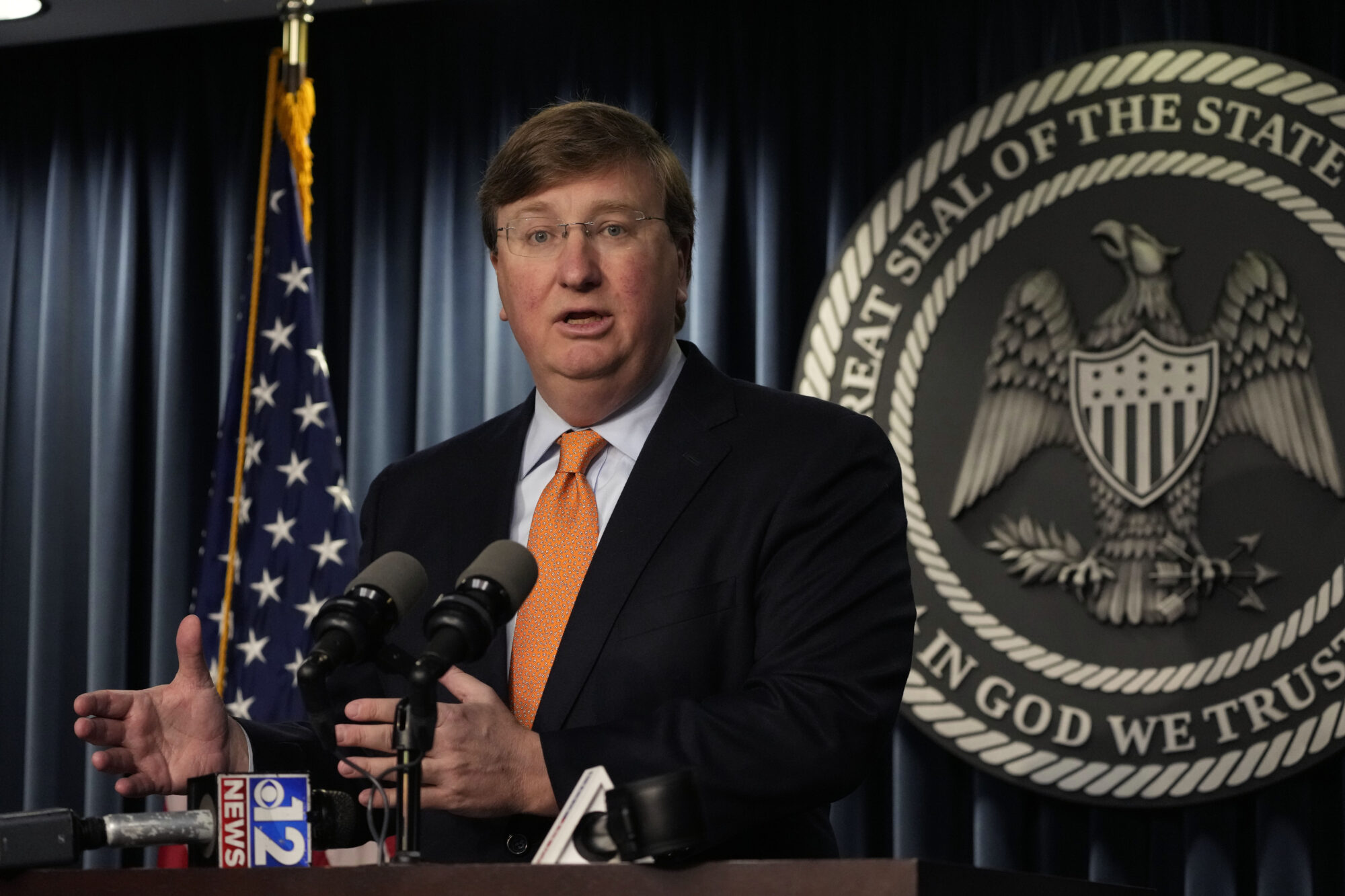
Mississippi Republican Gov. Tate Reeves answers a reporter's question on his announcement of a tech company expected to invest $10 billion to build two data processing centers that will create 1,000 jobs in central Mississippi, during a Wednesday, Jan. 24, 2024, news conference in Jackson, Miss. (AP Photo/Rogelio V. Solis)
- “The entire world knows the Callais decision has not yet been handed down by the U.S. Supreme Court. It is a decision that could (and in my view should) forever change the way we draw electoral maps,” Governor Tate Reeves said.
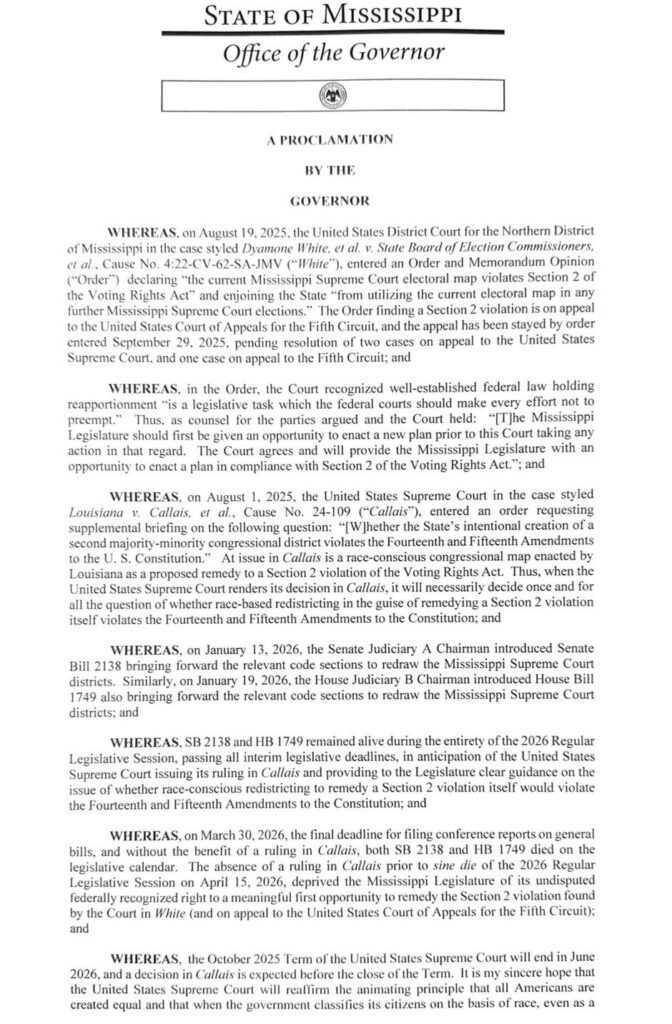
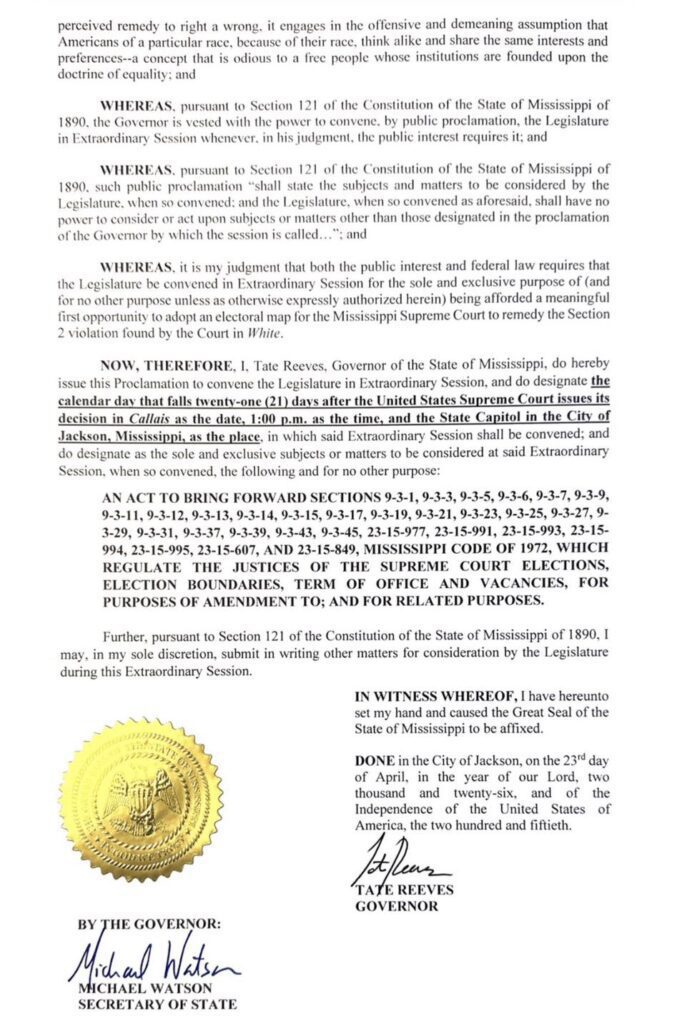
Governor Tate Reeves (R) announced Friday afternoon that 21 days after the U.S. Supreme Court issues its ruling in Louisiana v. Callais, he will call Mississippi lawmakers into a special session to address state Supreme Court redistricting.
“During the recently completed regular session, the Legislature discussed drawing new maps to comply with a decision from a federal judge from the Northern District of Mississippi – a decision that has been appealed to the 5th Circuit and the appeal has been heretofore stayed pending future U.S. Supreme Court decisions,” Reeves stated. “The entire world knows the Callais decision has not yet been handed down by the U.S. Supreme Court. It is a decision that could (and in my view should) forever change the way we draw electoral maps.”
READ MORE: Mississippi Supreme Court redistricting dies as U.S. Supreme Court decision over racial gerrymandering nears
A decision from the nation’s high court on the Louisiana v. Callais case is expected before the end of the court’s term in June. The matter at hand, as argued in October 2025, is whether Section 2 of the Voting Rights Act is constitutional as far as it allows for racial gerrymandering under the guise of creating a vehicle for equal access to the right to vote under fairly drawn districts.
In late 2025, U.S. District Judge Sharion Aycock ruled that district lines drawn in 1987 used for the election of the Mississippi Supreme Court violated Section 2 of the Voting Rights Act. Three judges are elected to the court from the Northern, Central and Southern districts. That challenge was brought in 2022 by the ACLU, the Southern Poverty Law Center and a group of black Mississippians, including state Senate Minority Leader Derrick Simmons (D), claiming black voting strength was diluted under the current boundaries.
Similar arguments have repeatedly been made since the passage of the Voting Rights Act, often leading to legal challenges, multiple rounds of redistricting at the local and state level, and millions spent in attorneys’ fees by all involved, not to mention the gerrymandered district boundaries to accommodate racial makeup instead of using simple population totals in a given area.
Judge Aycock wrote in her order that only four black people have served on the Mississippi Supreme Court and each of those held the same seat in the Central District, having first been appointed by a sitting governor.
The state has since sought to overturn the ruling, filing an appeal with the 5th Circuit U.S. Court of Appeals.
Given that lawmakers did not comply with Judge Aycock’s order to redraw the state Supreme Court districts during the regular session, attorneys for the state and those challenging the districts were required to notify the judge within seven days of the legislative sine die, informing the court that lawmakers did not redraw the boundaries this session.
The possibility remains that the court could draw new boundaries and order special elections for this November.
Governor Reeves now says it is his belief “and federal law requires” that the Mississippi Legislature be given the first opportunity to draw these maps, “and the fact is, they haven’t had a fair opportunity to do that because of the pending Callais decision.”
“For those reasons, I am using my constitutional authority to allow the Mississippi Legislature to use their constitutionally recognized right to draw these maps once the new rules of the game are known following Callais,” Reeves said.
The governor added that it his “sincere hope” that, in deciding Callais, the U.S. Supreme Court “will reaffirm the animating principle that all Americans are created equal and that when the government classifies its citizens on the basis of race, even as a perceived remedy to right a wrong, it engages in the offensive and demeaning assumption that Americans of a particular race, because of their race, think alike and share the same interests and preferences – a concept that is odious to a free people whose institutions are founded upon the doctrine of equality.”
You can read the full special session call below.