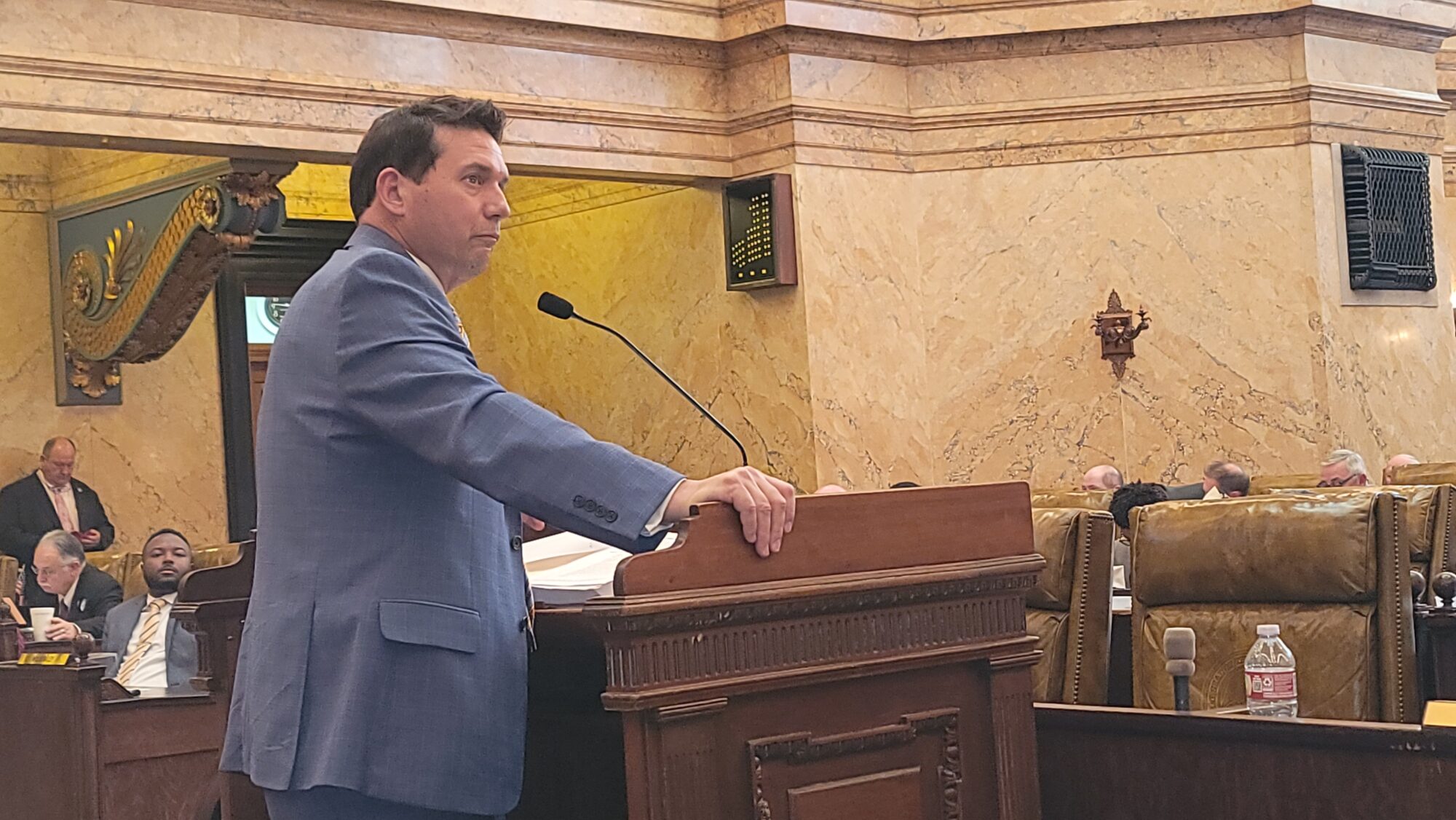
State Representative Lee Yancey presents in the well of the House, Wednesday, March 14, 2024. (Photo by Jeremy Pittari | Magnolia Tribune)
- State Rep. Lee Yancey suggests that if banning all kratom products outright is not something the Mississippi Senate would consider, there should be an additional layer between the general public and kratom, such as classifying it as a Schedule II substance.
Following the death of two Ole Miss students, two men were arrested by Oxford Police last week for illegally selling kratom products out of a local convenience store.
A connection between the deaths, arrests and kratom has not been announced by law enforcement. The State Medical Examiner has sought expedited toxicology testing from both student deaths.
“Law enforcement is currently conducting two separate death investigations. At this time we have no confirmed evidence indicating that the two deaths are connected,” read a statement from the Lafayette County Metro Narcotics unit. “However, packaged Kratom sold from a retail store was found during both investigations.”
The students, both young men aged 18 and 20 years old, were found in separate locations last week – one on campus and the other off campus
The City of Oxford has prohibited the possession, distribution and sale of kratom since 2019.
Even though use of kratom has not been determined as a contributing factor in the deaths, the police advised the public to avoid using kratom and any other substance not prescribed by a doctor.
In the wake of the deaths and subsequent arrests, one state lawmaker is calling for the Mississippi Legislature to once again consider a statewide ban on kratom.
“Those deaths were so tragic and convenience stores have been peddling unregulated drugs for some time now,” State Rep. Lee Yancey (R) told Magnolia Tribune on Monday. “It is beyond past time to take that seriously and demand that these products be tested.”
After the deaths of the two students, Oxford Police Department received a tip that illegal substances were being sold out of a business in the 100 block of Heritage Drive, known as the Puffs Vape, Tobacco and Beer Store, Oxford Police reported in a statement.
Investigators were able to make a “controlled purchase” of illegal substances in that store, a warrant was secured, and a search of the business found 500 doses of Kratom, vape cartridges containing THC, gummies and additional substances suspected to contain narcotics.
Two suspects were arrested in relation to the investigation – 51-year-old Yahya Mohamed Mosleh and 18-year-old Islam Mohamed. Both suspects are residents of Oxford. As the investigation continues the suspects could face additional charges. Amer Alowdi, 40, the owner of the business, fled the United States before facing a trafficking indictment in 2022.
While Mississippi does not have a statewide ban on kratom products, municipalities and counties have the ability to place prohibitions on the substance at the local level. The City of Oxford’s ban prevents the legal sale and distribution of products containing kratom to any person, regardless of age.
In his prior role as the Mississippi House of Representatives’ Drug Policy Committee chairman, Yancey has introduced a number of bills to ban kratom products outright, but the state Senate has never taken the bills up for a vote. Yancey now serves as chair of the House Business and Commerce Committee.
“Previous efforts in the Legislature have failed to ban kratom outright. They passed in the House but the Senate wouldn’t consider the bills,” Yancey said.
He suspects the Senate declined to take the bills up because the federal government has not taken action on the substance.
“The Senate didn’t want to get ahead of the federal government,” he added.
One bill on kratom did become law during the 2025 legislative session, HB 1077. The measure not only set age restrictions of 21 or older, but also made a synthetic form of Kratom, 7-OH, illegal. Another provision in the bill mandated that natural kratom products be stored behind the counter, out of reach of the customer.
Even though the 7-OH version of kratom has been banned, Rep. Yancey said manufacturers simply modify the substance’s chemical makeup slightly to skirt the current law.
“Those would have to be specifically mentioned in the law to be banned,” Yancey explained. “Cause they can change one molecule and have as potent of a drug and it not meet the letter of the law and escape regulation. It’s like playing whack a mole with all these drugs.”
Oxford Police is investigating other retailers selling the substance, with arrests forthcoming if businesses are found to be in violation of the local ban.
“This investigation does not end with these arrests,” Oxford Police stated. “These individuals and this business are not necessarily the only people involved in the illegal distribution of these products, and they should not expect to be the last arrests made as our enforcement efforts continue.”
“The question we ought to be asking is why are we allowing unregulated drugs to be sold in convenience stores?” Rep. Yancey posited. “We need to give law enforcement the tools they need to stop this.”
Yancey suggests that if banning all kratom products outright is not something the Senate would consider, there should at the very least be an additional layer between the general public and kratom, such as classifying it as a Schedule II substance. Schedule II substances have accepted medical uses but are also considered highly addictive.
While the toxicology report will provide more details on the cause of death of the two Ole Miss students, Yancey said there have been other deaths where kratom was involved.
“I would encourage every city and county to look at this and to consider whether this is something they really need in their community,” Yancey urged.