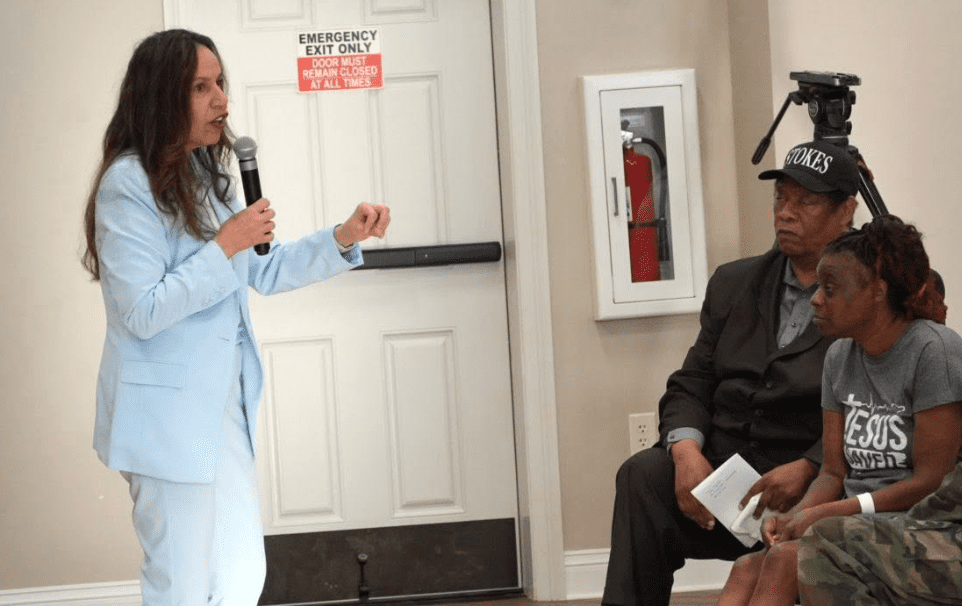
Chief Brackney speaks at a Jackson community meeting, April 2026 (Photo from Jackson PD on Facebook)
- Council member Tina Clay has asked the Attorney General for an opinion on using private funds to supplement the police chief’s salary.
A Jackson city council member recently requested a legal opinion from the Mississippi Attorney General’s Office regarding using private funds to supplement the municipality’s new police chief’s salary.
Council member Tina Clay asked for an opinion on April 15, about three weeks after the council voted 6-1 to hire RaShall Brackney as its top cop. Ashby Foote was the lone no vote.
Clay later learned that Mayor John Horhn told Brackney her annual salary was $150,000, making her the highest-paid city official. The council believed Brackney’s starting pay was $133,000.
During the following council meeting, Clay asked if she could rescind her vote after learning Brackney was starting at $150,000.
Despite the conflicting pay amount, at the March 10 City Council meeting, members voted 5-0-1 to legally give Brackney a higher salary. Clay abstained from voting on the salary increase while Foote was absent. The Police Chief, who started April 1, is making $25,000 more than her nearest department head, Lorenzo Anderson, who leads the city’s public works.
The chief’s higher salary has divided the council. Foote and Clay consider the higher salary and fringe benefits befitting a CEO, while council member Kenneth Stokes said, “We can’t get a Cadillac paying for a Volkswagen.”
In addition to the salary, Brackney’s contract calls for $15,000 for moving expenses and $3,000 for housing assistance during her first three months as chief. There is also a clause stating that if Brackney is terminated without cause during her first year, she is entitled to her full base pay.
The back and forth over the chief’s $150,000 salary led Mayor Horhn to suggest using private donations to offset the difference. Other possible ways to make up the disparity is to take $20,000 from the city’s general fund, auction proceeds, or salaries set aside for vacant positions, said Jackson’s Chief Financial Officer Jillian Caldwell.
Clay’s request to the Attorney General’s Office asked whether it is legal to use outside funds to make up the difference, as Horhn suggested. An opinion could take more than three months to render.
The Attorney General’s Office told Magnolia Tribune, “The Opinions and Policy Division handles all opinion requests and will aim to turn around requests within 100 days after receipt.”
Tom Hood, executive director of the Mississippi Ethics Commission, said, “Ethics in Government Law does not prohibit public servants from receiving private-sector income, but issues can arise, depending on the details.”
However, Hood noted that the opinion in a June 2022 case was based on different facts than the Jackson situation. That case asked if it was ethical for a leader of a state agency’s salary to be supplemented by a nonprofit association. The Ethics Commission ended its ruling in that matter by stating, in part, “The payment of private funds to a public servant for performing public work has the inherent potential to result in conflicts of interest.”

Daniel Tyson