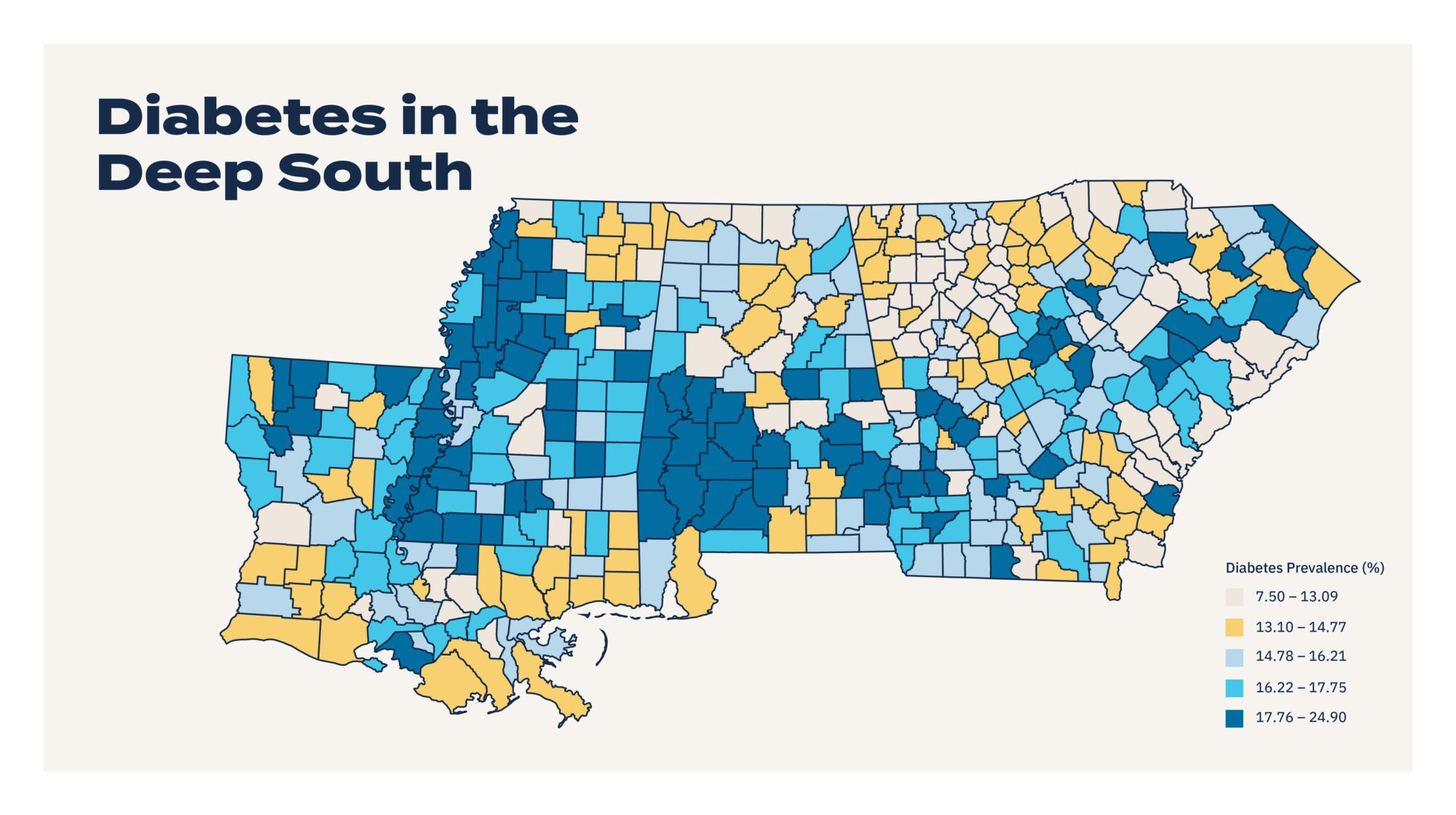
Researchers at the University of Mississippi and South College have mapped diabetes rates across the Deep South in relation to community resources such as safety, food security, public parks and available healthcare. They found that the environment in which people is associated with their likelihood of developing the chronic disease. Graphic by Sarah Tewolde/University Marketing and Communications
- Understanding where diabetes rates spike and dip could influence prevention methods.
Counties where residents suffer from higher diabetes rates across the Deep South often also face greater poverty, food insecurity and barriers to healthcare and physical activity, a new University of Mississippi study reveals.
The research, published in Journal of Racial and Ethnic Health Disparities, mapped diabetes rates across 418 counties in five Southern states, finding geographic patterns that researchers say can help communities better understand the conditions surrounding chronic disease.
“Individual health behaviors tell us only part of the story,” said Ruaa Al Juboori, Ole Miss assistant professor of public health and data analytics statistician. “Looking at diabetes geographically brings people’s surroundings into view: access to nutritious food, places to exercise, healthcare and community safety.
“Our study shows where a high diabetes burden and gaps in community resources occur together. That broader view helps identify where closer attention and prevention resources may be needed.”
More than 40 million Americans of all ages have diabetes, but the chronic condition is most prevalent in Deep South states such as Mississippi, Louisiana and Alabama.
Researchers from Ole Miss and South College reviewed counties in those states along with Georgia and South Carolina and mapped diabetes rates alongside characteristics of the communities themselves.
“Diabetes prevention is often framed as a matter of individual responsibility, such as eating healthier foods, exercising regularly and maintaining a healthy weight,” said Precious Patrick Edet, assistant professor of public health. “While these behaviors are important, our findings highlight that the environments in which people live can significantly shape their opportunities to make healthy choices.”
“Our study found that counties with higher levels of poverty, food insecurity and physical inactivity also tended to have higher diabetes prevalence.”
Diabetes is the most expensive chronic condition in the United States, presenting financial burdens both for the healthcare industry and for patients. Preventing diabetes and the associated costs may begin with looking at the communities where the chronic condition thrives, the researchers said.
“Our findings suggest that diabetes belongs in a broader conversation about community resources,” Al Juboori said. “Higher diabetes prevalence was associated with economic hardship, food insecurity and concerns about community safety, while lower prevalence was associated with greater access to exercise opportunities and primary care.
“For prevention planning, the question is whether residents have affordable food, accessible care and safe places to be active.”
The Mississippi Delta stood out as one of the Deep South’s diabetes hotspots. There, high rates of the disease overlapped with community challenges such as poverty, physical inactivity and lack of access to public parks, the researchers found.
“For Mississippi, this shows why looking beyond the statewide average matters,” Al Juboori said. “Communities have different needs and resources.
“These findings can help local leaders and residents identify where prevention efforts deserve closer attention and which gaps in community resources should be priorities.”
Identifying which community resources a county lacks could direct efforts to fill those gaps and offer residents more opportunities to lead healthy lives, Patrick Edet said.
“There is no one-size-fits-all solution,” she said. “Our study identifies geographic patterns and associated community characteristics, but local leaders should work directly with residents and healthcare providers to understand their specific needs.”
Some areas in the Deep South are notable for not having higher diabetes rates, the researchers found. In some counties that faced similar levels of poverty, food stability and healthcare resources as diabetes hot spots, the researchers instead found a lower-than-expected rate of disease.
These “cold spots” could be the focus of future studies.
“Cold spots draw attention to communities with lower diabetes prevalence and raise an important question: What might we learn from them?” said Neva Agarwala, a researcher at South College. “Looking more closely at their local resources, health services and community strengths could offer useful insights for prevention elsewhere.”
This article is republished courtesy of Ole Miss.