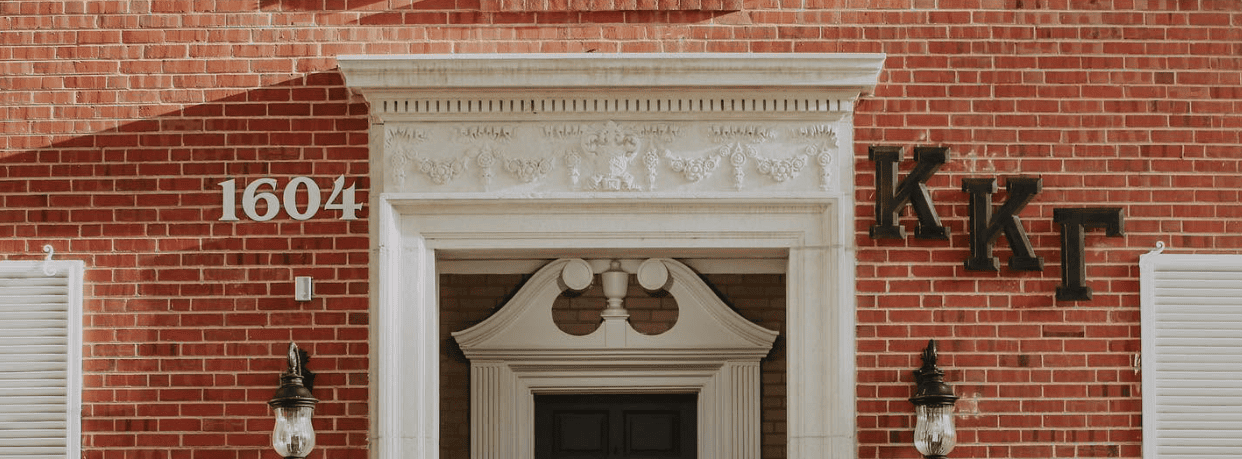
(Photo from Kappa Kappa Gamma at Wyoming sorority, May 2022, on Facebook)
- Kappa Sisters go to court. They argue that a sorority is supposed to be for women.
The fight to keep sororities a place for women only was in court this week.
On Monday, the Kappa Kappa Gamma sorority sisters from the University of Wyoming returned to the U.S. Court of Appeals for the Tenth Circuit in Denver. This is not their first time on those steps.
The trouble began in 2022, when Kappa’s national office forced their chapter to accept a 6-foot-2, 260-pound man over the objections of the women who lived in that house.
In 2023, six of these young women filed suit, arguing that Kappa broke its own governing documents and the promise of female-only membership they were given when they joined. A lower court dismissed the case. They appealed. And even after the court rejected their appeal on procedural grounds, they refused to walk away. This week they were back, with alumnae and advocates from across the country standing behind them in their fight to keep sororities for women.
When these women first went to court, Kappa’s own attorney argued that the word “woman” has no clear definition. At Monday’s hearing, Kappa’s position became even harder to defend. When the judge posed the question of Kappa expressly adding “men” to its definition of woman, Kappa’s attorney conceded: “No, that would not be a reasonable interpretation. The authority is not limitless.” When he pointed out that Kappa’s interpretation allows biological men to join, Kappa’s attorney answered: “Individuals who are born as men but who identify as women…absolutely.”
What absurdity.
The judge then pressed the larger question: why should Kappa be allowed to discard the historical meaning of a founding principle of the organization? Kappa’s attorney replied: “The historical meaning of what a ‘woman’ may have meant back then is not relevant.”
Every sorority member knows better. For more than 150 years, no one inside Kappa needed the word “woman” explained. Then leadership added a new category of membership, one that included biological men, but kept calling it what it had always been: a woman’s sorority.
Sadly, what happened at Wyoming is not an isolated story. The national leadership of all 26 National Panhellenic sororities have adopted policies allowing men who identify as women to join, and they have punished loyal members who object.
Kappa Kappa Gamma expelled long-time alumnae for defending single-sex membership, and Phi Mu did the same. Delta Zeta removed Payton McNabb, a young woman injured by a male
athlete in a girls’ volleyball game, after she confronted a man in the women’s restroom. These are the very organizations that once promised generations of women a space of their own.
This is personal for me. I joined a sorority at Mississippi State University, and the women in my chapter mentored me and gave me confidence and encouragement to pursue goals I didn’t imagine I could achieve. They cheered me on at my basketball games and stood beside me on my wedding day. They celebrated when each of my boys was born, and they walked with me through cancer treatment.
Decades later, they remain my closest friends. That was possible because it was a space built for women. Sisterhood takes an unsure freshman and surrounds her with women who will show up for her at 19 and at 99. Every incoming freshman deserves the same opportunity.
The National Panhellenic Conference and the national leadership of all 26 national sororities are betraying the very women and the very institution of sisterhood they promised to protect.
But there are signs that things are starting to change.
The U.S. Department of Education has now made it plain: “A school receiving federal funding that supports, sponsors, or promotes a sorority or fraternity, must meet its obligations under Title IX to protect its students from sex-based harassment and sexual assault, regardless of the sorority or fraternity’s policy. A sorority that admits male students is no longer a sorority by definition and thus loses the Title IX statutory exemption for a sorority’s single-sex membership practices.”
Eighteen states, including Mississippi, have passed laws defining the word “woman,” and the Department of Education has opened an investigation into the University of Wyoming over what happened there.
These women haven’t limited their fight to the courtroom, either. They’ve testified before state legislatures and helped push lawmakers to define “woman” in state law.
A fight that began inside one sorority house in Wyoming is now being fought across the country.
And perhaps that is because the principle at stake really is this simple: Reality is not negotiable; biology is not a matter of opinion; and the meaning of the word “woman” cannot be erased.

Lesley Davis