
- If body positivity only applies to women who don’t meet conventional beauty standards, it was never really body positivity. It was politics with its clothes off.
When Lizzo posted a naked photograph of herself as part of Dove’s “Self-Esteem Project” in 2021, mainstream media reacted as though she had struck a blow for women everywhere.
Women’s Health: “Lizzo Just Shared an ‘Unedited’ Naked Selfie to ‘Change the Conversation About Beauty Standards.’”
Glamour praised the photograph for promoting authenticity and resisting unrealistic social-media beauty standards.
Marie Claire: “Lizzo posted a naked Instagram photo to promote unedited beauty and we’re here for it.”
Dazed: “Lizzo’s unedited nude is exactly what social media needs right now.”
The message was difficult to miss. Women should be proud of their bodies. Beauty should not be dictated by conventional standards. A woman comfortable enough in her own skin to show it to the world was empowered and confident.
Slay, Queen!
Unless that woman is conventionally “hubba hubba” attractive, like Sydney Sweeney, of course.

Sweeney recently appeared nearly nude in an advertisement for sports-betting company Novig. The ad strategically covers the actress’ intimates with sporting equipment. Female athletes and feminist commentators responded with accusations that she was objectifying women, setting back women’s sports and feeding a culture that values women for their bodies instead of their accomplishments.
Which raises an awkward question: Why does Lizzo get to be proud of her body and Sydney Sweeney doesn’t?
Apparently, “body positivity” has developed an attractiveness exception.
If displaying a body that falls outside conventional beauty standards is empowering, but displaying one that falls squarely within them is degrading, then we aren’t really talking about a woman’s right to feel good about her body.
We’re talking about which women are permitted to enjoy and leverage showing off.
Not hot: “You’re so brave.”
Hot: “You’re feeding the patriarchy.”
Sydney Sweeney’s Novig Ad Is Not an Attack on Women’s Sports
The notion that Sweeney was attacking women’s sports is equally inane. The ad isn’t commentary on female athletes (XX, not XY). It’s selling a sports betting product. That industry is one used predominantly by men to bet on predominantly men’s athletics.
Sweeney wasn’t pretending to be an Olympic swimmer. She isn’t dressed as a WNBA player. She isn’t suggesting that female athletes should look like her.

So when Sydney Sweeney covers her breasts with footballs in an advertisement aimed largely at men, betting largely on men playing sports, who exactly introduced “women’s athletics” into the conversation?
There’s something almost surreal about watching the same cultural movement that has spent years struggling to define precisely what makes someone a woman for purposes of athletic competition suddenly become extraordinarily certain about what a “woman in sport” is supposed to look like.
The boundaries between male and female athletic categories are apparently complicated enough to require an ongoing national debate.
The boundary between acceptable and unacceptable female cleavage, however, has been located with scientific precision.
Sex in Advertising—and Sports—is Nothing New
One can certainly dislike the advertisement. Maybe gambling companies shouldn’t use sex to attract customers. Maybe advertisers rely too heavily on attractive bodies. Maybe American culture is too sexualized.
Those are coherent arguments.
But “beautiful woman uses sex appeal to sell a product to men” is hardly an innovation Sydney Sweeney dreamed up in 2026.
Beer companies have done it. Car companies have done it. Fragrance companies have done it. Fashion companies have done it. Calvin Klein has spent decades discovering that attractive people wearing very little clothing can move underwear.
Nor is the technique remotely limited to women selling products to men.
David Beckham turned wearing his underwear in public into an enormously valuable second career. Cristiano Ronaldo built an underwear brand around the not-entirely-subtle proposition that Cristiano Ronaldo looks exceptionally good in underwear.
The Dallas Cowboys Cheerleaders have mixed sex appeal and football for half a century. Sports Illustrated built an American institution around beautiful women in swimsuits, eventually including female athletes like Serena Williams, Lindsey Vonn, Ronda Rousey, Alex Morgan and Danica Patrick.
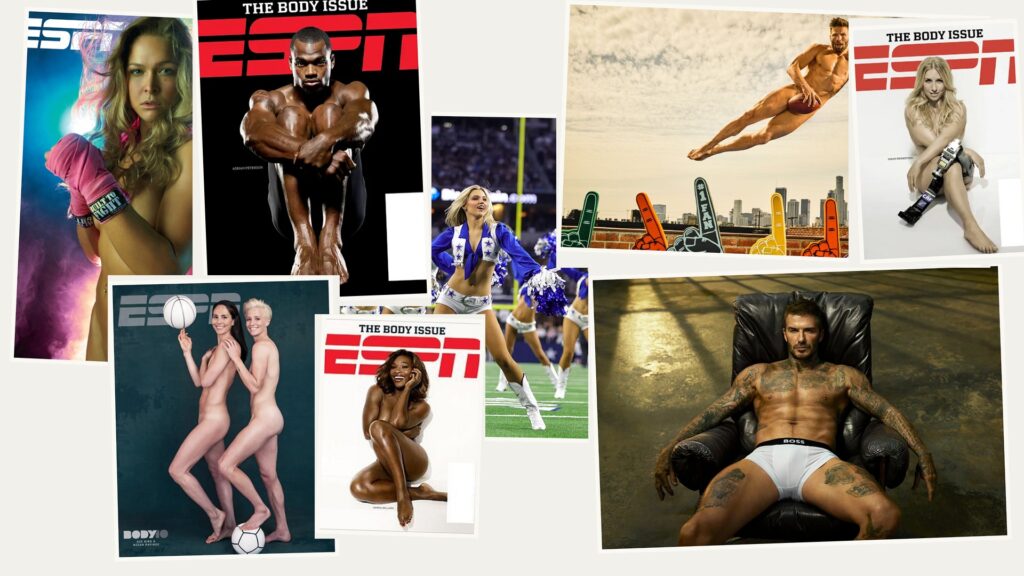
ESPN dispensed with the swimsuits entirely.
For 11 years, its celebrated “Body Issue” photographed more than 200 male and female athletes nude, generally using poses, limbs and sporting equipment to conceal the same portions of anatomy Sweeney conceals in the Novig advertisement.
Those athletes weren’t generally condemned for setting women’s sports back 50 years. Their bodies were celebrated as powerful, beautiful and worthy of admiration.
Some female athletes have gone even further, deliberately incorporating sex appeal into their commercial brands. Anna Kournikova became one of the most marketable athletes on Earth without ever winning a WTA singles title. Danica Patrick combined auto racing, Sports Illustrated and famously sexual GoDaddy commercials.
And when male Olympians reveal a little too much, our culture hardly averts its eyes in solemn respect for their athletic accomplishments. French diver Jules Bouyer became an internet sensation during the Paris Olympics because of what viewers could see through his swimsuit. Pole vaulter Anthony Ammirati went globally viral after a particularly intimate portion of his anatomy appeared to knock down the crossbar.
Mainstream coverage joined in the jokes.
None of this means Sydney Sweeney’s advertisement is high art. It isn’t. The joke is approximately as sophisticated as holding two footballs over your breasts.
Nor does it mean every sexualized image of a woman constitutes feminist empowerment.
But a culture that celebrated Lizzo’s nudity as body positivity, female athletes’ nudity as empowerment, male athletes’ bodies as fair game for public consumption, and decades of using sex to sell virtually everything, cannot suddenly pretend Sydney Sweeney invented the intersection of sexuality and sports.
For the record, I’d be perfectly fine (I think) if we lived in a more Puritan society.
Just pick a standard.
If women are supposed to be proud of their bodies, that principle has to include women whose bodies other people happen to find attractive.
Otherwise, it was never really body positivity.
It was politics with its clothes off.

Russ Latino