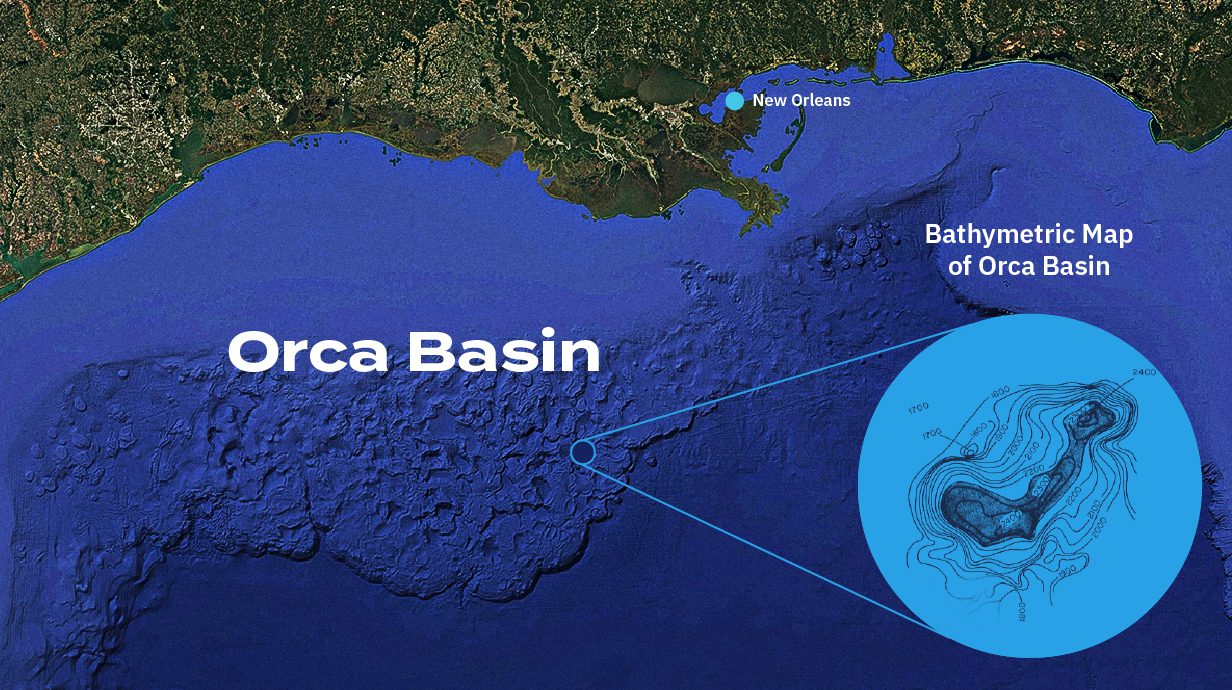
Researchers from the University of Mississippi and University of Southern Mississippi will collaborate to determine whether rare earth minerals such as lithium are present in a brine pool that sits at the base of the Orca Basin, a deep-sea formation off the coast of Louisiana. The minerals are in demand to supply the nation's technology needs. Illustration by Cole Russell/University Marketing and Communications
- Teams from Ole Miss and Southern Miss have partnered to determine whether the Orca Basin could hold valuable critical minerals. Finding extractable critical minerals in the Orca Basin could be a boon to U.S. mineral supply chains and national defense.
Mississippi researchers are investigating whether an unusual deep-sea brine basin off the coast of Louisiana naturally concentrates critical minerals, including lithium.
University of Mississippi geologist Leo Macelloni is partnering with researchers from the University of Southern Mississippi to determine whether the Orca Basin could hold valuable critical minerals, using a $950,000 contract from the Bureau of Ocean Energy Management, now called Marine Mineral Administration.
The three-year project will combine water chemistry, seafloor mapping and deep-sea sampling to study whether and how valuable elements accumulate in brine pools.
“We are working together to understand if the brine pools in the Gulf contain significant amounts of critical minerals like lithium,” said Macelloni, director of the Mississippi Mineral Resources Institute and Center for Marine Resources and Environmental Technology at Ole Miss. “These minerals are incredibly important for modern technology – everything from cell phones to car batteries to data chips – but the environment of brine pools is also very delicate.
“So, the challenge is not only to find these minerals, but to determine best practices to steward these resources while preserving marine life.”
Brine pools are deep-sea environments of extremely salty water. The high salt content makes the deep-sea water denser than the surrounding water, forming distinct pools and lakes. These sites are rare worldwide, but common in the Gulf.
Macelloni and USM professors Wokil Bam and Stephan Howden are planning a 15-day research expedition this year to collect water and brine samples. They hope to determine whether critical minerals are forming in one such pool in the Orca Basin.
“The Orca Basin is a fascinating natural laboratory because of its unusual geology and chemistry,” he said. “What makes the Orca Basin especially interesting is that these processes occur within a relatively confined environment, allowing us to investigate the mechanisms responsible for mineral transport and enrichment in greater detail.”
The Orca Basin is about 7,800 feet deep. The brine pool at its base is some 650 feet thick and covers nearly 50 square miles.
“In many ways, the Orca Basin provides a natural experiment for understanding processes that may also occur in other deep-sea environments worldwide,” Bam said.
Critical minerals have been found in brine fluids located beneath land – such as in the Smackover Formation beneath much of central Mississippi – but have not been confirmed in deep ocean brine pools, Macelloni said.
“Because conditions are so extreme there, we need to characterize the area before we can study it further,” he said. “We plan to collect samples of water and sediment to reconstruct the conditions of the area and assess the chemistry of the brine.”
If critical minerals are found in the basin, future projects could explore how to best extract those resources without damaging the brine pool’s environment, Macelloni said.
Finding extractable critical minerals in the Orca Basin could be a boon to U.S. mineral supply chains and national defense, but that is not the study’s only goal, Bam said.
“For us, success is not necessarily about discovering a large mineral deposit,” he said. “It is about developing a better understanding of the processes that control how critical minerals are transported, redistributed and concentrated.
“Even if the concentrations are too low for commercial extraction, we will gain valuable insight into how critical minerals behave in deep-ocean environments.”
This article is republished courtesy of Ole Miss.