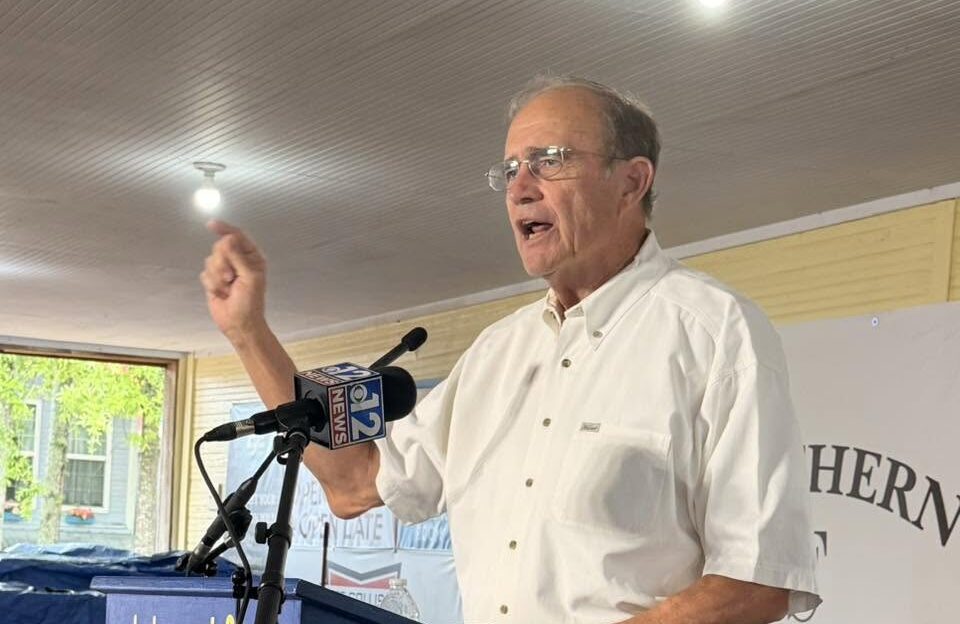
State Treasurer David McRae speaks at the Neshoba County Fair
- Fair access to banking is not a partisan issue. It is a matter of economic freedom, and that is something worth protecting—in Washington and Jackson alike.
Access to fair banking isn’t a luxury, it’s the price of entry in the modern economy. Whether you’re a small business owner, a nonprofit, a farmer, or simply a working family, you cannot function without fair, reliable access to financial services. That’s why the Fair Banking Standard Act is so important.
Recently, some critics have argued that this legislation is unnecessary because the Trump administration is already taking action at the federal level to dismantle “debanking,” a practice that allows large banks to close the accounts of people or groups with whom they disagree with politically.
Let me be clear: I applaud the work being done in Washington. President Trump and his administration have taken meaningful steps to rein in regulatory overreach and restore fairness to financial services.
However, while I wholeheartedly trust President Trump’s integrity on this issue, I can’t bank on what a future administration may do. Strong federal leadership today is not an excuse for Mississippi to refrain from protecting our citizens into the future.
State action and federal action are not mutually exclusive—they are complementary and often reinforce one another. If we believe that fair access to banking is essential, then it makes sense to protect it at every level of government. Executive orders and agency guidance can change with a new administration, and Mississippi families and businesses deserve protections that don’t disappear every four years.
That is precisely what this anti-debanking legislation provides.
This bill ensures that decisions about access to banking services are fair, objective, and not motivated by political viewpoints, religious beliefs, or lawful business activities. It sends a clear message: in Mississippi, financial services will not be weaponized for ideological reasons.
Some critics also warn that state legislation could create a “patchwork” of regulation or burden community banks. That concern misunderstands what this bill actually does.
The Mississippi legislation being debated today doesn’t impose new reporting requirements. It doesn’t add costly compliance mandates. It doesn’t dictate how banks price loans or manage risk. Instead, it limits the ability of state regulators to pressure these banks into denying services based on non-financial factors—such as political opinions or religious affiliations. In other words, it protects banks from political coercion just as much as it protects consumers.
I am hopeful community banks—the lifeblood of Mississippi’s economy—will benefit from the clarity. They should not be forced to navigate ambiguous regulatory expectations that leave them guessing about whether lawful customers could become political liabilities. Clear standards based on risk-based decision-making reduce uncertainty, not increase it.
Mississippi is not the first state to recognize this issue. States like Idaho, Florida, and Tennessee have already passed similar legislation, recognizing that waiting on Washington wasn’t a sufficient plan. By understanding that state governments have both the authority and responsibility to protect their citizens and businesses, they have done just that. Mississippi should do no less.
At its core, this is a question of principle. Should access to basic financial services hinge on objective financial risk? Or should it depend on whether a bureaucrat or activist disagrees with someone’s beliefs or business activities?
Mississippi’s answer should be clear.
I support President Trump’s efforts to restore fairness at the federal level. But federal progress does not eliminate the need for state leadership. By passing state-level anti-debanking legislation, Mississippi signals that economic participation in our state will not be determined by ideological gatekeeping.
Fair access to banking is not a partisan issue. It is a matter of economic freedom, and that is something worth protecting—in Washington and Jackson alike.

David McRae