House passes two medical cannabis-related bills onto Senate
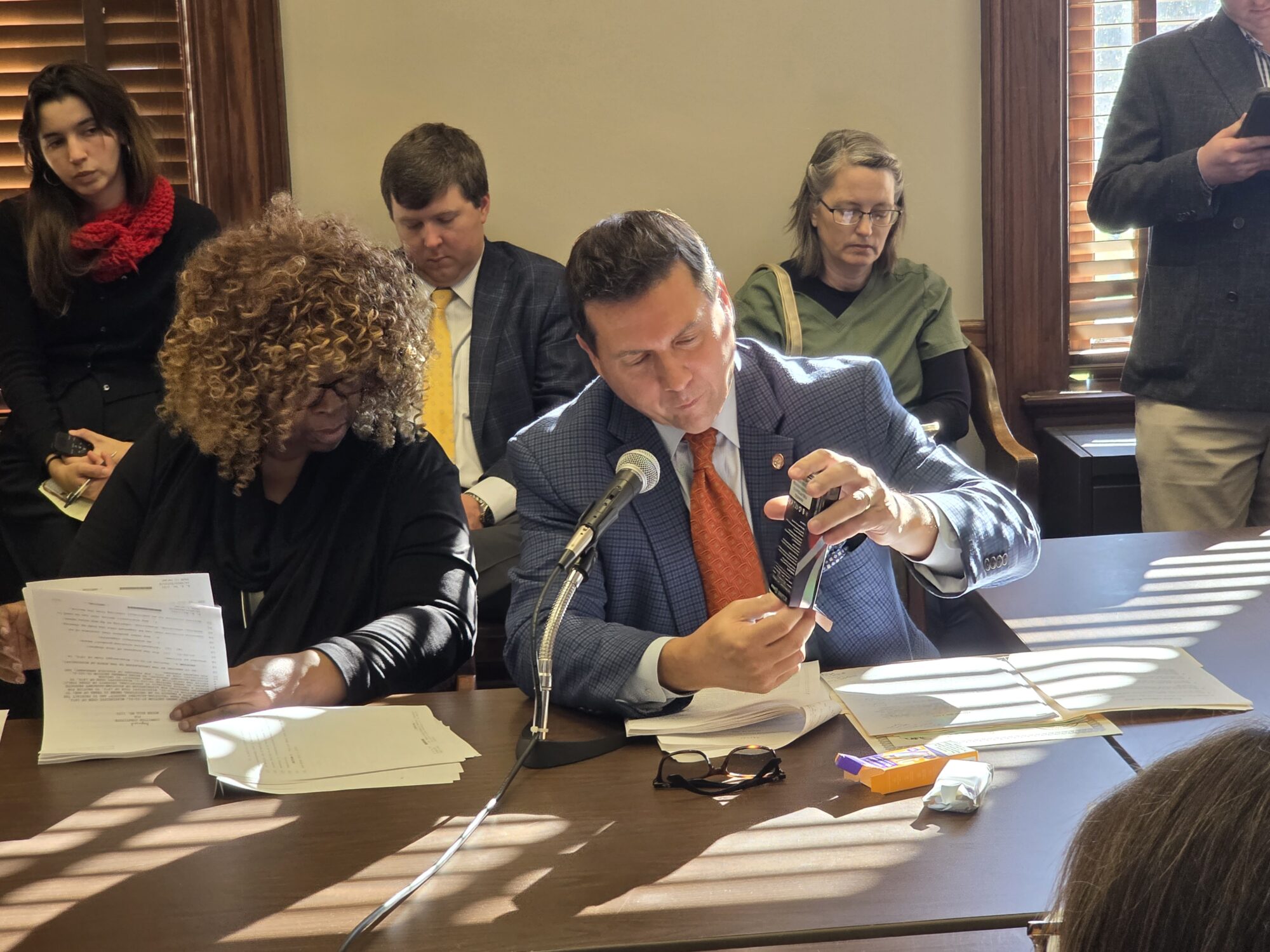
Rep. Lee Yancey (R) displays nicotine adjacent products being sold in the state during a recent House's Public Health and Human Services Committee meeting. (Photo by Jeremy Pittari)
- One measure would extend the validity of medical cannabis cards while another would create the “Right to Try Medical Cannabis Act.”
Two bills related to Mississippi’s medical cannabis program passed in the House of Representatives this week.
One bill extends the timeframe for a patient’s follow-up visit to keep their medical cannabis card valid, while a second bill creates a system where patients suffering from debilitating or terminal conditions not already on the state’s list of approved conditions can petition to try medical cannabis.
Authored by State Rep. Lee Yancey (R), HB 895 extends the time that an approved patient’s medical cannabis card remains valid before a follow-up visit is required to 24 months.
“It extends the validity period of a practitioner’s written certification from 12 months to 24 months,” Yancey described to the House on Wednesday.
Currently, the law requires a patient to make a mandatory 6-month follow-up visit with their provider, but this bill would eliminate that if it becomes law. HB 895 also allows the practitioner to request a follow-up evaluation at their discretion.
“Just removing the word mandatory. The practitioner can still require the patient to come back as often as necessary,” Yancey added.
At times, a patient may require a caregiver to fill their prescription. This bill would increase the resident designated caregiver’s validity to do that for up to five years.
“These are folks who are caring for someone who cannot or is not able to come to the dispensary themselves,” Yancey explained. “Currently, they had to get a background check and they’re having to get a card every year, where the background is lasting a lot longer than the card. This makes it consistent.”
It also removes the THC content cap on medical cannabis products that come in the forms of tinctures, concentrates and oils.
When the bill that established the medical cannabis programs passed four years ago, the cap was set at 30 percent THC on flower, and 60 percent cap on concentrates. This bill does not remove the cap on the marijuana flower forms of medical cannabis.
“Thirty percent is high enough, no pun intended,” Yancey said. “I haven’t seen any cannabis flower higher than 30 percent in any other state dispensary that I have been in.”
Removing the cap on the concentrates follows suit with other states in the nation, all of which no longer have caps on those products.
“The goal is to incentivize patients away from smoking cannabis flower,” Yancey said.
Yancey said that between 65 to 70 percent of medical cannabis purchases made by patients are in smokeable flower form. Limits can still be imposed by the practitioner should they decide to restrict the types of cannabis the patient can receive.
The bill passed the House by a vote of 98 to 11.
Another bill aimed at allowing more people suffering from progressive, chronic or terminal medical conditions to test and see if medical cannabis can be beneficial to them, HB 1152 is also moving through the legislative process. It aims to create a petition system through the Mississippi State Department of Health on a case-by-case basis. That bill was also authored by Rep. Yancey.
He said the bill would create a narrow path for a person suffering from a condition not on the state’s current list of qualifying conditions to try medical cannabis. The patient would first need to have a chronic, progressive or terminal condition and must have previously tried all traditional medications.
“They would have had to have tried everything else. There would have to be documented evidence of everything that they’ve tried,” Yancey explained. “And the state health officer could allow, on a case-by-case basis, this one individual to try medical cannabis. And it would not open the door for any other person; it’s just on a case-by-case basis.”
If the patients meets those qualifications, the medical provider can send a petition to the State Health Officer at the Mississippi State Department of Health, who will review the petition and all applicable records.
Any decision made by the State Health Officer on that petition is final and cannot be appealed. Additionally, the State Health Officer also has full control over the amount and type of medical cannabis authorized.
“And also provides that these patients are subject to periodic re-evaluation no less than once every 12 months,” Yancey said.
That “Right to Try” bill passed in the House by a vote of 104 to 7 on Thursday.

Jeremy Pittari