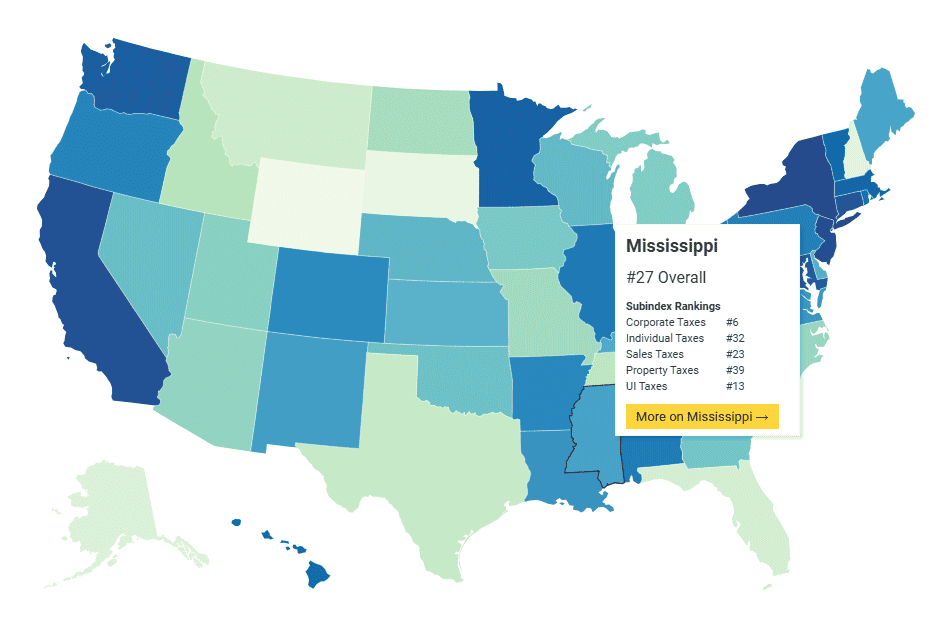
(From the Tax Foundation)
- The Tax Foundation’s Index compares each state on more than 150 variables in the five major areas of taxation. Mississippi benefits from a low, flat individual income tax rate and a relatively low corporate income tax rate.
The Tax Foundation recently released its State Tax Competitiveness Index. The report is aimed at enabling policymakers, taxpayers, and business leaders to gauge how their states’ tax systems compare across the U.S.
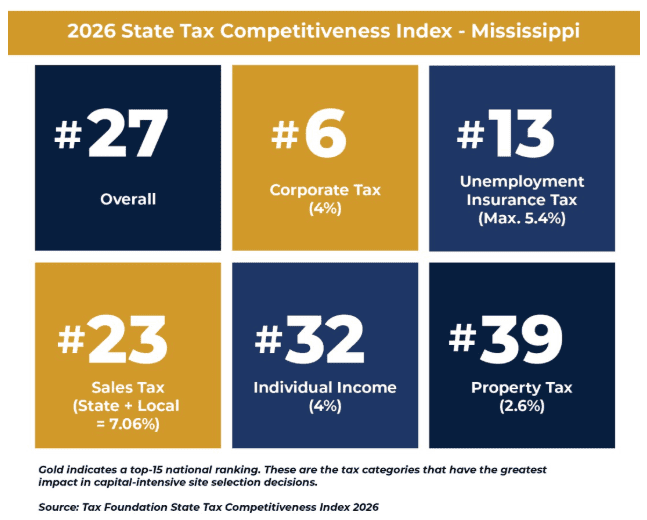
Mississippi ranks near the middle of the pack on the Index, as it benefits from a low, flat individual income tax rate and a relatively low corporate income tax rate.
The Index compares each state on more than 150 variables in the five major areas of taxation – corporate taxes, individual income taxes, sales and excise taxes, property and wealth taxes, and unemployment insurance taxes – and then it adds the results to yield a final, overall ranking.
The Tax Foundation says this approach rewards states on particularly strong aspects of their tax systems or penalizes them on particularly weak aspects, while also measuring the general competitiveness of states’ overall tax systems. The result, the Foundation says, is a score that can be compared to other states.
The Index states that “Mississippi’s throwback rule” exposes in-state firms to higher Mississippi tax liability when they sell tangible property into states with which they do not have nexus.
“Additionally, Mississippi maintains a graduated-rate corporate income tax despite moving to a single-rate individual income tax in 2023, a rate that has been reduced to 4.4 percent as of 2025, with the aim to reduce it further to 4 percent by 2026,” the Tax Foundation report outlines. “While Mississippi’s statewide sales tax rate is among the highest in the country, low reliance on local sales taxes yields a combined state and average local rate that sits near the middle of the pack.”
The Index states that as part of a series of pro-growth reforms, in 2023, Mississippi joined Oklahoma to become the second state in the country to enact permanent full expensing for machinery and equipment investments, thereby increasing the marginal attractiveness of Mississippi for firms that invest in large amounts of capital.
Additionally, Mississippi’s capital stock tax is scheduled to phase out by 2028, which will further improve the state’s ability to attract business investment.
“While Mississippi’s property taxes are relatively low, its taxation of tangible personal property, including business inventory, as well as intangible property, penalizes in-state investment and hurts the state’s property tax component score,” the Foundation report explains.
The Mississippi Development Authority shared this week that Mississippi’s combined state and local tax burden is $4,868 per capita, the lowest in the nation and 31% below the national average. Pointing to the Index‘s rankings, MDA said Mississippi being ranked No. 6 nationally for corporate taxes and No. 13 for unemployment insurance taxes carries significant weight in site-selection cost models for businesses looking to invest in the Magnolia State.
MDA further pointed out that Mississippi’s affordability index is 87.3, meaning a household earning $67,000 in Mississippi has purchasing power comparable to approximately $77,000 in the average U.S. market.
“At the same time, overall productivity has increased 12% over the past 15 years,” MDA explained in their September brief. “For companies comparing locations, the question isn’t simply what it costs to make the initial investment. It’s what the business case looks like five, 10 or even 20 years later.”
Mississippi’s neighboring states of Tennessee, Arkansas, Alabama and Louisiana came in with an overall competitiveness score of 8th, 34th, 37th, and 31st, respectively, in the Index.
The Index lists the Top 5 overall most competitive states with Wyoming in the top spot, followed by South Dakota, New Hampshire, Alaska and Florida.
The least competitive states ranked 47th through 50th were Connecticut, California, New Jersey and New York, respectively.