Mississippi IHL (Photo from IHL website)
- All of the eight public universities under IHL’s umbrella are receiving an increase in funding, with the University of Mississippi seeing the largest increase at 6.9% or $39.8 million.
Funding for Mississippi’s eight public universities was discussed Thursday by the Board of Trustees for the Institutions of Higher Learning.
After a recap of the suggestions made by the National Center for Higher Education Systems, the group hired by IHL to provide a performance-based funding model, the Board discussed the operating budget for the coming fiscal year and heard recommendations from Senior Associate Commissioner for Finance John Pearce.
This coming year’s total operating budget will be $6.69 billion, which is a 14% increase over fiscal year 2026, Pearce told the IHL Board. Of that total, about $964.2 million is from state and federal appropriations.
Pearce said the University of Mississippi Medical Center will receive the largest portion of the funding. UMMC’s total budget will be $2.58 billion, with $224.7 million coming from appropriations and $2.3 billion being self-generated. UMMC’s budget includes $7.6 million in American Rescue Plan Act (ARPA) funding for the school of nursing. Pearce noted the ARPA funds are on the decline as they are being spent. That funding was $41.6 million in the prior fiscal year.
“The largest bucket funding is for the University of Mississippi Medical Center, which continues to become an increasingly large part of the system’s budget, followed by the education and general budget, which is the education mission of the eight universities, and then followed by the restricted research funds provided from the federal government primarily,” Pearce explained.
From the previous year, there was a $87 million increase in the operating budget for the eight institutions. The state provided $16 million of that budget, most of which is going to one line item.
“Primarily for $2,000 faculty raises,” Pearce said.
All of the eight public universities under IHL’s umbrella are receiving an increase in funding, with the University of Mississippi seeing the largest increase at 6.9% or $39.8 million.
The University of Southern Mississippi will see the smallest increase at 2.23% or $5.3 million. It reflects the lowest percentage increase due to the institution’s total budget, even though the Mississippi University for Women is receiving the lowest total increase of $1.3 million.
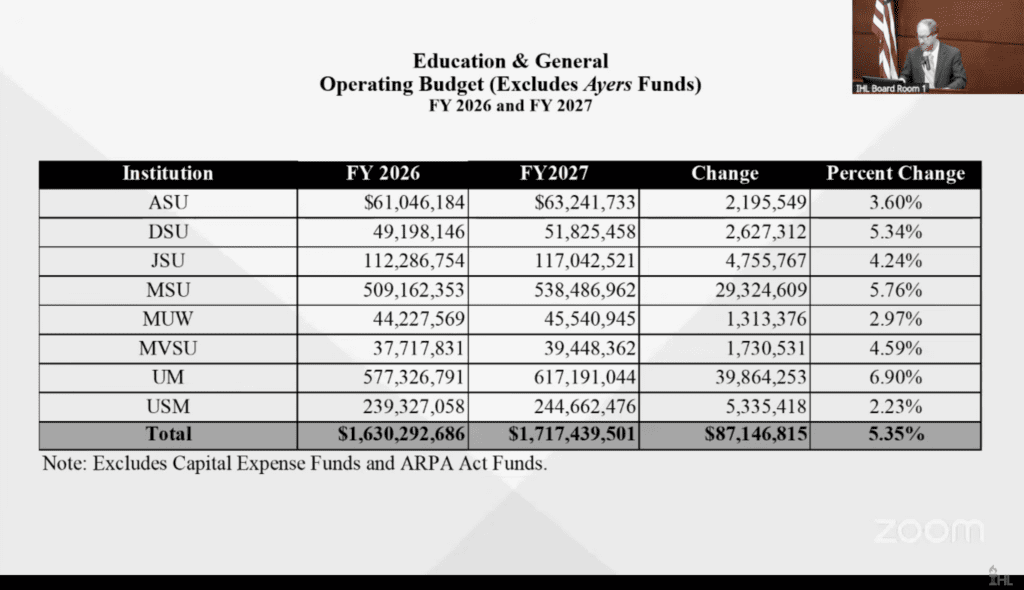
Increasing tuition revenue is a major factor for the increases in the education and general budget at two of the institutions, while the rest are mostly receiving increases due to the increased legislative appropriation.
“For Mississippi State University, of the $29 million increase, $23 million is coming from an increase in tuition revenue and for the University of Mississippi, $35 million of the $39 million is coming from the increase in tuition revenue,” Pearce noted.
As such, tuition is now a majority of the operating budget. According to data presented at the meeting, during fiscal year 2000, 32% of the budget came from tuition, with 56% being appropriations. This fiscal year, 68% is from tuition while 27% is from appropriations.
Funding priorities for the next fiscal year discussed by IHL include increasing tuition and fee rates, staff and faculty pay, and other metrics.
Pearce told the IHL Board that Mississippi’s average tuition and fees for residential students averages $9,000 annually, while the neighboring states of Tennessee are the highest at $11,600 and Arkansas is the lowest at $9,200.
While tuition is on average lower in Mississippi, faculty and staff compensation lag, despite the recent appropriations made by the Legislature to provide the $2,000 pay raises.
“So, even though we’ve been able to make some improvements in faculty compensation, other states are improving at a faster rate,” Pearce described. “For the Southeast region, the average faculty members of four-year institutions were paid $26,000 more than the average in our state. The next closest state to us is Arkansas.”
Recommendations for the next fiscal year based on the NCHEMS presentation is to adopt the performance-based funding framework, with foundational floor funding being the starting point for all institutions.
“So, Alcorn State University, Mississippi State University and the University of Mississippi would be the institutions below the floor funding, so we want to address that gap,” Pearce said.
Performance funding would be a part of that model, incorporating metrics in excellence, improvement, and financial and administrative efficiency being key components.
If the IHL Board decided to go above floor funding and reach the level four funding model proposed by NCHEMS, that gap would be $156 million.
“So, the total request will be $129 million for fiscal year 2028, the increase over 2027,” Pearce said for the next fiscal year’s budget request.

Jeremy Pittari