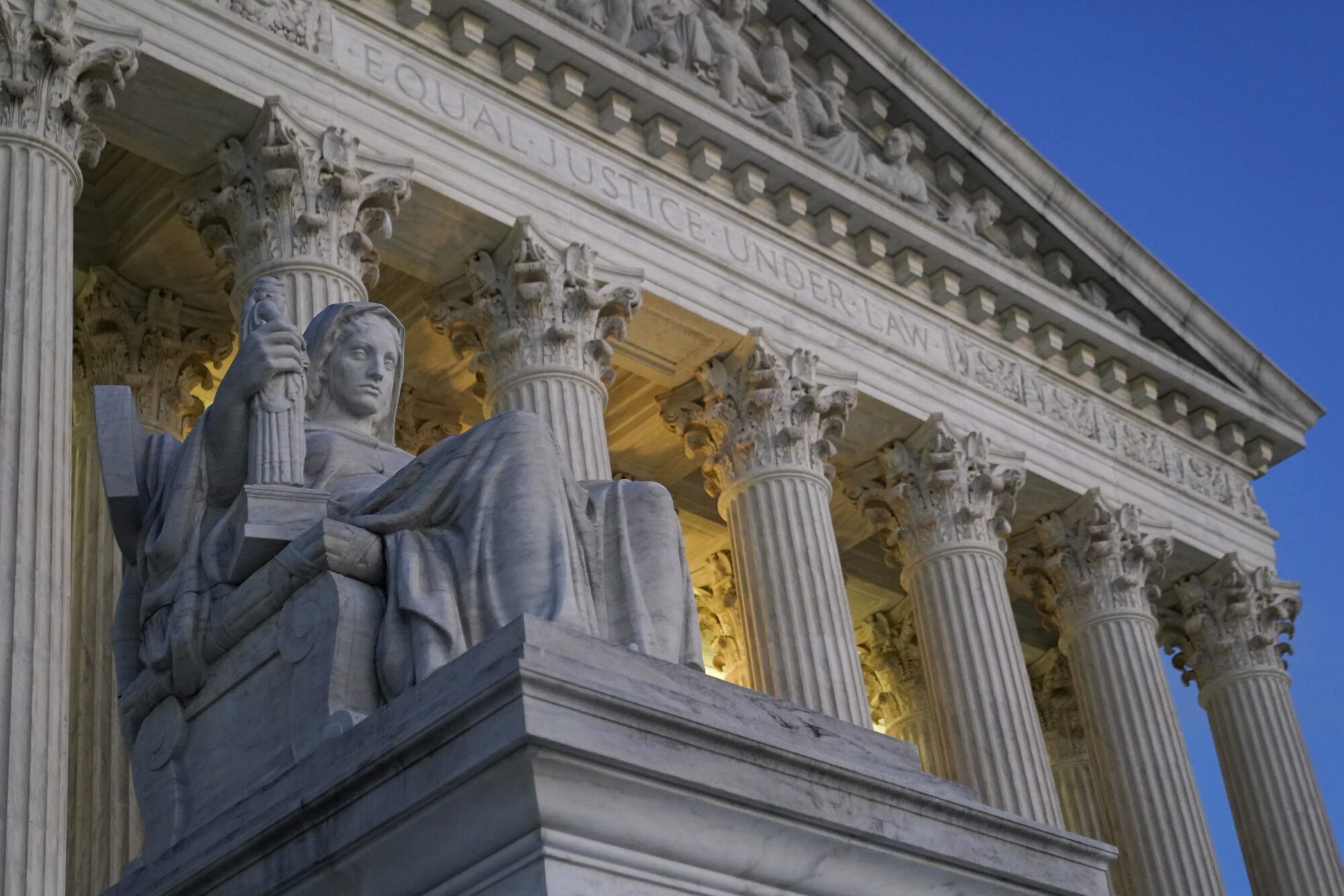
FILE- Light illuminates part of the Supreme Court building on Capitol Hill in Washington, Nov. 16, 2022. (AP Photo/Patrick Semansky, File)
- Terry Pitchford was sentenced to death for his role in the murder of a store owner near Grenada. His attorneys claim the jury that convicted the now 40-year-old was racially biased.
The U.S. Supreme Court has sided with a black death row inmate from Mississippi who claimed the makeup of the jury that convicted him was racially biased.
Per court documents, in 2004, two black teenagers, Terry Pitchford and Eric Bullins, robbed a grocery store near Grenada. During the robbery, Bullins shot store owner Reuben Britt three times, killing him. Bullins, who was under 18 at the time of the murder, reached a plea agreement and received a 20-year sentence for the homicide as he was ineligible for the death penalty.
The State charged Pitchford, 18, with capital murder and sought the death penalty.
During jury selection at Pitchford’s trial, the prosecutor used peremptory strikes against four of the five black potential jurors. As the U.S. Supreme Court held in Batson v. Kentucky, the Equal Protection Clause bars prosecutors from exercising peremptory challenges based on race.
On appeal to the Mississippi Supreme Court, the state justices determined that Pitchford had waived his Batson objections but that was reversed at the U.S. District Court where the court concluded that the Mississippi Supreme Court had unreasonably applied Batson and had unreasonably determined that Pitchford waived his Batson objection. The State then appealed and the Fifth Circuit Court of Appeals reversed the District Court, concluding that the Mississippi Supreme Court’s waiver finding was reasonable.
In a 5-4 decision handed down on Thursday by the U.S. Supreme Court, justices said the Mississippi Supreme Court unreasonably applied the Batson precedents and unreasonably determined that Pitchford waived his opportunity to rebut the prosecutor’s asserted race-neutral reasons for the peremptory strikes of four black prospective jurors.
“The State’s argument that Pitchford preserved his Batson objection but nonetheless somehow waived his Batson pretext argument does not make much sense and is not a reasonable reading of this record,” Justice Brett Kavanaugh wrote the majority, adding, “After a prosecutor asserts race-neutral reasons for a peremptory strike, the defense counsel must at least have an opportunity to argue that the asserted race-neutral reasons were not the actual reasons—that is, the reasons were pretextual. Then, the trial court can determine whether those asserted reasons
were the actual reasons or instead were pretextual. In this case, whether due to confusion, oversight, an overly hurried jury selection process, or some other cause, things broke down, and the ordinary trial-court procedure for resolving Batson claims at step three never occurred—
notwithstanding the repeated efforts of Pitchford’s counsel to pursue and preserve the Batson objection.
Justices Neil Gorsuch, Samuel Alito, Amy Coney Barrett and Clarence Thomas dissented.
Gorsuch, writing for the minority, the State offered race-neutral reasons for each of the peremptory strikes of the black prospective jurors.
“One prospective juror, it said, had returned late to court after lunch break and had a history of mental problems. Two had brothers who had been convicted of violent offenses. Another ‘had
no opinion on the death penalty.’ Plus, he was similar to Mr. Pitchford in several ways: They were ‘approximately the [same] age,’ they ‘both ha[d] children about the same age,’ and they ‘both ha[d] never been married,'” Gorsuch wrote. “The judge accepted these reasons as race neutral and directed the parties to resume jury selection.”
Gorsuch went on to say that the Mississippi Supreme Court held that Pitchford had not carried his ultimate burden to show purposeful discrimination.
“In short, I respectfully dissent because, as I see it, the Court’s opinion errs on the law and the factual record alike. But if the Court’s decision is mistaken, at least its impact is limited,” Gorsuch concluded of his colleagues’ decision in the majority.
The Court reversed the judgment of the Fifth Circuit Court of Appeals and remanded the case for further proceedings consistent with the opinion, but stopped short of “dictating what further proceedings may be appropriate on remand,” as Gorsuch wrote.
Pitchford, now 40, remains in jail.
The full decision can be read below.

Frank Corder