Despite drop in latest public health emergency preparedness ranking, Mississippi’s State Health Officer remains confident
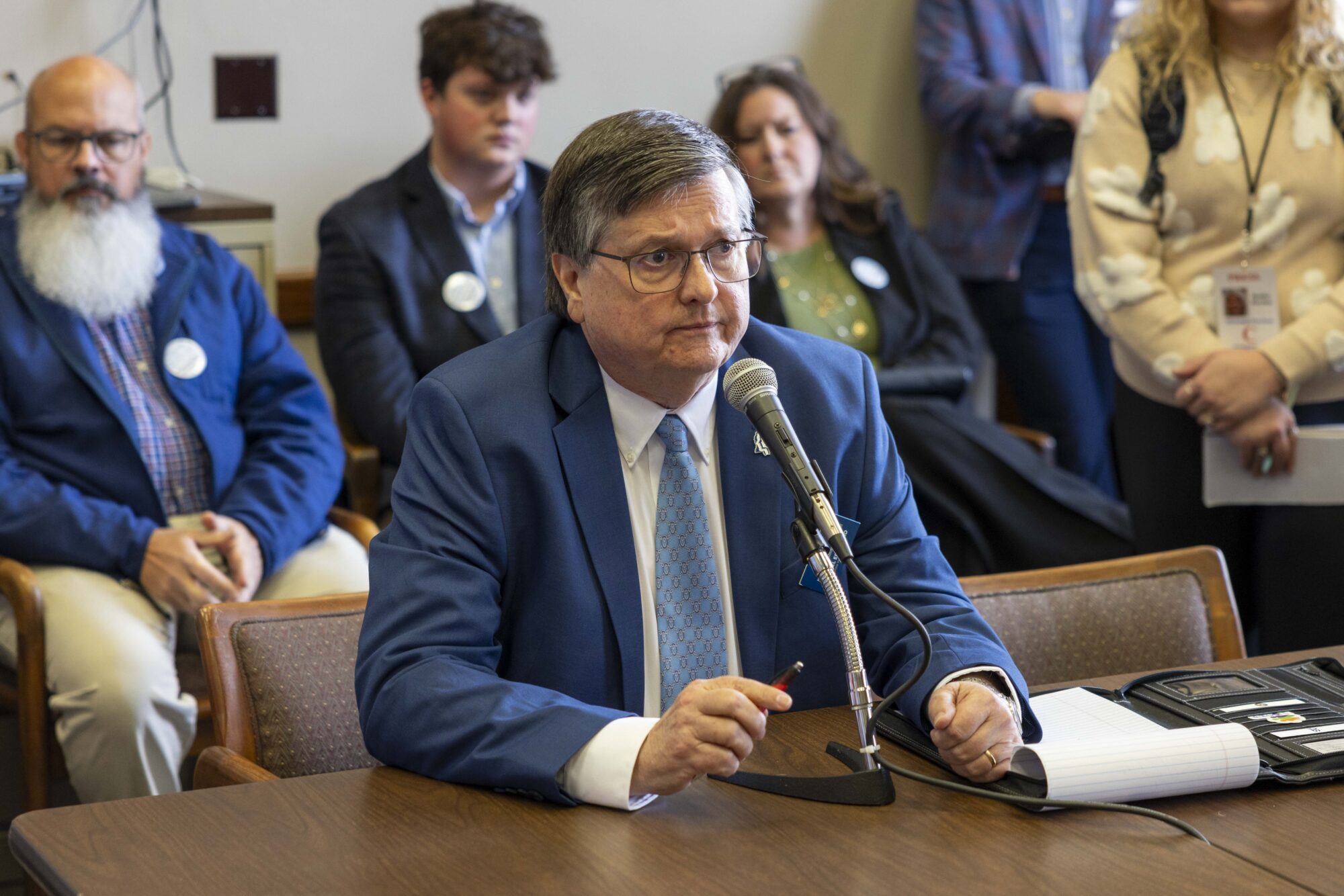
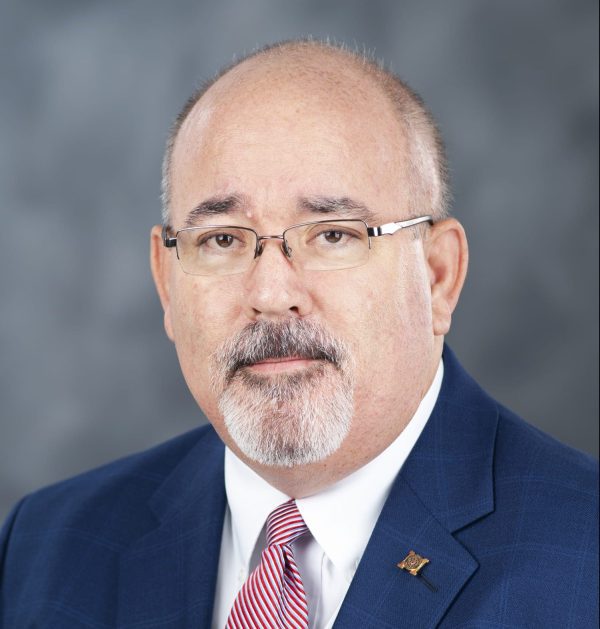
State Health Officer Dr. Dan Edney (Photo from MS Dept. of Health)
- “In terms of my heartburn level for emergency preparedness at the state level, I don’t have very much,” Dr. Daniel Edney said. “It’s just one of the things that we’ve always done really well in Mississippi.”
Even though Mississippi’s public health emergency preparedness performance ranking has fallen, State Health Officer Dr. Daniel Edney remains confident of the systems in place to protect the public.
Trust for America’s Health Ready or Not 2026: Protecting the Public’s Health from Diseases, Disasters, and Bioterrorism report evaluates the nation’s readiness in 2025 for public health emergencies through 10 indicators of state preparedness, including healthcare workforce mobility, state public health funding, laboratory surge planning, access to paid sick leave, and community water system safety.
Across the nation, 20 states were listed in the high-performance tier, 17 states and the District of Columbia were in the middle-performance tier, and 13 states were in the low-performance tier. Mississippi is ranked among the lowest of the three performance tiers.
Yet, as Dr. Edney said, until last year, Mississippi regularly ranked among the top of the three tiers used by Trust for America’s Health to rank the states. The ranking scores each state on its public health emergency preparedness performance.
Edney attributed the drop in Mississippi’s ranking to several factors, including changes to the ranking system and uncompleted responses.
“My team actually met with them to see what had changed,” Edney explained, saying the Department of Health took a hard look at changes. “And they had added new scorecards to states.”
“So, when I did the after action of the valuation of why our prepared rankings dropped, some of it was things that we just needed to fix on our reporting side, but our preparedness was just the same. Some of it was due to scorecards that we can’t control that we probably aren’t going to score as well as we used to,” Edney explained. “But in terms of my heartburn level for emergency preparedness at the state level, I don’t have very much. It’s just one of the things that we’ve always done really well in Mississippi.”
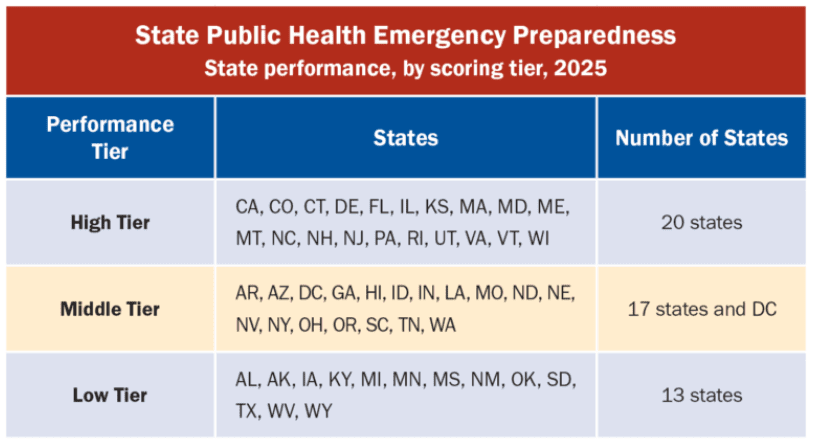
Areas of Concern in Health Emergency Preparedness Report
The report outlined several national concerns, including flu and other preventable disease vaccination rates, the possibility for outbreaks of measles, Hantavirus, Ebola, and federal funding cuts to healthcare programs.
Flu
In Mississippi, flu vaccinations were one area in the report where the state fell short. According to the report, Mississippi’s flu vaccination rate for residents aged 6 months or older was at 29.7%. The Centers for Disease Control and Prevention reported that the national average in 2024 and 2025 was 50.2%, a drop of 5.3 points compared to the previous year.
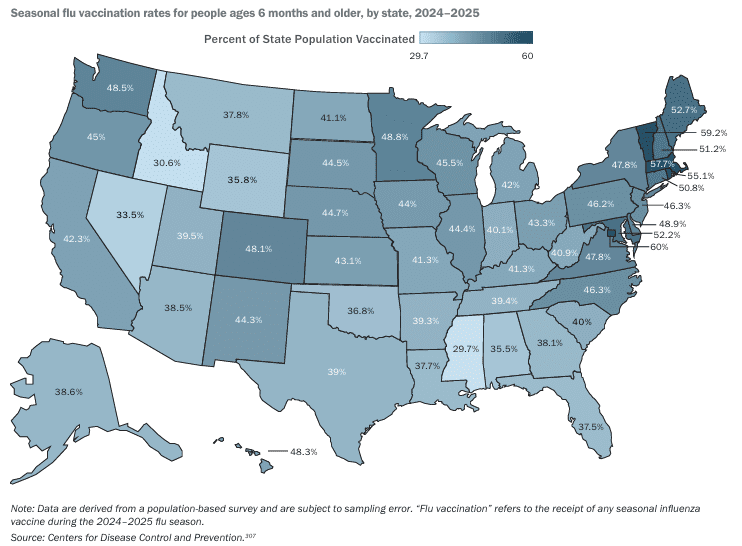
Edney agrees the vaccination rate for flu and pneumonia is lower than he would like it to be in Mississippi, especially for the young, elderly, and those residents with pre-existing conditions.
This most recent flu season provisional data shows that there was one pediatric flu related death, and last year the Mississippi Department of Health recorded 110 flu-related deaths across all age groups. Nationwide, between 20,000 and 35,000 people across all age groups die from the flu, Edney estimated.
Measles
In the Trust for America’s Health report, concern was noted over the possibility of increased measles cases due to lower vaccination rates in some states. While flu vaccinations are not a strong suit in Mississippi, Edney took pride in the state’s current important childhood vaccination rate.
“That’s one of our great victories historically, that the state law has school-age vaccine requirements,” Edney said. “It eliminated measles in Mississippi. The last endemic case, meaning a case of measles from someone in Mississippi who got it in Mississippi, was 1992.”
He added that there was a case of someone with measles traveling through Mississippi in 2002 but that it did not result in an outbreak due to the state’s vaccination rate.
“It just was one case, isolated. Our community immunity around that individual held and we had no other cases,” Edney said.
Measles is a highly contagious virus that can spread rapidly in populations with low vaccination rates, typically in those less than 95%. While Mississippi has an average vaccination rate of 97.5%, there are some counties where religious exemptions allowed under state law are resulting in a drop in rates.
“I think we have five or six counties that have fallen below the 95% rate. If the childhood vaccination rate drops below 95%, then the risk of endemic measles cases starts to go up significantly and the lower it gets the higher that risk gets,” Edney explained.
The State Health Officer said the lowest vaccination rate in the state can be found in George County at 91.8%, with Pontotoc and Lincoln counties at 93%. The highest childhood vaccination rates can be found in the counties in the Delta.
“So, that’s a win for the Delta,” Edney said.

In response, the Mississippi Department of Health is reaching out to school superintendents in the affected counties to ensure they have a plan in place to help address the issue.
“They’ve never had to worry about this, but now they need to have action plans for if a measles outbreak should occur,” Edney said. “We just can’t afford what happened in Texas and South Carolina to ever happen here.”
Edney continues to champion the importance of vaccinating children before entering school.
“The only way to keep these things away is through vaccinating our children,” he added. “It’s proven to be our safest, best option for protecting our children from these very dangerous diseases.”
Hantavirus and Ebola
Other concerns listed in the report focus on the Andes Virus, a strain of Hantavirus. Cases of the virus were recently reported on a cruise ship, resulting in 18 American passengers being observed for 45 days at the Nebraska Quarantine Unit, the Centers for Disease Control and Prevention stated. None of the individuals are currently showing symptoms.
The other concern reported is the possibility of an Ebola outbreak in the United States. Edney believes the more pressing concern is the possibility of Ebola entering the country.
“Ebola could be a very big deal if we ever allowed an infected patient to get past our safety measures and get into a home community,” Edney said.
That is why the CDC works in countries where it is prevalent in order to help keep it from spreading, utilizing intense screening and observation for those traveling abroad.
“Ebola is highly transmissible and has a high mortality rate so we can’t play with Ebola and we’re not. The CDC’s taking it very seriously,” Edney said.
Healthcare Workers
Mississippi’s shortage of healthcare workers is yet another area of concern listed in the report.
“We have huge needs in our paramedic workforce. We’re only at about 50% the number of paramedics and EMTs that we need,” Edney said. “Our nursing workforce has been improving. It’s still lower than it needs to be, but it’s been improving.”
One of the ways the State of Mississippi is working to address the shortage is through the Rural Health Transformation Program. Edney is excited about the plans outlined by Governor Tate Reeves (R) to use those grant funds to address current shortages. Additionally, some hospitals have been reopening previously closed units.
“I know we’ve seen that in the Jackson market, which is very, very promising and I’m really optimistic with the investments that are coming from the Rural Health Transformation Grant that really will help healthcare workforce in the rural areas,” Edney said.

Federal Funding Cuts
The One Big Beautiful Bill, signed into law in the summer of 2025, included some cuts to federal funding for healthcare. Edney said some states are being affected by those cuts more than others but with Mississippi not expanding Medicaid he believes the effects to the Magnolia State will be less severe.
“It did cut us some, but not as severely as some of the expansion states,” he added.
During this year’s legislative session, a bill was passed and signed into law by the governor to increase Medicaid funding by 16%. Those increases in state funding were needed more so to cover the rising cost of healthcare, rather than due to the federal cuts, Edney described. However, he still has concerns on how the federal cuts to subsidies will affect the healthcare system due to a predicted reduction in those with health insurance.
“Those subsidies have gone way down and we’re seeing the enrollment rate in those products start to go way down,” Edney said. “It’s a big concern, especially for the hospitals because their uninsured rate will be going up.”
He said the Department of Health is monitoring the level of federal grant funding that covers a number of affected programs in Mississippi.
“Right now, 65% to 70% of the state’s Department of Health funding comes from our federal grants. But right now, we’re stable and stable is okay,” Edney said.