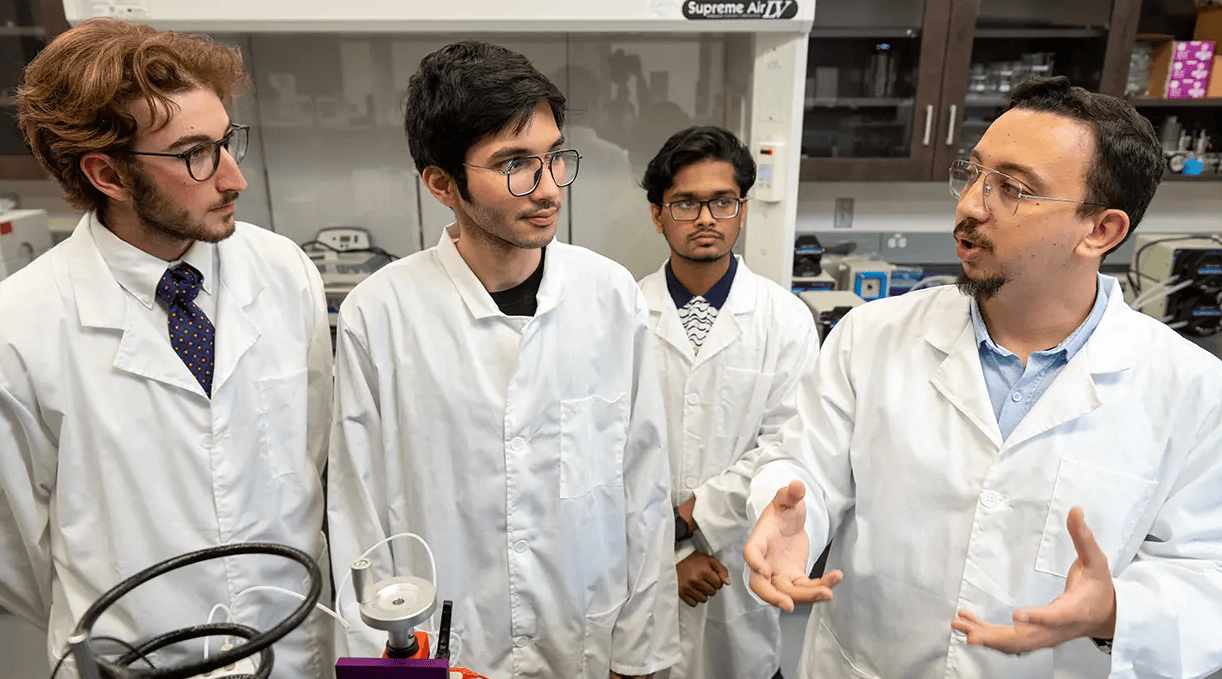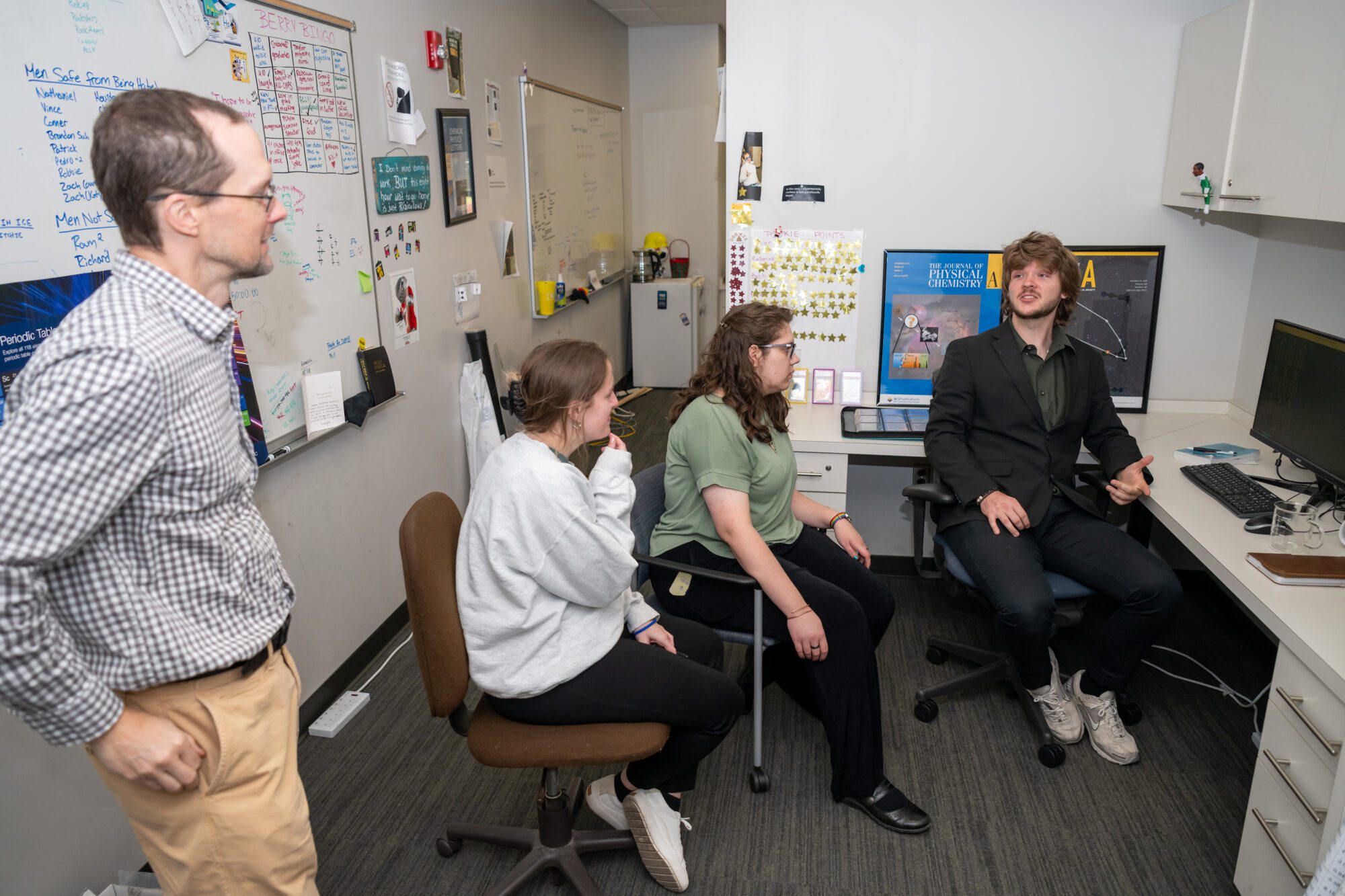
Ryan Fortenberry (left), associate professor of chemistry and biochemistry at the University of Mississippi, speaks with students in his astrochemistry lab. NASA has awarded Fortenberry two grants to study how space dust forms and to explore how to break extraterrestrial rocks down to produce water. (Photo by Srijita Chattopadhyay/Ole Miss Digital Imaging Services)
- Astrochemist Ryan Fortenberry will study planet seeds and spectral fingerprints through new grants.
A University of Mississippi researcher will study the earliest stages of planet formation and the chemical abundance of the universe through two new NASA Astrophysics Research and Analysis grants.
Ryan Fortenberry, associate professor of chemistry and biochemistry, said receiving two grants from the same program in the same cycle is rare.
“This never happens,” he said. “These are two very different projects, but we approach them in very similar ways. The odds of them both getting funded at the same time are astronomical.”
One grant allows Fortenberry to study a building block of all planets, rocks and moons: dust. Most rocky space bodies start their lives as collections of dust that slowly combine over billions of years to form planetary bodies. The origins of that dust, however, are more nebulous.
Fortenberry’s research will explore a pathway for dust formation that begins with simple molecules containing metals reacting with water. When water and gas-phase metals interact, the reaction leaves behind a small, stable cluster that is solid.
These clusters may act as the earliest “seeds” that later grow into full dust grains, rocks, moons and planets.
“But the thing that I’m really excited about is the reverse,” he said. “It’s the same physics. It’s the same stuff, and it’s also pertinent to NASA, but for completely different reasons, and that’s making water out of rocks. It’s the same physics; it’s just in the reverse direction.”
Unlocking the formula to turn rocks into water could revolutionize how we think about space travel, he said.
“The benefit of turning rocks into water is that if you have a source of hydrogen, you have as much water available to you as you have hydrogen,” he said. “Hydrogen is light. You can transport it much more easily than anything else.
“Now we can have, effectively, a source of water wherever we need to go, whether that’s desert regions of the Earth or Mars. Any place where you have rocks, this process will hold because the fundamental chemistry is the same.”
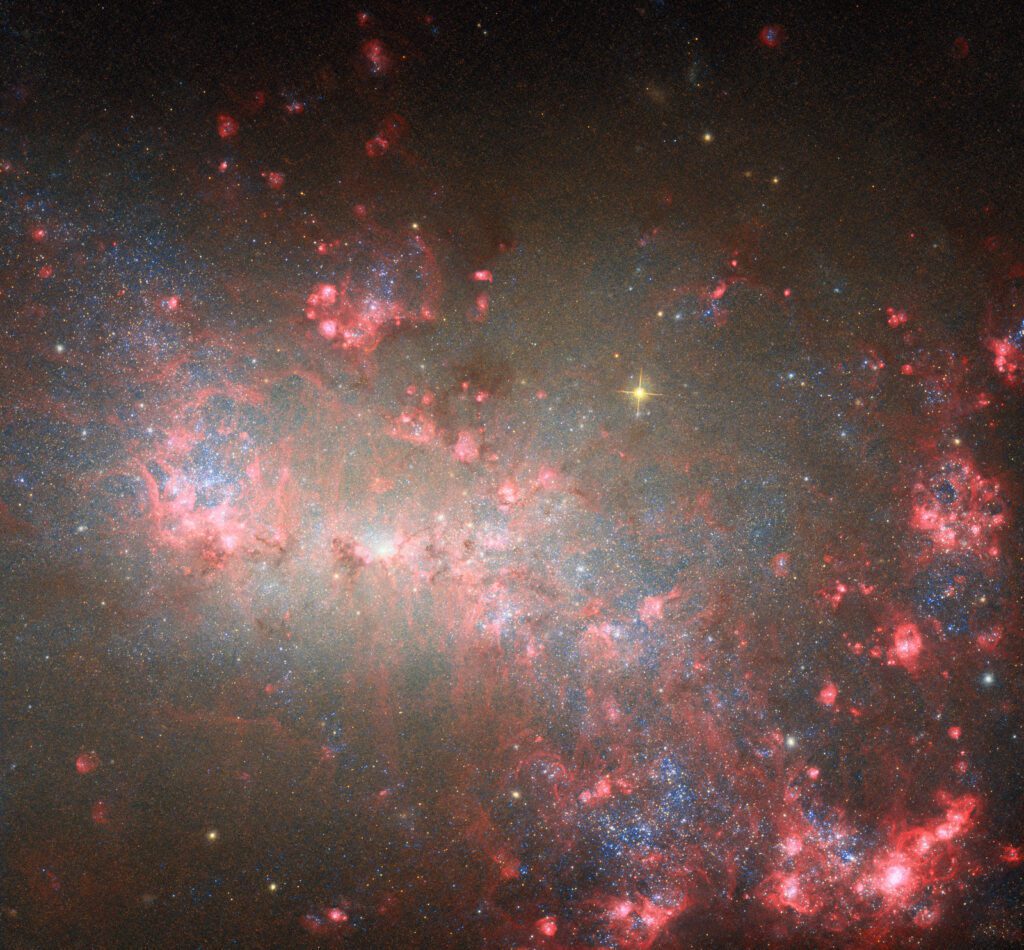
Through the second grant, Fortenberry and Vincent J. Esposito, assistant professor of chemistry at Chapman University, plan to develop advanced molecular models to interpret data from the James Webb Space Telescope about polycyclic aromatic hydrocarbons, complex formations of carbon that appear across the universe and on Earth.
These molecules behave like spectral fingerprints because of how they interact with light and are thought to be common in space, especially in areas where planets or stars are forming. Definitive evidence of their makeup has been difficult to obtain because earlier telescopes did not have the resolution to distinguish subtle molecular features.
“When you synthesize PAHs in the laboratory and you put them out on something, they absorb all wavelengths of light,” Fortenberry said. “They’re black – they’re the reason tar is black – and they’re sticky. So, because they absorb everything and because they stick together, it’s really hard in the laboratory to figure out what their individual spectra are.
“We know what they look like in a group, but we don’t know what they look like individually. It’s like we know what the forest looks like, but we can’t see the individual trees.”
But with the James Webb Space Telescope’s improved resolution, astronomers can detect finer molecular details than before. Fortenberry and Esposito’s project aims to generate the quantum chemical data needed to identify those molecules and distinguish between different kinds of polycyclic aromatic hydrocarbons.
“This gives us information about the chemical abundance of the universe,” Fortenberry said. “If we understand how much carbon is actually out there, we know how much is available for life. We know what materials could form in space.
“More broadly, when we take chemicals – PAHs or anything else – and put them into an extreme environment like space, we have to ask new questions because they don’t behave the same ways we would expect. So, we ask new questions, we develop new science and we gain new insight.”
This material is based on work supported by NASA grant nos. 80NSSC24M0036 and 80NSSC24M0132.
This article is republished courtesy of Ole Miss.