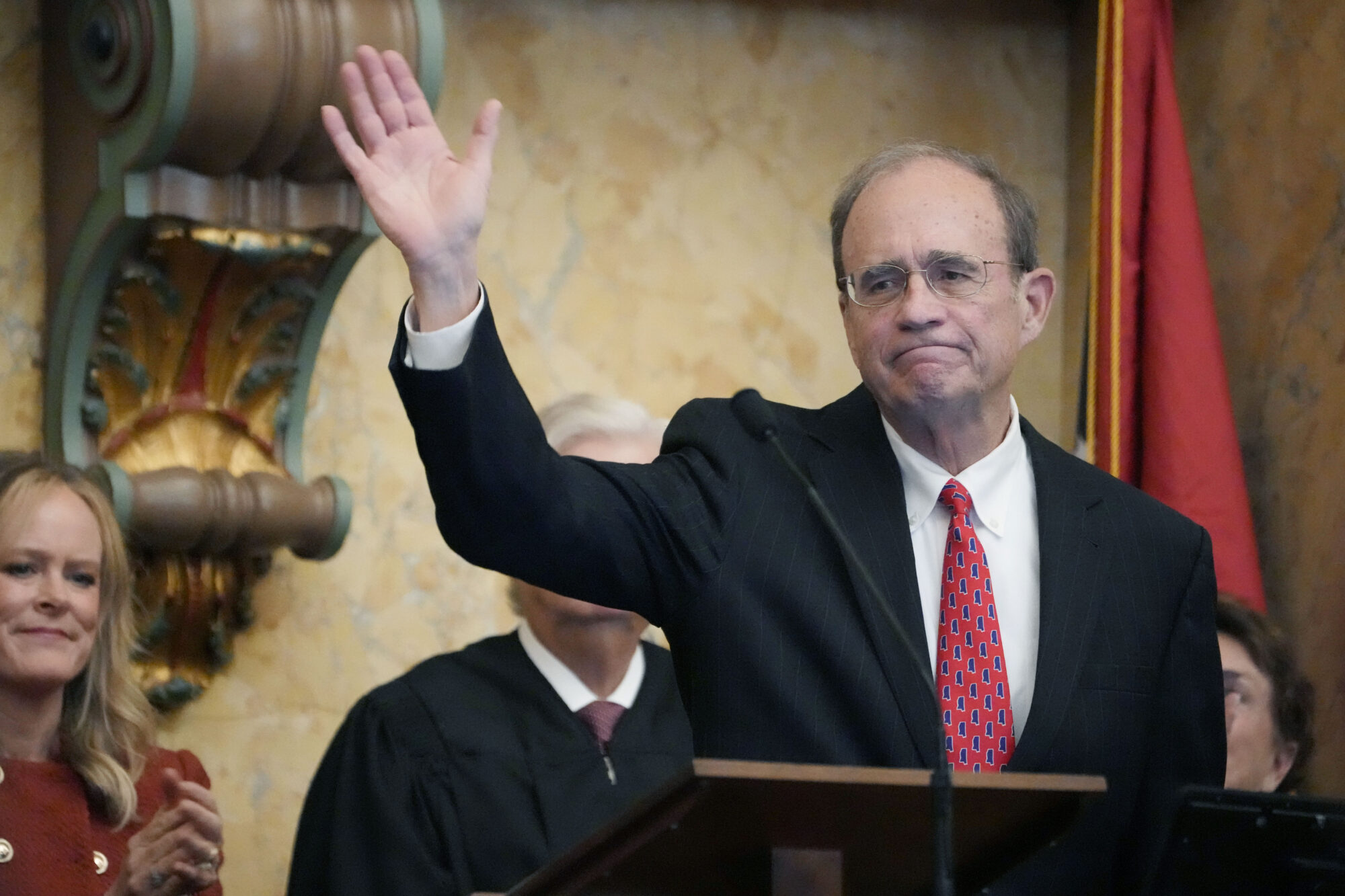
Mississippi Lt. Gov. Delbert Hosemann waves to lawmakers in the joint session of the Mississippi Legislature after delivering his speech, moments after reciting the oath of office for his second term, Thursday, Jan. 4, 2024, in the Mississippi House Chamber at the Mississippi State Capitol, in Jackson, Miss. (AP Photo/Rogelio V. Solis)
- The House took action on two vetoes Wednesday, but efforts fell apart in the Senate, leaving many at the Capitol visibly frustrated and confounded over the day’s events.
The recent vetoes issued by Governor Tate Reeves (R) will stand after lawmakers could not reach consensus on attempts to override the governor’s vetoes.
Efforts to override a governor’s veto typically begin in the chamber in which the legislation originated, as was seen on Wednesday.
House lawmakers sent their vetoed bills back to committee to consider overrides. When they returned to the floor, the Republican-majority chamber voted to override two vetoes, one for the establishment of the Gulf Coast Restoration Revolving Loan Program under HB 1648 and the other for portions of HB 1924 related to certain opioid settlement spending.
READ MORE: Governor vetoes Coast revolving loan fund, partially vetoes local projects spending bills
The House also voted to suspend the rules to consider extending repealers on several youth court statutes under HB 938 that died prior to lawmakers heading home on April 3.
All three measures were then sent to the Senate.
Yet, when the measures made their way across the Capitol, the Senate could not muster the votes necessary to act on the House overrides or on their own bills Reeves had vetoed.
The governor’s veto of HB 1924 was upheld in the Senate after only 19 Senators voted to override his veto, well short of the necessary two-thirds vote needed. The effort to revive the youth court repealer extension language only drew 33 votes in support. In addition, the Senate did not even take up the override for the opioid settlement veto for HB 1924.
As for the governor’s veto of SB 2477, which he fiercely argued would have risked the state losing upwards of $1 billion in federal funding for rural healthcare, the Senate did not bring the bill up for an override attempt, leaving Democrats unwilling to back other efforts from their colleagues in the Republican-majority chamber.
SB 2477, authored by State Senator Hob Bryan (D), sought to require a competitive bidding process for the establishment of a state health information exchange, restricting the use of the state’s emergency purchase procedure. It would have also required every agency that awards grants or funds derived from the Rural Health Transformation Program to submit quarterly spending reports to the Legislature.
Governor Reeves took to social media late Tuesday to make his case once again as to why he views the legislation as “a bad idea.”
READ MORE: Governor urges lawmakers not to risk $1 billion in federal funding by overriding his veto
“Why are Democrat Senator Hob Bryan, the LG, and some other state legislators determined to shoot Mississippi in the foot?” Reeves wrote on Facebook. “Because they’d rather stick it to the Republican governor and to President Trump than acknowledge they are jeopardizing over $1 billion to improve healthcare in rural communities across our state.”
Two other Senate bills that were partially vetoed but were not taken up by the chamber were SB 2189 and SB 3071. SB 2189 provided nearly $253 million in funding for local improvement projects. Governor Reeves had vetoed seven line items in the bill on over $4 million in projects he did not support. As for SB 3071, the governor’s took exception with two projects and line item vetoed $1.65 million in appropriations in that measure.
When the dust cleared late Wednesday night, lawmakers in both parties were visibly frustrated and confounded after what transpired, or rather did not, in the Senate, with some quietly laying the blame at the feet of Lt. Governor Delbert Hosemann (R) as whispered conversations stirred around the Capitol. Hosemann did not comment on the day’s events.

Speaker Jason White (R) expressed his bewilderment over the Senate’s disjointed work during the day but was not surprised. Overriding a governor’s veto is never an easy effort, and the threshold needed to sustain the veto is far less in the Senate.
Before the House adjourned sine die, officially closing out the 2026 session, Speaker White entertained “adjourn in memory” speeches from members. One member spoke up and suggested the House adjourn in memory of the Senate.
“Somebody said adjourn in memory of the Senate,” White said from the dais to laughter in the chamber. “I don’t know about that. We better not do that.”

Frank Corder