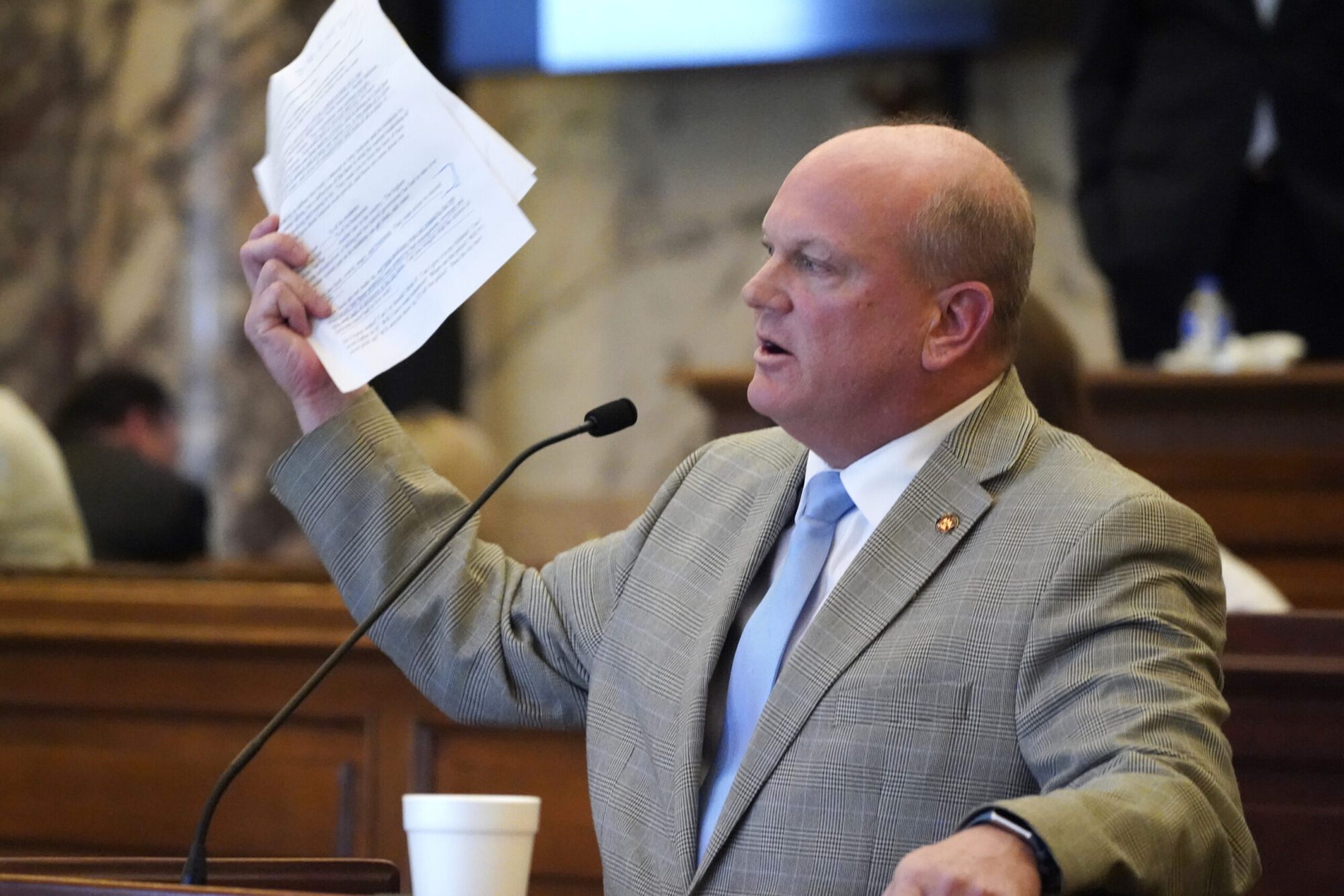
Senate Judiciary A Committee Chairman Brice Wiggins, R-Pascagoula, waves a letter asking for help to combat crime in Jackson, Miss., during his call for support for the controversial Jackson Capitol Complex Improvement District bill, Thursday, March 30, 2023, at the Capitol in Jackson, Miss. (AP Photo/Rogelio V. Solis - Copyright 2023 The Associated Press. All rights reserved.)
- With the Senate saying the bill’s demise is “neither conservative nor good government,” the House contends that that Senate continues to believe “a one-size-fits-all approach” for local governments is the answer.
A legislative measure to reform the state’s juvenile justice court system died Wednesday after the Senate voted to continue working on the bill, unaware that the House had adjourned for the day.
What followed on Thursday was a question of who was to blame for the legislation dying at the deadline on an issue the Mississippi legislature has been working on for years.
With the Senate saying the reform bill’s demise is “neither conservative nor good government,” House leadership contended that that Senate continues to believe “a one-size-fits-all approach” for local governments is the answer.
On Wednesday, State Senator Brice Wiggins (R), chairman of the Senate Judiciary A Committee, said attorneys for both chambers agreed the bill is dead after the House adjourned around 4 p.m. Wednesday
“I feel bad for the children. I feel bad for the people who put the work into this legislation,” Wiggins said. “It’s a shame.”
The senator praised his House counterpart, State Rep. Jansen Owen (R) and the House Judiciary Committee for its work on the matter.

The next day, Speaker Jason White (R) told Magnolia Tribune that SB 2728 “lacked widespread support in its current form,” saying the bill died “because most judges and local county governments opposed it.”
“Almost all involved agree we must move toward a more uniform state-wide system with transparency and reporting,” White said, adding, “The Senate and the Lt. Governor continue to want to force a one-size-fits-all approach on local governments, which has not been well received.”
Senator Wiggins said there was some opposition to the bill, but he received text messages and letters of support from judicial officials, advocates for children, and juvenile justice reformers. Many of those letters of support he shared with Magnolia Tribune.
In a statement, Wiggins said his floor statements on Wednesday “accurately reflect what happened.”
“The House’s statement 12 hours later and after the pressure had set in is an attempt to cover up the Speaker’s mistake of adjournment,” Wiggins said. He went on to say that Speaker White threw the House Chairman and Judiciary Committee leadership “under the bus.”
The House, Wiggins said, “chose to keep children in a system costing millions that produces terrible outcomes. That is neither conservative nor good government.”
“The shame is the status quo won again, and our children continue to suffer,” the senator concluded.
The Mississippi Chancery Youth Court Act of 2026 sought to address issues the state has confirmed as troublesome. It would have created three pilot chancery youth courts starting January 1, 2028, in the 10th, 15th, and 19th districts. Among other provisions, the legislation would have allowed for the petitioning of youth court special masters approved by the Chief Justice of the state’s Supreme Court. It also called for the elimination of referees starting January 1, 2028.
Additionally, outlined in the measure was who was entitled to youth court proceedings. It sought to create a diversion program to be administered by the Department of Human Services Youth Services department.
Wiggins said the Senate will see the bill again in January 2027.

Daniel Tyson