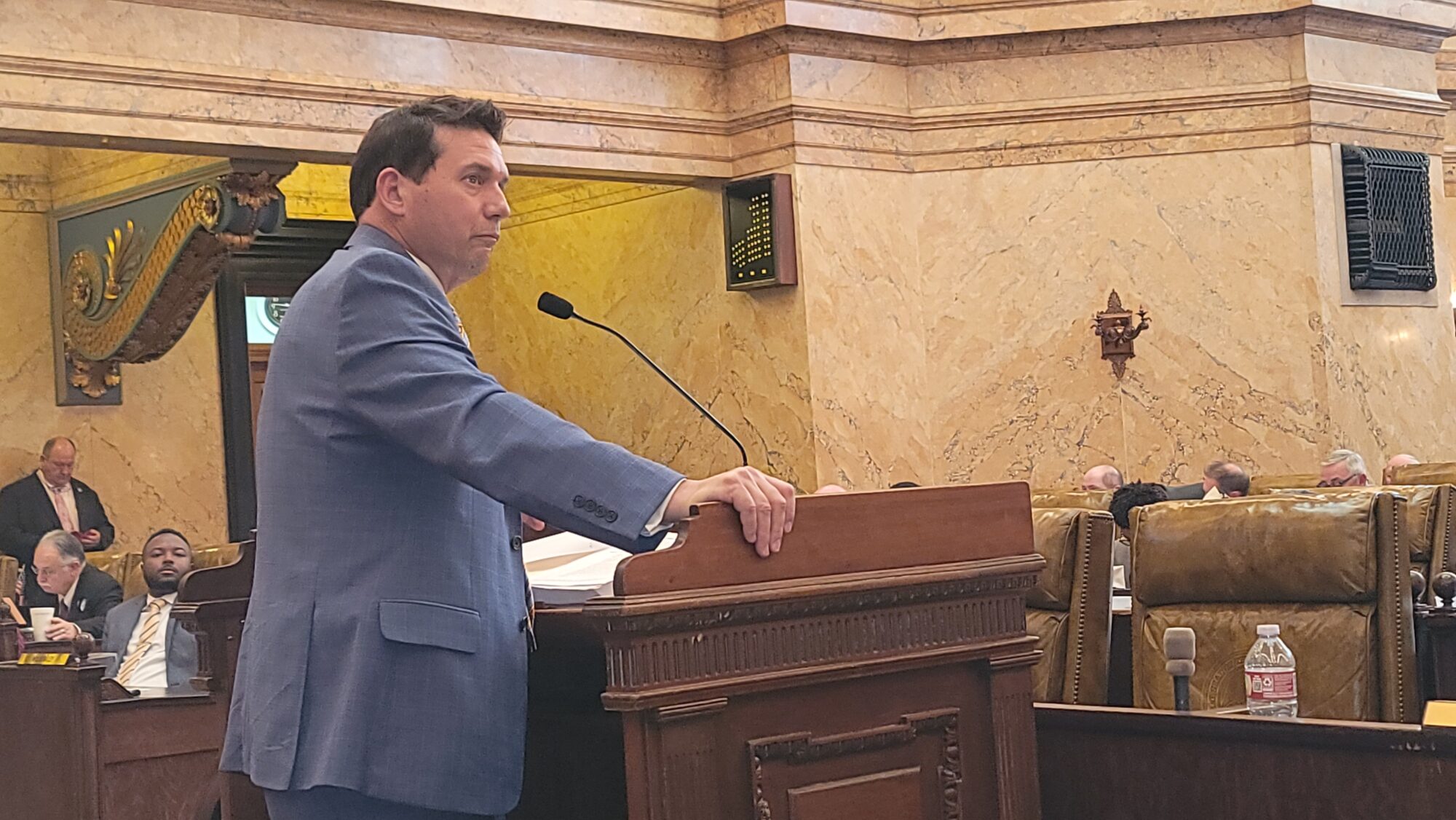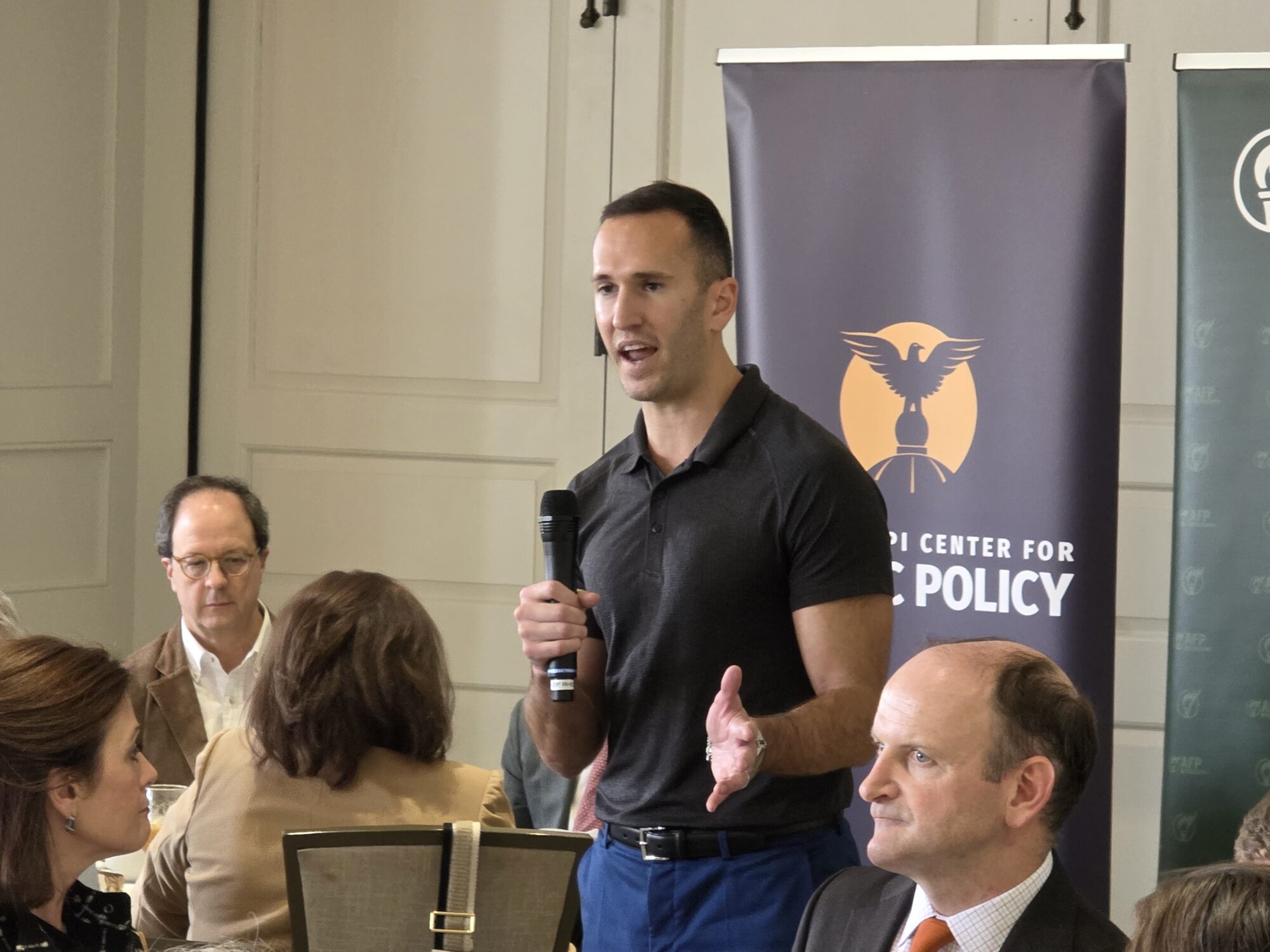
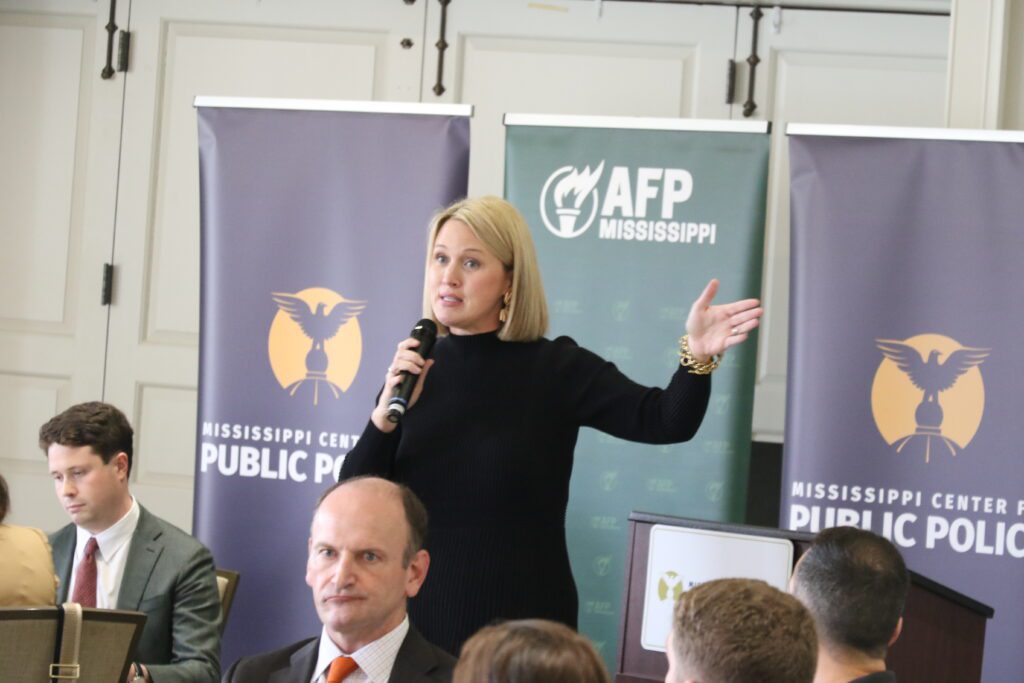
National school choice advocate Corey DeAngelis speaks to a crowd at a luncheon held by the Mississippi Center for Public Policy about the need for universal school choice and for Mississippi's governor to hold a special session to force the Senate to discuss the issue. (Photo by Jeremy Pittari | Magnolia Tribune)
- National school choice advocate Corey DeAngelis urged Governor Tate Reeves to call a special session to handle the issue after the Senate killed the House bill.
Even though HB 2 died in the Senate Education Committee last week, supporters of education freedom are not giving up on their push to allow parents to find the best options for their child.
READ MORE: Mississippi Democrats celebrate Republican senators’ decision to kill Trump-backed school choice plan
On Tuesday, the Mississippi Center for Public Policy hosted a luncheon with the focus squarely on how access to more education choices helps families. One speaker even called on Governor Tate Reeves (R) to take a cue from another state and bring the issue to lawmakers in a special session.
Access to school choice, or the lack thereof within Mississippi, forced one mother to take matters into her own hands. Dyslexia is a well-known learning disability that can be easily overcome if the child gets the right help. Leah Ferretti, Director of Mississippi Ready, described how when her son was diagnosed with dyslexia the A-rated public school he attended was unable to help him.
“We took that diagnosis to our principal and I thought, ‘Hey, I just take it and turn it in and they’re going to serve my baby,'” Ferretti explained.
What she found was much different.
“A special education teacher had not ever darkened the doors of that school since its commencement,” Ferretti added.
At first, she and her husband considered moving to another district which offered a dyslexia program to help their son. Ultimately, the family decided to take matters into their own hands, sending Ferretti back to college to get a degree she could use to help their young child.
“So, I didn’t have a choice but to go back to school to be able to help my child because we were in an area of the state that didn’t have a dyslexia therapist in the entire region,” Ferretti said.
Since 2020, 17 states have passed universal school choice bills, national school choice advocate Corey DeAngelis told the attendees at the luncheon. While Mississippi’s bill to create a similar program has been rejected by the Senate this session, he said the fight continues.
“In the past five years alone we’ve had more advancement on the issue than in the preceeding five decades, DeAngelis said, adding that “conservative parents woke up” when they saw curriculums were not aligned with their values during the COVID pandemic.
School choice programs are gaining momentum across the nation, he said, such as in Arizona, Florida and Texas. Today, hundreds of thousands of children are benefitting from school choice scholarships in these states.
DeAngelis said it makes sense to send the tax dollars allocated to a student with that student to the school that serves them best. He pointed to Pell Grants, which provide tax dollars that college students can use to attend any institution of their choice.
“Do you have to take Pell Grants to a government-run college? No, you can take it to a religious university if you want. The decision is for the student to make, and the funding follows that decision that the student makes,” he said.
Opponents of expanded school choice fear public schools will close as a result, but DeAngelis contends that not one single school has closed as a result of the passage of school choice bills.
“The status quo is their main argument, that it’s going to hurt the public school system. Okay, if you’re going to fearmonger about these things, point to where it’s happened. It never has happened,” DeAngelis said. “And we have 30 states now that have some form of school choice.”
Another point DeAngelis made was that state dollars follow the student, while the local dollars associated with that student remain with the public school. He said that means when a student leaves a public school, that school essentially receives more money to teach fewer students.
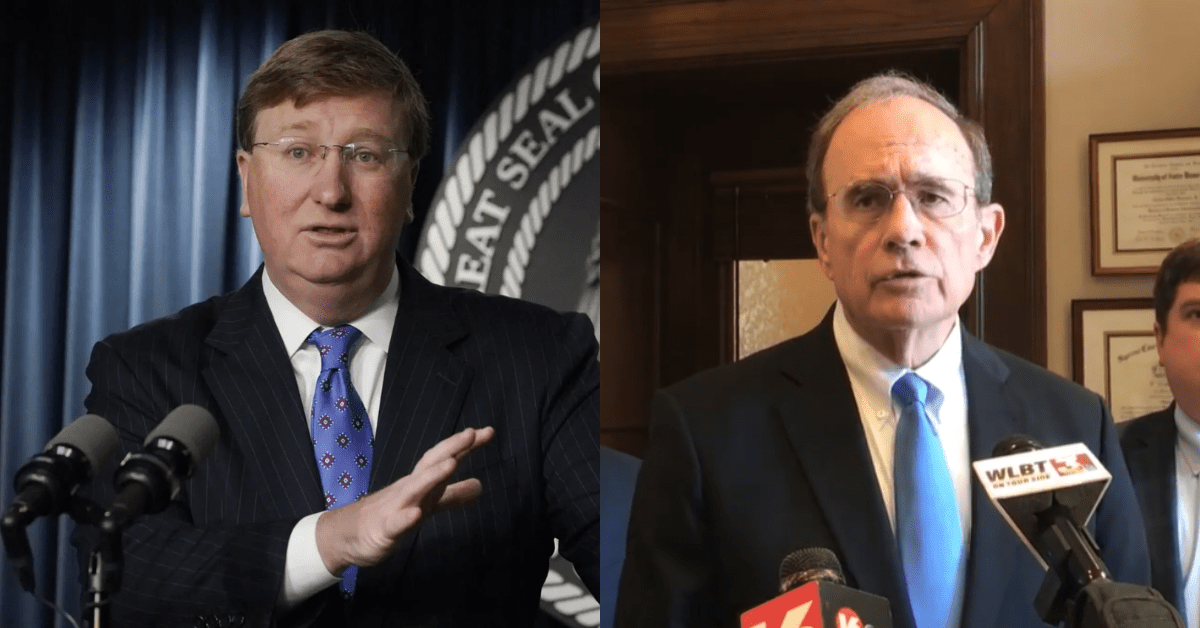
With the death of HB 2, DeAngelis suggested that Mississippi’s governor follow suit with Texas Governor Greg Abbott’s comments during his State of the State Address.
“He looked straight into the camera and said, ‘I don’t care how many special sessions it takes. I’m going to keep calling people back. Special session, after special session, after special session,” DeAngelis described of Abbott’s remarks.
DeAngelis said he planned to meet with Governor Reeves later that same day, and one of the things he planned to propose was that very plan of action.
“The session isn’t over yet,” he added. “Tate Reeves can call specials, even within sessions.”
DeAngelis said holding a special session would force the Senate to discuss the matter, especially since the leader of the Senate seems to support school choice in action, but not in policy.
“I mean, Senate leadership supports school choice. [Lt. Governor] Delbert Hosemann sent his own kids to private school and I’m not blaming him for that. Everybody should seek out the best education for their kids,” DeAngelis said. “But he shouldn’t pull up the ladder from behind himself and tell other families that they can’t have the same kind of opportunities that he can.”