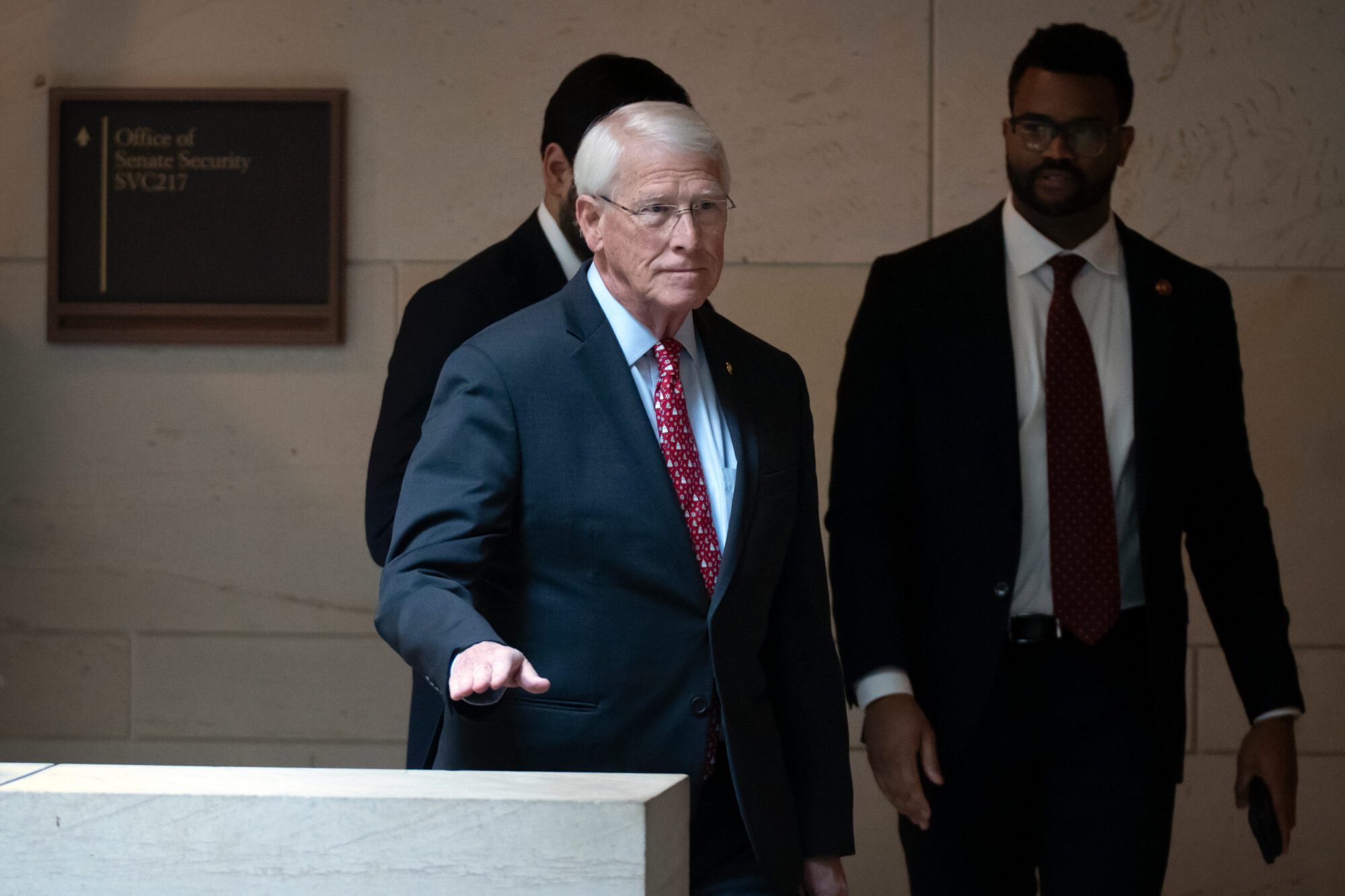
Senate Armed Services Committee chairman Sen. Roger Wicker, R-Miss., leaves after a meeting with U.S. Navy Adm. Frank M. Bradley on Capitol Hill, Thursday, Dec. 4, 2025, in Washington. (AP Photo/Mark Schiefelbein)
- See what’s in the National Defense Authorization Act and how the defense spending will impact the Magnolia State.
Mississippi’s U.S. Senators voted in favor of the FY2026 National Defense Authorization Act (NDAA) on Wednesday, sending the $901 billion in defense spending bill to President Donald Trump’s desk.
The NDAA, which passed by a 77-20 vote, provides a 3.8% pay raise for troops and implements policy reforms through appropriations that are vital for defense and national security activities. It also authorizes funding for the nation’s nuclear weapons programs and military construction and family housing projects.
Notably, the legislation officially ends the war in Iraq, repealing the authorization for the 2003 invasion.
Senator Roger Wicker (R), Chairman of the Senate Armed Services Committee, helped shepherd the legislation through the process.
“Not since the era of World War II has our nation faced an axis of aggressors across multiple theaters seeking to dismantle American influence. The bill we now send to the president’s desk is a reflection of that reality and an appropriate response,” Wicker said in a statement after final passage. “In this NDAA, my colleagues and I have prioritized the structural rebuilding of the arsenal of democracy and returning the department to its warfighting mission. Crucially, it also contains the most sweeping upgrades to the Pentagon’s business practices in 60 years—a watershed moment for our military.”
Senator Wicker has frequently raised concerns over the need for the United States to deter aggression from increasingly hostile nations like China, Russia, North Korea, and Iran.
Wicker also noted that the measure sets the U.S. on a path to modernize its defense capabilities and augment drone manufacturing, shipbuilding efforts, and the development of innovative low-cost weapons.
“Thanks to the partnership and bipartisan support from Ranking Member [Jack] Reed, and that of all members who worked to improve this bill, our military will be better prepared to meet the challenges ahead,” Senator Wicker said.
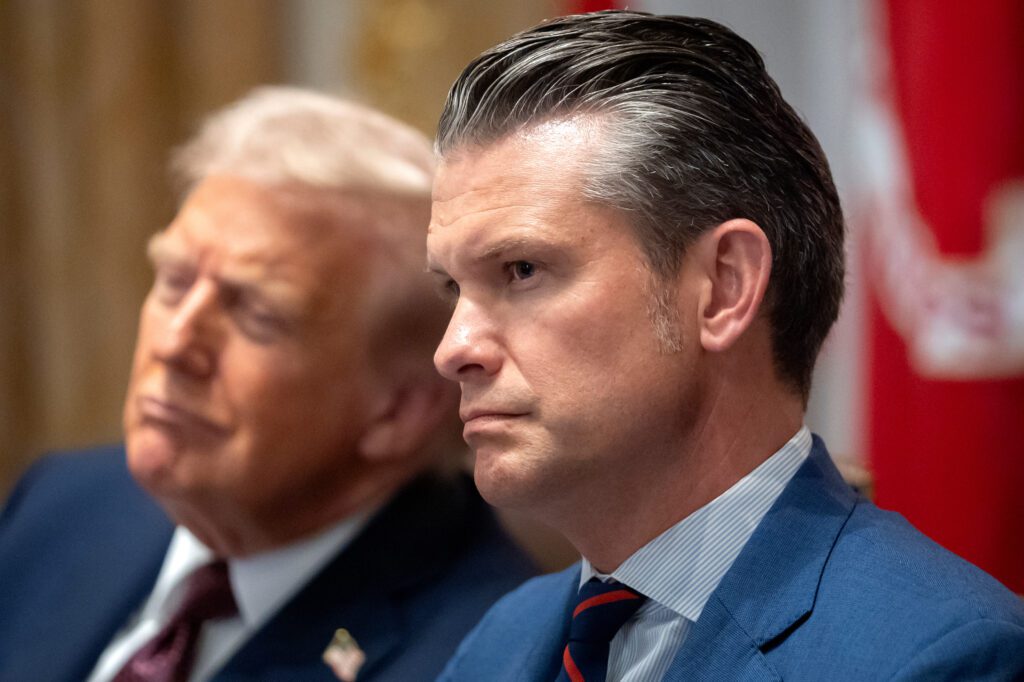
The White House has voiced support for the legislation, despite it including provisions that seek additional information on the ongoing military operation in the Caribbean to combat narco-terrorists as well as require the U.S. to maintain its current military levels in Europe and send additional military assistance to Ukraine. If Secretary of War Pete Hegseth withholds unedited video of the Caribbean boat strikes, his travel budget could be cut by a fourth until it is released to lawmakers on the House and Senate Armed Services Committees.
The NDAA also repeals diversity, equity and inclusion (DEI) offices and associated trainings as well as climate change programs at the Pentagon.
As the compromise legislation includes many of his executive actions and priorities, President Trump (R) is expected to sign the bill into law.
Senator Cindy Hyde-Smith (R), who serves on the Senate Appropriations Committee and its Subcommittee on Military Construction and Veterans Affairs, said the bill sets the stage for President Trump to accelerate his Peace Through Strength national security agenda.
“Our nation has always contended with new threats to our national security, but the scope of those threats escalates with every technological advance and the prospect of our adversaries getting their hands on those technologies,” Hyde-Smith said. “This NDAA bill, aligned with President Trump’s Peace Through Strength agenda, begins to pivot our military to meet these evolving threats.”
In the U.S. House of Representatives, all four Mississippi Congressmen – Trent Kelly (R-MS 01), Bennie Thompson (D-MS-02), Michael Guest (R-MS 03), and Mike Ezell (R-MS 04) – voted in favor of the measure.

How NDAA Impacts Mississippi
Mississippi’s Senators both touted the state’s outstanding contributions to national defense, with Wicker saying that Mississippi’s work is once again recognized in the bill.
In particular, Senator Wicker noted that the NDAA “clearly reflects Mississippi’s status as a multi-domain state—a term which indicates leadership across an array of American military capabilities, including air, sea, land, space, and cyberspace.” He said the NDAA authorizes a total of $528.7 million to support military installations, defense industry sites, and academic research facilities in every corner of Mississippi.
Here is a look at how the NDAA impacts Mississippi, as shared by Senator Wicker’s office:
NDAA Upgrades Mississippi’s Military Infrastructure
The FY26 NDAA:
- Authorizes funding for 5 military construction projects in Mississippi, including:
- $14.2 million for a Water Tank Storage System at Columbus Air Force Base
- $11.6 million for an Army Aviation Support Facility and Readiness Center at Camp Shelby
- $2.2 million for an Army Aviation Support Facility at Meridian Readiness Center
- $19 million for a Base Supply Warehouse at Key Field Air National Guard Base
- $6.7 million for a Corrosion Control Hangar at Key Field Air National Guard Base
- Enables the Department of Defense to use progressive design build contracts for construction projects. This format can align the DOD with commercial construction program management and will reduce risks and costs in complicated projects.
- Creates a pilot program for wastewater surveillance to detect infectious diseases at military installations. Wastewater surveillance for drugs can help installations respond more effectively to issues such as fentanyl use. Testing would be performed at Mississippi State University labs, with university staff conducting work throughout the pilot program.
- Increases funding authorizations by $50 million for the Port Infrastructure Development Program.
NDAA Supports Mississippi’s Cybersecurity Initiatives
The FY26 NDAA:
- Authorizes $10 million to support development of Artificial Intelligence enabled systems for Army multi-domain operations. This allows for the Army to use AI to automate the identification of drone swarms and help soldiers quickly automate a “kill chain” to shoot the drone swarms down.
- Authorizes $6 million to safeguard against the emerging threats posed by cognitive hacking, foreign malign influence, and propaganda. Additionally, there will be a new workforce created that better aligns the fragmented nature of organizations that deal with malign foreign influence campaigns.
NDAA Backs Mississippi’s Development of Cutting-Edge Land-Based Systems
The FY26 NDAA:
- Authorizes $6 million to support research on autonomous testing of military vehicles. The system will create vehicle designs that better withstand extreme conditions, reduce equipment failures in combat situations, and enable accelerated testing without risking personnel. Jackson State University will conduct some of this research.
- Authorizes $3 million to continued development of next generation roadway repair materials for the Army, which will support effective maneuvering of military assets.
NDAA Recognizes Mississippi’s Naval Prowess
The FY26 NDAA:
- Ensures the long-term continuation of the Naval Small Craft Instruction and Technical Training School at the John C. Stennis Space Center.
- Authorizes $5 million for critical sensing capabilities for shallow water, littoral, and riverine environments, particularly near ports, over extended mission durations.
- Authorizes funds for numerous shipbuilding programs, including support for efforts in Pascagoula and Gulfport to construct small boats, submarines, ship-to-shore connectors and berthing barges.
- $320 million to support the procurement two additional Ship to Shore Connectors. The program delivers the capability to move assault forces rapidly within the littoral operational environment to accomplish Unified Command Plan (UCP) missions. This ensures the Joint Force Commander’s ability to conduct amphibious operations and operate over the high-water mark, including movement over ice, mud, rivers, swamps, and marshes.
- $7 million to support the procurement of combatant craft assault boats for Naval Special Warfare.
- $10 million to support manufacturing of composite shaft fabrication in support of the Navy’s Next-Generation Attack Submarine SSN(X) program.
- $78 million to procure additional auxiliary personnel lighter (APL) vessels for the Navy. The program replaces outdated and dilapidated transport ships and will greatly improve sailors’ quality of life.
- Authorizes $5 million to support the development of advanced manufacturing systems for the Navy. This will support major defense and space manufacturing at the John C. Stennis Space Center.
- Establishes formal programs for uncrewed maritime systems. Additionally, it supports the National Oceanic and Atmospheric Administration’s uncrewed maritime systems operating in Gulfport by establishing formal programs for those systems.
NDAA Taps Into Mississippi’s Modern Aircraft Manufacturing
The FY26 NDAA:
- Authorizes $3 million for the procurement of ultra-lightweight aerial drones for special operations.
- Authorizes $7 million for the procurement of long-range projectiles, which are produced in Tupelo. Enabling offensive strike capabilities over hundreds of kilometers from artillery weapons provides the ability to strike before the enemy can attack friendly forces.
- Prevents changes to the Initial Enry Rotary Wing Pilot Training program before the Army conducts a validated analysis of its current program. The Army currently uses Mississippi-made helicopters for this training.
- Requires the Coast Guard to conduct a fleet analysis and identify the number of rescue helicopters it needs.
NDAA Prioritizes Military Personnel
The FY26 NDAA:
- Authorizes funding to support a 3.8 percent pay raise for military members
- Authorizes $168.8 million to fully restore the JROTC funding authorizations, which supports over 80 programs in Mississippi.
- Adds $15 million to continue the critical flagship language program at the University of Mississippi.
- Strengthens requirements the DOD must meet before modifying scope to military treatment facilities. This will ensure that the Keesler Medical Center can continue to serve more than 27,000 people including military retirees, families, and over 7,000 active-duty members.