
- Charter schools are intended to offer a different way to do public education. Comparing them to schools that follow a more traditional path is difficult. When digging below the surface of a single letter grade, charter schools are providing value to students and parents who choose them.
In the 2025-26 school year, every charter school in Mississippi except one had a higher percentage of students performing at or above grade level in English language arts (ELA) than the local district-run schools that serve the same grade levels as the charter. Most of them outperformed the district schools at every grade level. ELA includes reading, writing, and other language skills.
This reality is masked by a hyper-focus on the letter grade assigned to Mississippi’s public schools, including charter schools, in the recent report from the Mississippi Department of Education (MDE) on the state’s accountability model.
Critics of charter schools are using letter grades to say charter schools are not working. There’s no question charter schools need to improve, but let’s start by looking at the schools their students would have to attend if charters weren’t available to them.
The most striking contrast is in the city of Jackson, where one charter middle school is graded C and three are graded D. That doesn’t look good.
However, four of the seven middle schools run by the Jackson Public School district (JPS) are graded F.
One of the remaining three is a D, and the other two, Bailey APAC and Northwest Middle School, only admit students who are already high-achieving and have no negative behavior record.
That means middle school students in Jackson who are struggling academically would be forced to attend a D – or more likely an F – school the district assigns them to, based on where they live, if they didn’t have a charter school available to them.
Every district-run middle school in Jackson except Northwest and Bailey has fewer than 20% of their students who are proficient in reading and in math.
None of the charter middle schools in Jackson have such a low percentage in either subject.
That’s not to say charter schools don’t need to improve. However, it is one indicator that charter schools are doing a better job than most other public schools in their area (reminder: charter schools are public schools but are not run by the district), especially for struggling students.
One problem (of many) with using only the letter grade to compare schools is that it doesn’t show how a charter school’s unique methods of providing an education can benefit individual students in line with their particular needs.
Another problem with using only the letter grade is that the grade applies to the entire school, which can mask how well and/or how poorly the school is doing in different subjects and different grade levels.
A more direct comparison is possible by using grade-level scores on each academic subject on the state tests. Third grade math scores at a charter school can be compared to third grade math scores at district schools, a charter’s fifth grade science scores can be compared to fifth grade science scores at district schools, and so forth.
Even more specifically, results for each grade level and subject are reported by how many students were proficient or advanced, which essentially means performing at or above grade level.
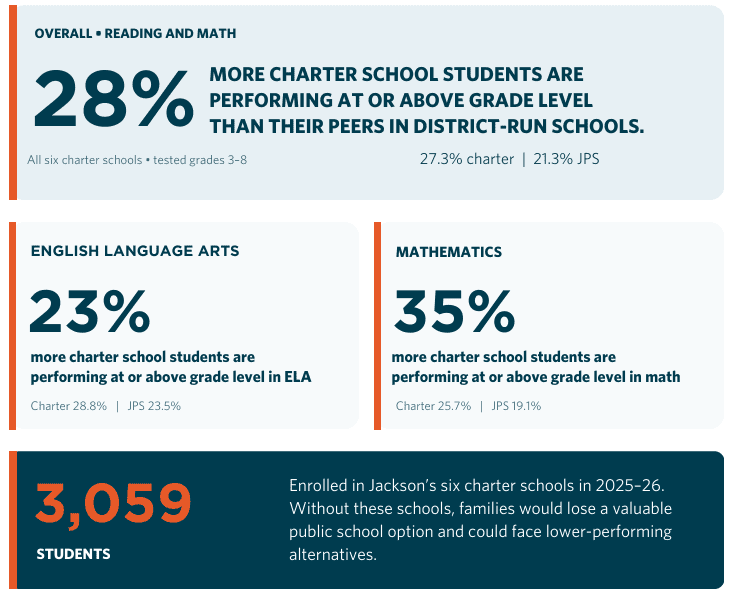
When charter school students are compared to students in the same grade levels in their local district schools, every charter school in the state except one had a higher percentage of proficient students in ELA. For example, a charter school serving grades 4-8 was compared to all students in grades 4-8 in their local district-run schools. This provides a more direct comparison of the achievement levels of children in grades 4-8 than the state accountability scores which lump that school into a comparison with ones that serve grades K-5 or 6-8, for example.
(For purposes of this comparison, we only include public schools that accept all students, just as charter schools do, not schools that restrict admission.)
In math, charter schools underperformed district schools in 3rd through 5th grade but in 6th, 7th, and 8th grade, they compared much more favorably. This could be an indication that the longer students are in a charter school, the better they perform compared to their peers in district-run schools, though no study has been done to confirm that indication.
These are important distinctions that aren’t seen when one letter grade is assigned to an entire school.
One more note on how unwise it is to use the single letter grade in the accountability system, especially for districts as a whole. There are six D-graded district-run schools in A-graded districts, 15 D schools in B districts, and 92 D schools in C districts. There are two F schools in districts graded B; there are 11 F schools in C districts.
That means students in 126 D or F schools are stuck in the school they’ve been assigned to, with no hope of a new charter school opening in their district. That’s because new charter schools are not allowed to open in any A, B, or C district unless the school board approves – which has never happened. Only a change in the state’s charter school law would fix that.
Charter schools generally draw children whose parents are looking for an alternative to the school assigned to them by the district because their children are not doing well at that assigned school. According to charter school leaders, the students who enroll in their schools generally arrive two to three grade levels behind.
Charter schools are intended to offer a different way to do public education. Comparing them to schools that follow a more traditional path is difficult. But as demonstrated above, when digging below the surface of a single letter grade, charter schools are providing value to students and parents who choose them.
We need more of them.
For more, see Beyond the Letter Grade: What Student Proficiency Reveals About Mississippi Charter Schools.

Forest Thigpen