(AP Photo/Stephanie Scarbrough)
- Mississippians will choose between Cindy Hyde-Smith and Scott Colom today. But the stakes extend far beyond the two names on the ballot.
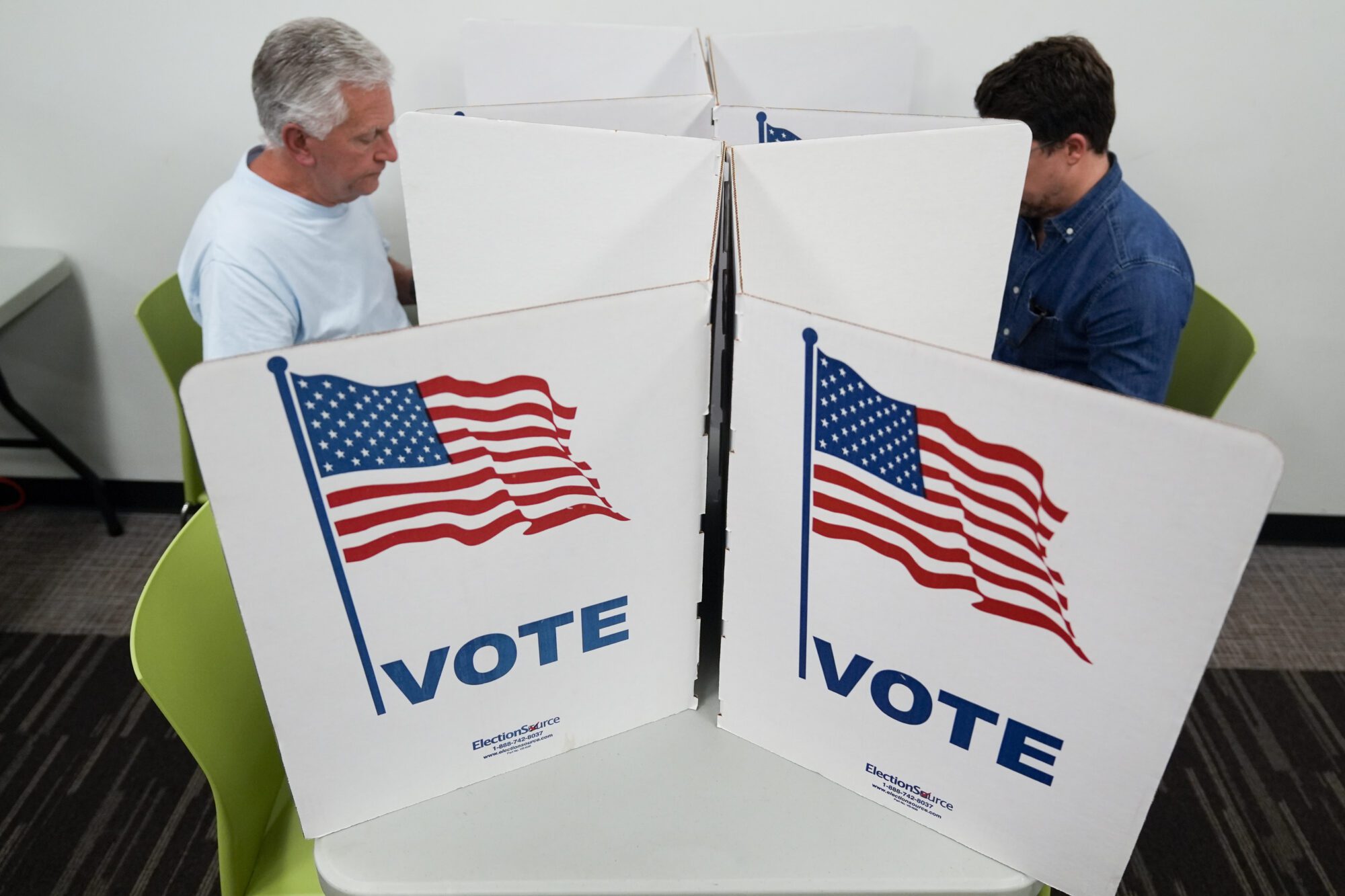
When Mississippians head to the polls today, they’ll ostensibly be choosing between incumbent Republican U.S. Senator Cindy Hyde-Smith and Democratic challenger Scott Colom.
But the choice is much bigger than either candidate.
The reality of modern Washington is that individual members of Congress have relatively little independence from the political parties with which they caucus. Party leadership controls committee assignments, legislative priorities, and much of what ever reaches the floor for a vote. To the extent individual senators can chart their own course, that independence is generally earned through seniority, relationships, and accumulated political capital.
Neither Hyde-Smith nor Colom will be setting the national agenda.
Whichever wins will largely be expected to advance the priorities of the national party they represent.
That means Mississippians are choosing more than a senator. They’re choosing between two competing visions for the future of the country.
The problem is that neither political party seems particularly certain of what that future should look like.
In 1964, Ronald Reagan delivered a speech on behalf of Republican presidential nominee Barry Goldwater that would become known as “A Time for Choosing.” It helped launch Reagan’s political career and articulated a fundamental choice between individual liberty and an increasingly powerful central government.
More than six decades later, Americans again face a time for choosing.
Only now, the choices aren’t nearly as clear.
Two Parties That Have Lost Their Way
The modern Democratic Party has increasingly embraced an ideology that views American society through the lens of competing identity groups, systemic oppression, and historical grievances.
The rise of democratic socialism within the party is real. So, too, is the influence of intellectual traditions traceable to Karl Marx, Antonio Gramsci, and later critical theorists who frame politics as a struggle between those who wield power and those subjected to it.
There is an important distinction between addressing historical injustice and constructing an entire political worldview around permanent divisions between oppressors and oppressed. One is fair introspection, the other is a cynical and dangerous exploitation.
The former is necessary for a just society. The latter risks destroying the very social fabric that binds communities together.
Teaching Americans to see themselves primarily as victims, and their neighbors primarily as oppressors, is not a recipe for national unity or shared prosperity.
It is a recipe for resentment.
It also cuts against the values that have made America exceptional: individual responsibility, equality under the law, opportunity, merit, and the belief that our destinies need not be determined by the circumstances of our birth.
The track record of these ideologies the world over is abysmal and bankrupt.
But Republicans should be careful about congratulating themselves.
It’s increasingly difficult to articulate what the Republican Party stands for, beyond opposition to whatever Democrats happen to be doing.
There was a time when the Republican Party offered a clear philosophical alternative to progressivism.
It stood for constitutional limitations on government, fiscal restraint, free enterprise, individual liberty, and the proposition that government exists to serve the people, not the other way around.
Those principles offered a coherent framework for governing.
Today, the party too often seems consumed with niche cultural controversies that generate enormous emotional responses but do little to address the everyday challenges facing American families.
Worse, an entire political movement has allowed much of its identity to become inseparable from one man.
Donald Trump will not be president forever. A political philosophy worthy of governing the greatest nation on earth ought to be capable of surviving any single political personality.
And whatever happened to fiscal conservatism? Both parties have participated in an explosion of federal debt, seemingly content to leave the bill for our children and grandchildren.
Neither party appears particularly interested in the basic blocking and tackling of responsible government.
Making government work better. Spending within our means. Protecting constitutional freedoms. Creating conditions for economic growth. Solving problems instead of merely assigning blame.
Instead, Americans are treated to a never-ending political spectacle in which outrage substitutes for substance, performance substitutes for accomplishment, and the next viral confrontation matters more than the next generation.
Bread and circuses.
A Record Republicans Have Struggled to Explain
The irony is that Republicans entered this election cycle with a governing record they could have spent considerably more time explaining and defending.
Consider the One Big Beautiful Bill.
For all its imperfections, including legitimate concerns about its impact on federal deficits, the legislation prevented substantial tax increases that otherwise would have hit working Americans across the income spectrum.
Without congressional action, the individual income tax provisions of the 2017 Tax Cuts and Jobs Act would have expired. Marginal tax rates would have increased for millions of taxpayers. The standard deduction claimed by most Americans would have been slashed in half. The child tax credit would have similarly been cut.
These were not tax provisions benefiting millionaires and billionaires.
They directly affected middle-class families, working parents, and ordinary wage earners.
Inflation, while still a real burden on household budgets, has fallen by nearly 2/3rds from its 9.1 percent peak under President Joe Biden. And the administration’s border enforcement policies have produced a significant reduction in unlawful crossings. For the first time in decades, we have a genuinely secure border.
Those are tangible policy developments that deserve serious discussion.
Instead, Republicans have often seemed more comfortable fighting the culture war of the week than explaining how their policies affect the lives of ordinary Americans.
Good government is not a television performance. It is not a social media engagement strategy. It is the often unglamorous work of making difficult decisions, weighing tradeoffs, and accepting responsibility for the results.
We could use a lot more of it.
The Lesson of Rome
Speaking of bread and circuses, I recently returned from a trip to Europe that included several days in Rome.
Standing in the Colosseum, walking through the Roman Forum, and taking in structures built nearly 2,000 years ago, I was struck by the extraordinary achievements of a civilization that once dominated much of the known world.
For centuries, Rome was the center of military, economic, political, and cultural power.
Its citizens built roads, aqueducts, institutions, and monuments that have survived millennia. Its influence on law, government, architecture, and language remains with us today.
And yet, for all its greatness, Rome fell.
I suspect there were plenty of Romans at the height of the empire’s power who could scarcely imagine a world in which Rome was no longer dominant.
They were wrong.
What remains today are magnificent reminders of past glory. Monuments to a civilization that accomplished extraordinary things, but could not sustain its supremacy indefinitely.
There is a lesson in that for Americans.
Our republic is celebrating its 250th birthday. In the grand sweep of history, the American experiment is still remarkably young.
Yet we have grown accustomed to our position in the world. We take for granted our prosperity, our freedom, our military strength, and the institutions that have made those things possible.
We behave as though American greatness is a birthright rather than an inheritance that must be protected, maintained, and passed along.
It is not.
History is littered with great civilizations whose citizens believed their dominance would endure forever.
It never does.
The continued success of the American experiment is not guaranteed by the brilliance of the Founders, the sacrifices of previous generations, or the wealth and power we have accumulated.
It depends on the choices we make now.
It depends on whether we can recover a sense of duty to something larger than ourselves. Whether we can recognize our fellow Americans as neighbors rather than enemies. Whether we can demand more from our leaders than entertainment and partisan gratification.
And whether we are willing to do the difficult, often thankless work of preserving the institutions and principles that made this country exceptional.
Today, Mississippians will make a choice between Cindy Hyde-Smith and Scott Colom. That choice matters. Elections have consequences, and the direction of the United States Senate will help determine the policies that shape our nation’s future.
But the larger choice confronting America cannot be settled in a single election.
It is a choice between grievance and shared purpose. Between political theater and responsible government. Between complacency and duty.
Reagan understood that the preservation of American freedom required more than winning elections. It required Americans who understood what made their country worth preserving.
Sixty-two years later, that challenge remains.
We are living in a time for choosing.
And history offers no guarantee that we will choose wisely.