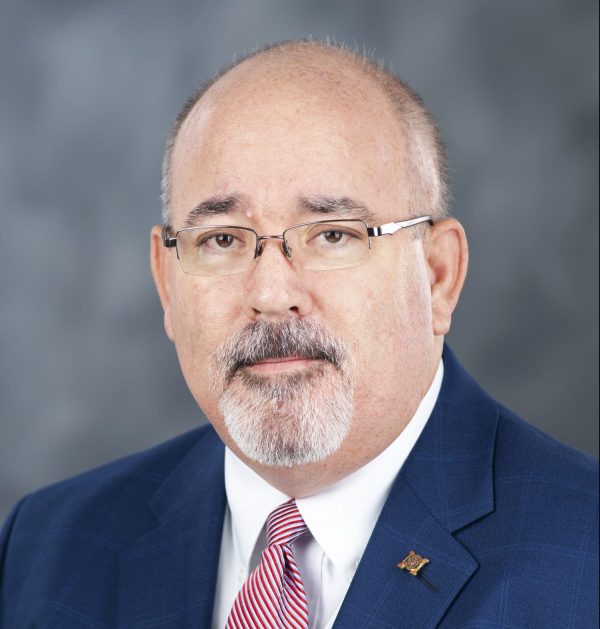
President Donald Trump and Senator Cindy Hyde-Smith (AP Photo/Jacquelyn Martin) - Scott Colom and former President Bill Clinton (Photo from Colom's campaign Facebook page)
- Mississippi hasn’t elected a Democrat to the U.S. Senate since 1982. That’s a long time, and it speaks to the considerable structural advantages Republicans enjoy. But those advantages aren’t self-executing. They depend on actual human beings getting off their couches and casting ballots.
History and conventional wisdom suggest sitting U.S. Senator Cindy Hyde-Smith will dispatch Democratic challenger Scott Colom in Tuesday’s midterm elections.
But look a little deeper, and there are reasons Republicans shouldn’t take anything for granted.
Colom, whose nomination to the federal bench was blocked by Hyde-Smith in 2023, has turned that history into something of a political subplot. Hyde-Smith’s objections included financial support Colom previously received from groups backed by billionaire Democratic donor George Soros. Now, Soros and other national Democratic funders are helping finance Colom’s effort to unseat her.
Colom has run a disciplined campaign focused on affordability, agriculture and the economic anxieties facing Mississippi families. He’s also benefiting from a difficult national environment for Republicans, with frustration over the cost of living, tariffs and the war with Iran creating political headwinds.
And then there are the Democrats’ closing acts.
Former Presidents Barack Obama and Bill Clinton, along with former Vice President Kamala Harris, have all become involved in the race. That’s an awful lot of Democratic star power for a state that conventional wisdom says isn’t competitive.
Obama and Harris can help energize African American voters. Clinton may still have some appeal to the old Yellow Dog Democrats who migrated into the Republican fold over the last few decades.
None of these people would be spending political capital in Mississippi if Democratic strategists didn’t see at least some opening.
But is there really one?
I’ve been telling anyone who will listen for more than a decade that Republican dominance in Mississippi is neither a foregone conclusion nor a forever thing. To a degree, Republicans have developed an unearned confidence, aided by the fact that national Democrats have largely ignored the state.
I understand the chicken-and-egg argument. Democrats haven’t invested because they haven’t been winning. They haven’t been winning, in part, because they haven’t invested.
But Mississippi’s electoral history tells a more complicated story than the state’s reputation as an impenetrable Republican fortress.
Consider Hyde-Smith’s own record.
In 2018, she defeated former Democratic Congressman Mike Espy by just 7.3 percentage points in a special election runoff. Two years later, with Donald Trump on the ballot helping drive Republican turnout, she defeated Espy by 10 points.
Compare those margins with Roger Wicker’s 25.6-point victory in 2024, Thad Cochran’s 22-point victory in 2014, or Trent Lott’s 34.3-point victory in 2000.
The point is simple: Mississippi is a Republican state, but the size of that advantage is not fixed.
And Colom brings some advantages Espy didn’t have.
He’s younger, has less political baggage and has benefited from substantial financial support. His messaging on affordability has been consistent, and his attention to agriculture is smart politics in a state where farmers are feeling the squeeze from tariffs, rising costs and uncertainty surrounding the war with Iran.
Similar economic concerns have made normally reliable Republican Senate seats in agricultural states like Kansas and Iowa the subject of increased national attention.
There is also a meaningful difference between 2020 and 2026.
Trump isn’t on Tuesday’s ballot.
He remains a powerful political figure in Mississippi, regardless of what national approval ratings might suggest. His visit in the closing days of the campaign is an important effort to shore up Republican enthusiasm.
But Republicans cannot simply assume the same voters who turned out for Trump in 2020 and 2024 will show up for Hyde-Smith in a midterm election.
For Colom to pull off an upset, some combination of three things would need to happen.
First, African American turnout would need to approach the levels seen during Barack Obama’s presidential campaigns. Historically, black voters in Mississippi have participated at lower rates than white voters in many elections.
Second, Colom would need to attract a larger share of white voters than Democrats typically receive. Recent Democratic statewide candidates have struggled to break much beyond the mid-to-upper teens among white voters. That’s simply not enough to win without extraordinary turnout elsewhere.
Third, Republican voters would have to stay home in meaningful numbers.
That last variable may be the most underappreciated.
Colom’s campaign has worked to make Hyde-Smith less appealing to voters on her right, while simultaneously trying to persuade voters in the middle that she’s out of touch with their economic concerns.
It’s an interesting two-front strategy. Whether it works is another question.
I remain skeptical that the Democrats’ late surge of money and national attention will produce the electoral changes they’re seeking. Had those resources arrived months earlier, the dynamics of the race might look considerably different.
There’s also the question of what comes next. Colom could emerge from this campaign as a significant contender for the Democratic gubernatorial nomination in 2027, particularly if Brandon Presley chooses not to run.
That race could set up very differently, with a potentially crowded and bruising Republican primary creating opportunities Democrats haven’t enjoyed in years.
But that’s a discussion for another day.
For now, the question is what happens Tuesday.
Mississippi hasn’t elected a Democrat to the U.S. Senate since 1982. That’s a long time, and it speaks to the considerable structural advantages Republicans enjoy.
But those advantages aren’t self-executing. They depend on actual human beings getting off their couches and casting ballots.
Republicans who assume the outcome is predetermined may be overlooking the most important lesson from Hyde-Smith’s own electoral history: when Democrats field credible candidates, have sufficient resources and turn out their voters, the margins can get considerably tighter.
Whether Colom can translate those ingredients into a genuinely competitive race is the question Tuesday will answer.
Mississippi is still a deeply Republican state.
That doesn’t mean Republicans can afford to sleepwalk through an election.