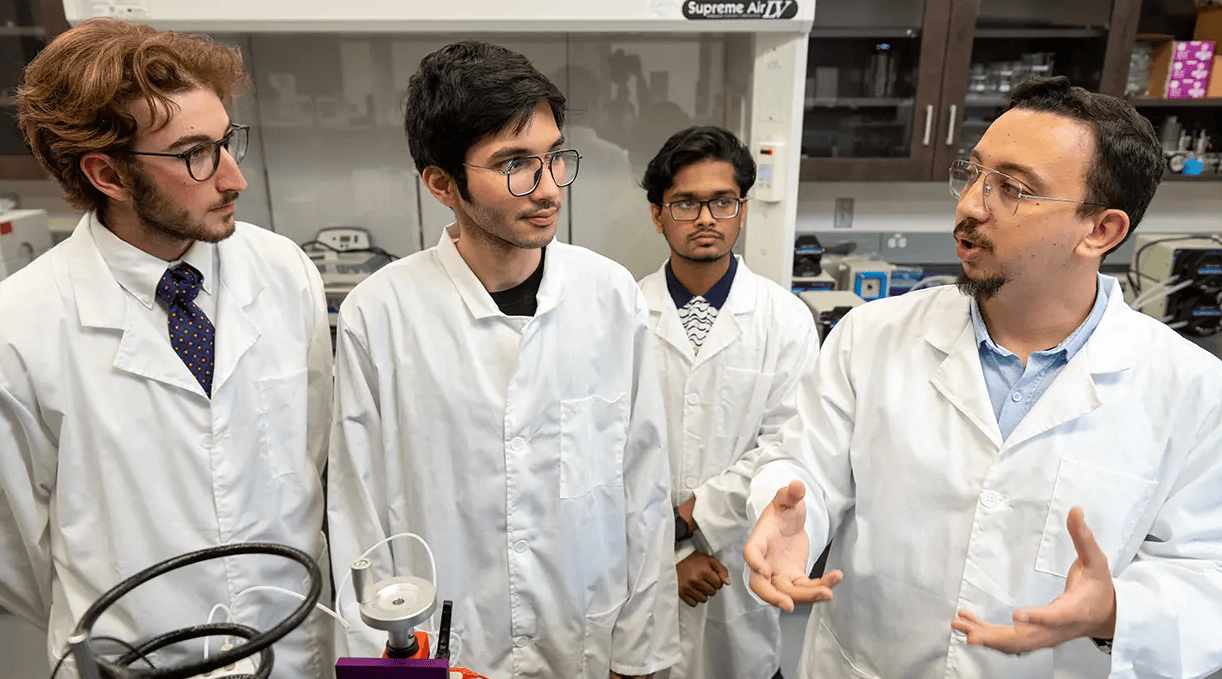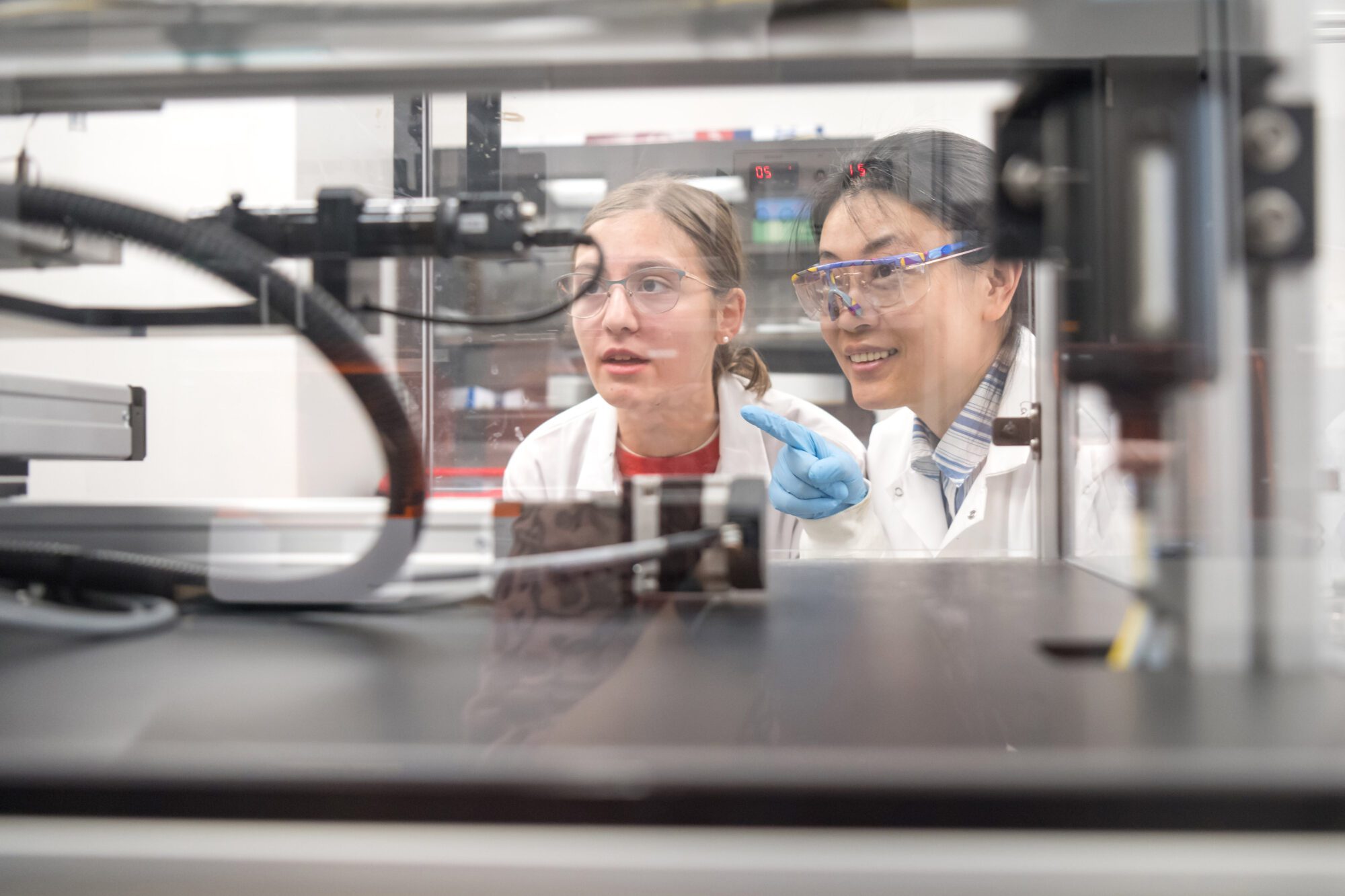
University of Mississippi sophomore Molly Heimbuck (left), a biomedical engineering major from Scappoose, Oregon, and research scientist Yu Zhang work with the MicroFab JetLab in the Pharmaceutical Engineering and 3D Printing Lab. Professor Mo Maniruzzaman plans to use the technology as part of a 'self-driving' lab to speed development of new drugs to treat chronic conditions. Photo by Srijita Chattopadhyay/Ole Miss Digital Imaging Services
- The AI-powered facility could help scientists discover and develop new medications faster.
The Health Resources and Services Administration has awarded a University of Mississippi researcher $7 million to create a lab that can develop, test and refine medications with little human intervention.
Artificial intelligence-powered, self-driving laboratories are key to getting life-saving medications into patients’ hands faster, said Mo Maniruzzaman, chair and professor of pharmaceutics and drug delivery. Maniruzzaman plans to create such a lab at Ole Miss.
“Chronic conditions and diseases like diabetes and cancer claim millions of lives each year,” he said. “We want to treat these diseases, but the reality is, it takes about 8 1/2 years for a medicine to go from concept to market. For a state like Mississippi, where the burden of chronic disease is among the highest in the nation, that’s unacceptable.
“The question we have to ask ourselves is, ‘What if there was a way to drastically shorten that process so we could bring medication to patients faster and, potentially, save their lives?’ We believe the answer lies in the self-driving lab.”
A self-driving laboratory combines artificial intelligence with robotics and automated laboratory equipment to run experiments and explore potential drugs and manufacturing processes faster than traditional, manually conducted experiments.
“Self-driving labs combine the power of multiple machines like pieces of puzzles,” he said. “The moment you integrate all those pieces into a seamless, automated line, that is what we call a self-driving lab.”
Many of those puzzle pieces are already in Maniruzzman’s lab, such as 3D printers and advanced robotic bio-fabrication kits that can print multiple medications on one pill or medications that can time release to the patients’ needs.
“This technology is so important for people who have chronic conditions and are taking multiple medications a day,” said Janhavi Deshmukh, a third-year doctoral student in pharmacy who works in the lab. “What if instead, they could take only one pill that will release medication on a schedule? That’s what this technology allows us to do.”
Md. Rahat Kader Khan, a doctoral student in computer engineering, is helping to upgrade one such printer for the self-driving lab. He and other students have incorporated remotely operated cameras that can record the process of printing and stream it to a researcher’s phone or laptop.
“It takes considerable time to finish a print, but now we have a model that can show you where the print is in the process and can even send you a notification when it’s finished,” he said. “This system can monitor any number of variables all while you do whatever other work you need to do, and it can let you know if something goes wrong.”
Over the next two years, Maniruzzaman hopes to incorporate these existing technologies into one system operating under the supervision of engineers and researchers at Insight Park, the university’s research and business incubator.
“The moment you bypass manual interventions, you get rid of human error,” he said. “By integrating this self-driving concept that can run 24/7 without compromising quality, we can actually fast-track the discovery process. That’s our goal.”
The goal is not to erase the human researcher, but to allow the researcher to focus on high-level problems while the machines do the routine work, Maniruzzaman said.
“This lab can analyze millions of data points, predict a potential new drug candidate and then run automated experimentation, and it never gets tired,” he said. “But it can only do that when paired with human insight.
“Our lab is not here to replace anything; it’s here to supplement some of the processes to get medicine to patients faster.”
This article is republished courtesy of Ole Miss.

Clara Turnage