Jim Abbott (left) with his managing editor and investigative reporter, David Rushing
- Some anecdotes will bring hearty laughter and a few nostalgic tears to anyone who has ever lived in a small town where everybody knows everybody and can recite family genealogies for generations backward.
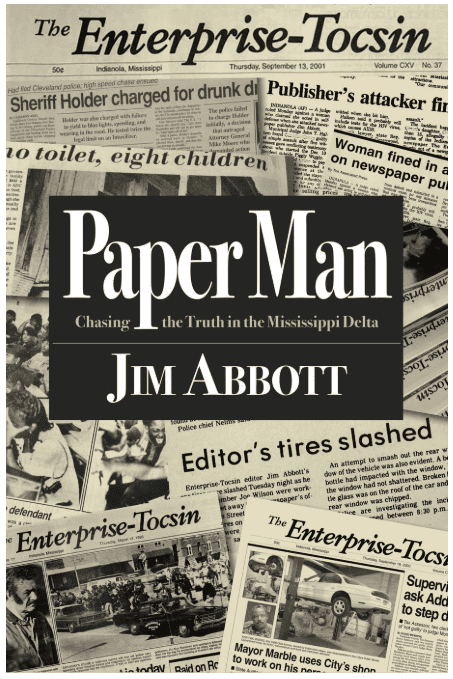
Paper Man Chasing the Truth in the Mississippi Delta is the must-read memoir of retired journalist and longtime editor of the Indianola Enterprise Tocsin, Jim Abbott. Released in early September and published by The Nautilus Publishing Company of Oxford, Paper Man is the compelling perspective of an older, wiser man who was once a good ole Mississippi frat boy standing on the sidelines cheering against James Meredith’s enrollment at Ole Miss in 1962.
A Greenwood native, Jim was 26 years old, a young husband, father, and Vietnam veteran in 1970 when he moved to Indianola to become the youngest newspaper editor in the state. As editor of the Enterprise-Tocsin, the local weekly with a storied history dating back to 1888, he was wide-eyed, creative, and bursting with energy, ideas, and skill. He had also arrived while the sparks of racial tension that had begun in the summer of 1964 still simmered. Indianola, though charming and welcoming in many ways, supported a community newspaper that ignored about half of the city’s residents.
In the ten years between the James Meredith debacle that put a black eye on Mississippi’s image in the eyes of the nation and Jim’s arrival as the editor of a small-town newspaper in the heart of the Delta, his views on the Mississippi faux policy of “separate but equal” had undergone a gradual transformation.
Summer jobs in Wyoming and California led him to reconsider opinions he had adopted years earlier.
In 1966, his senior year at Ole Miss, Senator Robert Kennedy addressed the student body in the new Tad Smith Coliseum, where the seats had yet to be installed. Jim, who had reviled the senator’s brother, President John Fitzgerald Kennedy, a few years before, sat on the concrete floor with hundreds of students and was moved by Robert Kennedy’s speech. He did not expect to be.
Soon after earning his business degree and taking a job in advertising in Natchez, Jim was called to active duty in Vietnam. As part of the United States Army Reserve’s 173rd Quartermaster Company, based out of Greenwood, active duty was not in his plans until it unexpectedly was. This was 1968, when the Lyndon Johnson administration began calling Reserve and National Guard units to active duty in response to the military situation following the Tet Offensive by North Vietnam.
After a 15-month stint in Vietnam, he returned to Mississippi and to Ole Miss to earn another degree. This time, it was a journalism degree to go alongside his business degree. Jim took every journalism course offered, wrote and took photos for the campus newspaper, The Daily Mississippian, and absorbed every nugget of journalistic skill available to him.
One of his final classes was a graduate-level sociology course taught by George McLean, editor and publisher of The Tupelo Daily Journal. As Jim says, “That experience would change my life.”
“Brain Drain” was a popular term of the time. Statistics revealed that Mississippi’s best and brightest minds were leaving the state after college graduation to find greener pastures elsewhere. Mr. McLean encouraged the students in his class not to flee their home state to make a name for themselves in bigger markets, but to stay in Mississippi and make a difference in their own backyards. McLean’s message resonated. Jim was just enough “crusader” by nature to embrace the message and follow McLean’s advice.
His next stop was Indianola, once touted on the national stage as “Segregation City of the Nation.” The city was the birthplace of the Citizens’ Council, an organization some called the “uptown Klan.” They did not don hooded sheets and burn crosses, but they were committed to segregation forever, albeit through peaceful and legal means.
Jim immediately rolled up his sleeves, assessed his challenges, and went door to door in the business community, introducing himself and laying out his vision for a vibrant newspaper. Many embraced him, while others treated him coldly when he talked about the Enterprise-Tocsin’s role in serving the whole community. The “whole” community idea still felt threatening to many.
The Enterprise-Tocsin had never covered city board meetings, county government issues, or anything else considered “hard news.” Instead, the front page featured the “Yard of the Month” and carried inside columns about women who took afternoon shopping trips to Greenville or entertained their bridge clubs.
Jim wanted to replace those fluff stories with coverage of city government, court trials, and impactful reporting on issues that affected the public. It was definitely a new day in Indianola.
From contentious school board appointments and economic boycotts to an inside view of Parchman Penitentiary incognito, Jim and his small staff covered everything. Sunflower County had never seen anything like Jim Abbott’s investigative reporting.
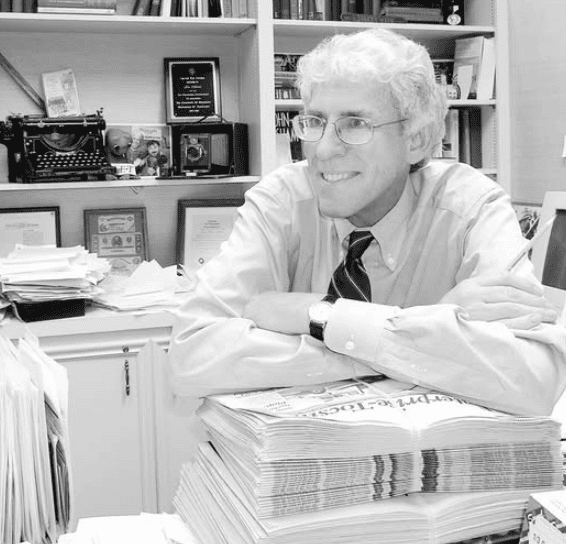
He was the first editor with a true journalism background, but he also had advertising, sales, and marketing credentials, plus a gift for photography. He was part truth-teller and part diplomat as he navigated a sometimes bumpy road to elevate the once-mediocre paper into one of the most respected weeklies in the entire Mississippi Press Association’s (MPA) membership. A past president of the MPA, he is also a member of their Hall of Fame and the recipient of a Silver Em Award from the University of Mississippi’s School of Journalism.
His deep friendship with Indianola’s native son, B.B. King, began in 1977 and continued until B.B. died in 2015. The stories of their first interview and the eventual fundraising and construction of the thirteen-million-dollar B.B. King Museum speak volumes about Jim’s positive influence on his city and his genuine heart for all people.
One enjoyable story among many is Indianola’s 1983 “Garden Party,” honoring B.B. King at the home of prominent sisters Christine Swartz and Jessie Lee. The event took a year to plan and drew 300 guests, half white and half Black. The small committee working together was “tight-lipped and secretive,” Jim said. As the evening approached and word leaked, national media requests began to flood the Enterprise Tocsin office. “No media,” remained the firm policy as Jim delivered an unequivocal “No” to even the most prestigious publications.
No cameras were allowed, though a reporter from the New York Times managed to drop by without one at the end of the evening and ran a 1,400-word story on their front page a day later.
The spin was positive, and so was the nationwide response that brought more publicity. Six weeks later, Diane Sawyer introduced a 13-minute segment on CBS’s Sunday Morning Show titled, “Something Happened in Indianola, Mississippi.” The same segment was aired two years later, introduced this time by Charles Kuralt, who said, “It was a party remarkable.”
To say that the book is all about race would be incorrect. It is not. Some anecdotes will bring hearty laughter and a few nostalgic tears to anyone who has ever lived in a small town where everybody knows everybody and can recite family genealogies for generations backward.
A true slice of life and history of the Mississippi Delta over four decades, Paper Man is a gem.