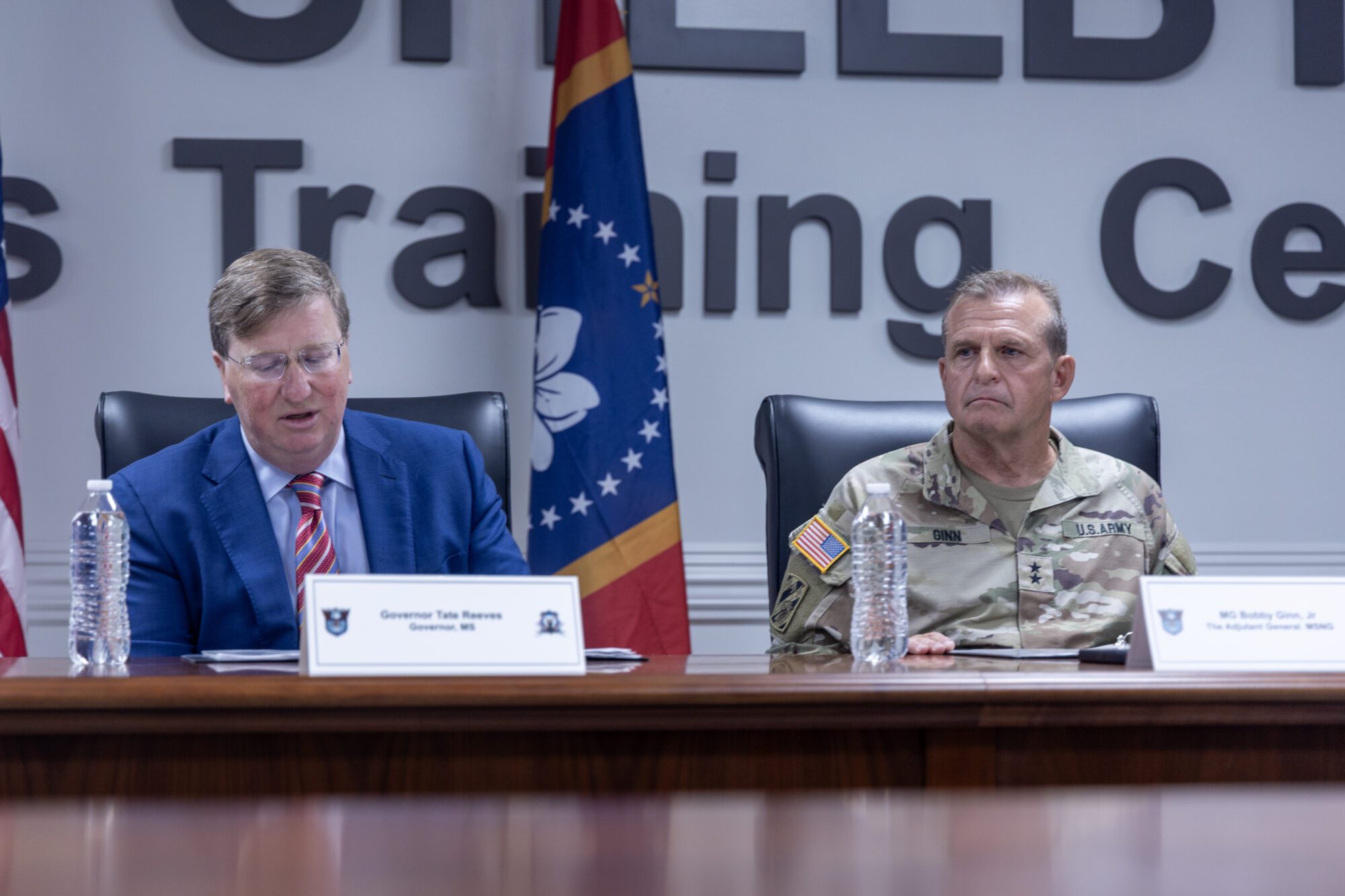
Governor Tate Reeves and Maj. Gen. Bobby Ginn Jr. (Photo from Mississippi National Guard)
- The initiative is designed to accelerate delivery of advanced capabilities to American warfighters by lowering barriers for commercial innovators, including non-traditional defense companies, to test emerging technologies on military ranges.
The Mississippi National Guard, in partnership with the U.S. Army Test and Evaluation Command (ATEC), announced last week that that the Camp Shelby Joint Forces Training Center has been designated as a permissive test range under the U.S. Army’s Permissive Test Range Expansion Initiative.
The initiative is designed to accelerate delivery of advanced capabilities to American warfighters by lowering barriers for commercial innovators, including non-traditional defense companies, to test emerging technologies on military ranges.
Camp Shelby is one of the five premier military test ranges selected to provide U.S. private industry with streamlined access to realistic, specialized environments for internal research, development, and rapid experimentation. The other four locations are Dugway Proving Ground, Utah; West Cibola Range at Yuma Proving Ground, Arizona; Camp Grayling Joint Maneuver Training Center, Michigan; and the Multidomain Training Area (MDTA) range complex, part of the Africa Multidomain Training and Experimentation Center (AMTEC), in Morocco.
“We are thrilled to partner with the U.S. Army Test and Evaluation Command,” said Major General Bobby M. Ginn Jr., adjutant general of Mississippi and commanding general of the Mississippi National Guard. “Camp Shelby, with its distinct history of training warfighters coupled with its unique capabilities, stands out as an exceptional location for a test range. We are committed to supporting the test and evaluation of cutting-edge technologies that empower our warfighters and enhance their operational effectiveness across all warfighting domains.”
Ginn added that Camp Shelby’s designation as a permissive test range “reinforces Mississippi’s long-standing commitment to national defense and to the Soldiers and Airmen who are ‘Always Ready, Always There’ for our state and our nation.”
Mississippi Governor Tate Reeves was on hand for the announcement. He called the initiative “a massive win for our state and our nation.”
“By opening Camp Shelby to America’s innovators, we are helping get better capabilities into the hands of our servicemembers faster, while positioning Mississippi as a key hub for defense technology, testing and future manufacturing,” Reeves said.
Through the initiative, companies developing systems such as drones, counter-drone technologies, long-range fires and low-cost interceptors will be able to access Camp Shelby’s extensive airspace, maneuver areas, and range infrastructure.
The expanded access is intended to support rapid design-test-build cycles, enabling industry to gather the data needed to refine their platforms and more effectively compete for contracts with the Department of War, the Department of Homeland Security, and other federal agencies.
“Historically, accessing military test ranges could be difficult for private companies, particularly startups and other innovators without an existing relationship with the federal government,” Governor Reeves said. “If you are developing technology that can make our servicemembers safer, more effective or more capable, come innovate at Camp Shelby, and come see what the Mississippi National Guard and the Magnolia State have to offer.”
According to the National Guard, Camp Shelby, which encompasses more than 134,000 acres, is located in portions of Perry and Forrest Counties with a small portion in Greene County. The training center was established in 1917 in support of mobilization during World War I and it has served almost continuously since then as a training site, not only for the Reserve Components of the Army, but also for the Active Components of the Army, Navy, Marine Corps, and Air Force. The training site consists of a mix of State, Department of Defense, and U.S. Forest Service lands in the DeSoto National Forest.