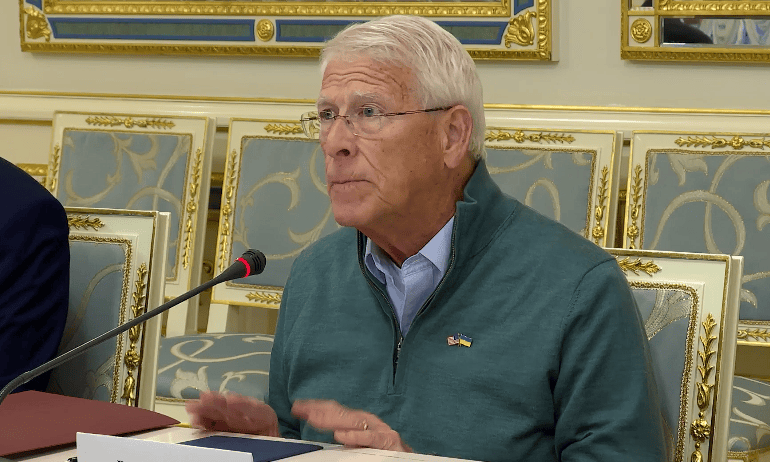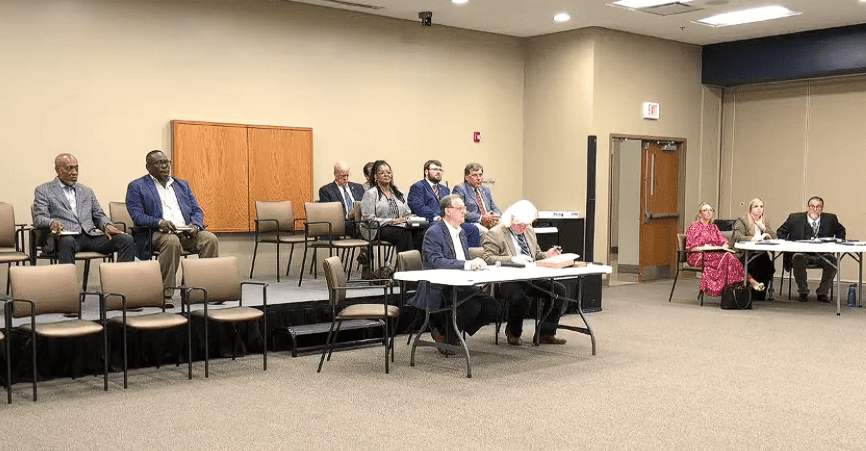
Joint Committee on Redistricting and Reapportionment holds redistricting hearing at Itawamaba Community College, August 18, 2026 (Photo from livestream)
- The series of public meetings are being held as part of the Legislature’s anticipated effort to redraw legislative, congressional, and judicial districts in the wake of the U.S. Supreme Court ruling in Callais.
Lawmakers serving on the Joint Committee on Redistricting and Reapportionment kicked off a series of public hearings Tuesday night in Itawamba County aimed at obtaining citizens’ comments and suggestions on the redistricting efforts being considered by the Mississippi Legislature.
The planned public meetings are being held as part of the Legislature’s anticipated effort to redraw legislative, congressional, and judicial districts in the wake of the U.S. Supreme Court ruling in Callais v. Louisiana that determined racial gerrymandering to be unconstitutional as it had been practiced under Section 2 of the Voting Rights Act.
The first of the public hearings was held Tuesday evening at Itawamba Community College.
State Senator Dean Kirby (R), chairman of the joint committee, opened the meeting clarifying that lawmakers are handling redistricting for state House and Senate electoral districts as well as congressional and judicial districts, not municipal or county districts. Those are done at the local level.
Maps of the current legislative, congressional and judicial districts were displayed for public viewing at the hearing, along with population totals.
“We’re not here to debate. We’re not here to answer questions. We’re here to listen,” Kirby told those in attendance.
Speakers’ remarks were limited to five minutes.
Rev. Jeffery Gladney, pastor of Johnson Chapel Missionary Baptist Church in Shannon, opened the remarks, telling lawmakers that nothing in the Callais decision requires Mississippi to redistrict.
“Unfair maps does not hold up the promise of unalienable rights,” Gladney said. “It weakens an already broken community system.”
Gladney claimed that the goal of redrawing the electoral districts map is to “eliminate black districts,” calling the effort to redistrict an attack on black voices.
“If the maps are redrawn, they will split neighborhoods, divide communities, take away resources from those already weakened communities,” Gladney asserted before saying losing Congressman Bennie Thompson (D) in the 2nd District would mean losing “his influence, his voice, and the resources that he’s able to bring back to his district.”
“We would lose a champion for democracy,” Gladney said of Thompson if his district is redrawn to allow for a less racially gerrymandered congressional map that gives black candidates and voters an edge.
Governor Tate Reeves (R) has publicly said lawmakers should consider redistricting the 2nd Congressional District in the wake of the Callais decision.
“The tenure of Congressman Bennie Thompson’s reign of terror over the 2nd Congressional District is over. It is not a question of if; it’s a question of when,” Reeves said in May.
Congressman Thompson, for his part, compared the ruling in Callais to a second Civil War.
“This is equivalent to a second Civil War,” Thompson told Al Sharpton on MS NOW’s “Politics Nation” in response to the host’s prompting of what the ruling means to “black Southern lawmakers.”
At the Itawamba hearing, Rev. Dr. Robert James, President of the Mississippi State Conference of the NAACP, shared Gladney’s sentiments, asking if Mississippi will “cling to the old patterns of exclusion” or will it “honor the full diversity” of its people.
James said equal representation means avoiding partisanship, “because in Mississippi, partisanship has long been a function as a pretext for race.”
However, the U.S. Supreme Court ruled in Rucho v. Common Cause in 2019 that, “To hold that [state] legislators cannot take partisan interests into account when drawing district lines would essentially countermand the Framers’ decision to entrust districting to political entities.”
“We conclude that partisan gerrymandering claims present political questions beyond the reach of the federal courts. Federal judges have no license to reallocate political power between the two major political parties, with no plausible grant of authority in the Constitution, and no legal standards to limit and direct their decisions,” wrote Chief Justice John Roberts.
Other speakers, mostly Democrat-aligned, at the Tuesday redistricting hearing shared Gladney and James’ sentiments, focused mainly on the need for continued racial considerations when drawing districts. One speaker even called the redistricting process “racism” and “fascism,” and labeled President Donald Trump (R) “a fascist dictator” in his remarks.
The series of redistricting hearings, which all begin at 6 p.m., will continue this fall at the following locations:
- August 27 – Northwest MS Community College
- September 1 – Delta State University
- September 8 – Alcorn State University
- September 10 – Meridian Community College
- September 17 – University of Southern Mississippi
- September 22 – Mississippi Gulf Coast Community College Hospitality and Resort Management Center
- October 1 – Mississippi State Capitol
Each of the hearings will be live streamed on the Mississippi Legislature’s YouTube channel.