Listen to the audio version of this article (generated by AI).
- The White House wants state lawmakers to axe Bennie Thompson from Congress, but the path to accomplish that task between now and November is unclear.
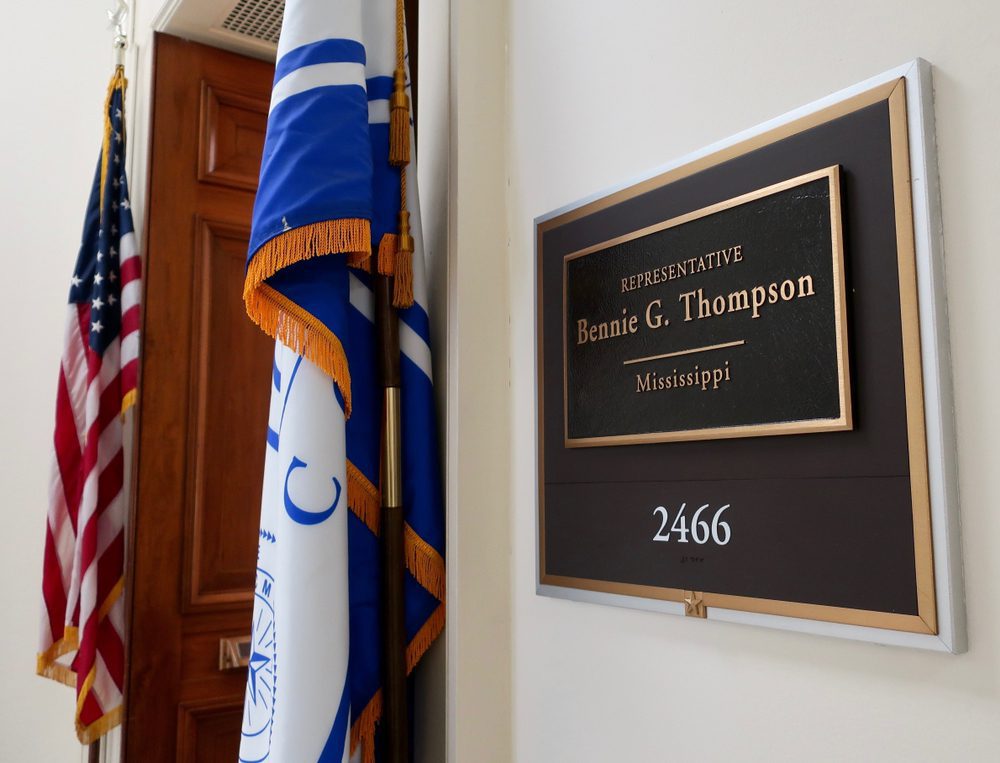
Even before the Supreme Court’s decision in Callais changed the redistricting landscape, Mississippi faced pressure from the White House to redraw its congressional lines. The state maintains four seats in the U.S. House of Representatives, but the one occupied by Congressman Bennie Thompson stands center-stage in a national redistricting frenzy aimed at the 2026 midterms.
On the same day Florida Governor Ron DeSantis signed a new redistricting plan for the Sunshine State, Byron Donalds, a black Republican and DeSantis’ likely replacement, called explicitly on Mississippi to target Thompson. Thompson, who oversaw the January 6th Commission as Chairman of Homeland Security, has drawn the ire of the President and those around him for how he conducted that investigation.
Governor Tate Reeves previously announced a special session to address redistricting for the Mississippi Supreme Court, but to date has not expanded the call to address congressional redistricting. Were that call to be made and were the Legislature to act to eliminate Thompson’s district, that action would face a bevy of real world challenges. Lawsuits would almost certainly follow.
While Callais changed the evidentiary standard for proving a violation of the Voting Rights Act, holding that the Constitution requires proof of actual discriminatory intent, it did not eliminate Section 2 claims altogether. Whether a VRA case challenging the elimination of Thompson’s district would succeed on the merits or not, such a claim could prevent implementation of any new map in time for the 2026 midterms.
Then there’s the practical reality that Mississippi has already held its primaries. The other states currently in controversy for mid-decade redistricting — California, Virginia, Florida, Alabama, Louisiana and Tennessee — have not. All of those states either are facing their own legal challenges or will.
In the case of Mississippi, the Legislature would not only have to pass new maps. For those maps to impact the 2026 midterms, the Legislature would have to undo the results of March’s primaries, set a new primary date, and likely re-open candidate qualification. This could prompt a different set of non-VRA legal challenges under the Due Process clause — potentially from winning primary candidates forced to compete again or from parties that already undertook the process and expense of running primary elections.
Post-primary legislative redistricting is uncharted legal territory with big implications beyond 2026.
Understanding the Gerrymander Landscape
Gerrymandering is not a new concept. Partisan drawing of lines has been unfolding in this country since the advent of political parties. The goal of political parties is to win elections. Both want to gain power. Neither want to lose it.
For example, President Donald Trump received 42 percent of the vote in the states of Connecticut, Illinois, Maryland, Massachusetts and Virginia in 2024. But because those states are controlled by Democrats, congressional districts in each have been drawn to drastically dilute the power of Republican voters.
Those states combined congressional delegations will include 45 Democrats and 5 Republicans if Virginia’s recently passed plan ultimately takes effect. That’s a 9 to 1 ratio. Republicans have 1/4th the representation they would have in these states if proportionality was the standard.
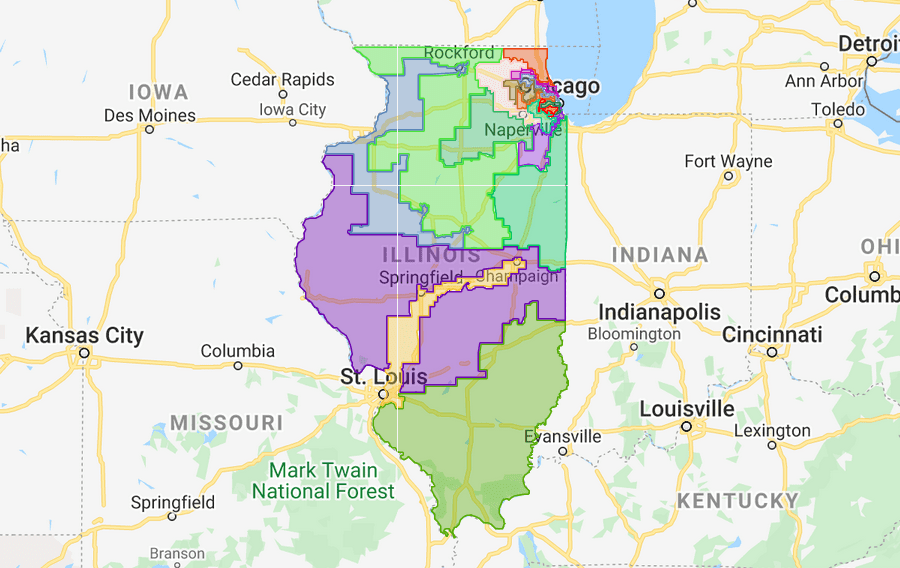
Consider Illinois’ current congressional map. No this is not a kindergarten art project, but a blatant example of partisan gerrymandering:
Recent Flurry of Redistricting Activity Pre- and Post-Callais
What is somewhat unique here is the timing of the latest flurry of activity. Most redistricting takes place once a decade after the census, though there is no constitutional prohibition on mid-decade redistricting. Redistricting also customarily takes place prior to the beginning of an election cycle and not during the cycle, itself.
A wave of mid-decade congressional redistricting is reshaping the 2026 election landscape, with several large states already enacting new maps and others moving to redraw districts following the U.S. Supreme Court’s decision in Callais.
Texas
Texas lawmakers approved a new congressional map in 2025 that could result in up to five additional seats for congressional Republicans, though that largely depends on GOP candidates maintaining and expanding recent inroads with Hispanic voters. A federal district court later blocked the plan, finding likely violations of the Voting Rights Act. In November 2025, the U.S. Supreme Court issued an emergency stay, allowing the state to proceed with the map while litigation continued. In Callais, the Court eliminated the legal basis for the lower court’s ruling and permitted Texas to continue using the new map, which was in effect for the state’s March 3rd primaries.
Primary date: March 3, 2026
California
California voters approved a 2025 ballot measure authorizing the legislature to adopt a congressional map, replacing the prior commission-drawn plan. Lawmakers enacted a new map for the 2026 cycle, creating new racial minority districts that could result in as many as five new Democrat seats. Courts previously allowed the maps to stand under the pre-Callais framework. Legal challenges remain pending, though, and could be strengthened by the Callais decision, which found that a district drawn in Louisiana on the explicit basis of race violated the Constitution’s prohibition on racial preferences.
Primary date: June 2, 2026
Virginia
Virginia voters approved a constitutional amendment allowing mid-decade congressional redistricting. The General Assembly also passed a new congressional map contingent on that amendment that is projected to add four new Democrat seats and create a 10:1 partisan ratio. Republicans pulled 46 percent of the vote in Virginia in 2024. Implementation has been blocked by procedural litigation related to how the constitutional amendment was passed. The map is not currently in use.
Primary date: June 16, 2026
Florida
Florida lawmakers approved a new congressional map during a 2026 special session, which Governor Ron DeSantis signed into law on Monday. This marks the first post-Callais act of redistricting. The map, which is projected to add four Republican seats, is currently in effect for the 2026 elections. Lawsuits challenging the plan have been filed under the state constitution, which expressly prohibits partisan gerrymandering and the dilution of minority votes.
Primary date: August 18, 2026
Surrounding States Considering Redraws
Alabama
Alabama had been operating under a court-ordered map adopted after prior Voting Rights Act litigation that firmly protected two Democrat seats in Congress. The court’s ruling prevented redistricting prior to 2030. The state is seeking to have that injunction lifted in the wake of Callais. Alabama Governor Kay Ivey called a special session for the purpose of moving its primary date in the event the state is permitted to use new lines. No new plan has been finalized.
Primary date: May 19, 2026
Louisiana
Louisiana, the state at issue in Louisiana v. Callais, is moving to redraw its congressional districts. The legislature is considering a new map, and officials are evaluating election scheduling as part of the process. No final map has been adopted.
Primary date: November 3, 2026 (jungle primary system)
Tennessee
Tennessee Governor Bill Lee called a special session to evaluate maps that begins Tuesday. On the potential chopping block is a single seat held by Democrats in the Volunteer State. That seat, centered around Memphis, is currently held by white Democrat Steve Cohen. Cohen’s presumptive GOP challenger, Charlotte Bergmann, is black.
Primary date: August 6, 2026
In sum, new congressional maps are in place for the 2026 elections in Texas, California, and Florida, though both California and Florida face pending legal challenges. Virginia has approved a framework and a contingent map that remains blocked in court. Alabama, Louisiana, and Tennessee are actively considering or developing new plans following the Supreme Court’s ruling, with primary calendars shaping the feasibility of any changes. Comparatively, Mississippi’s challenge is unique — having already completed primaries.

Russ Latino