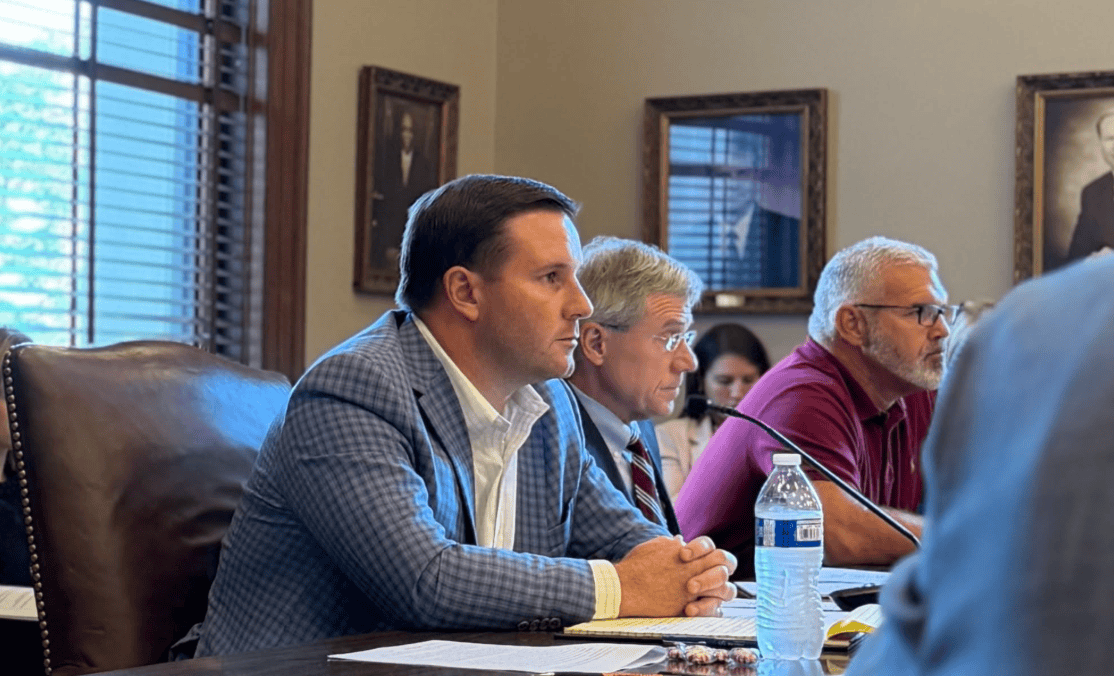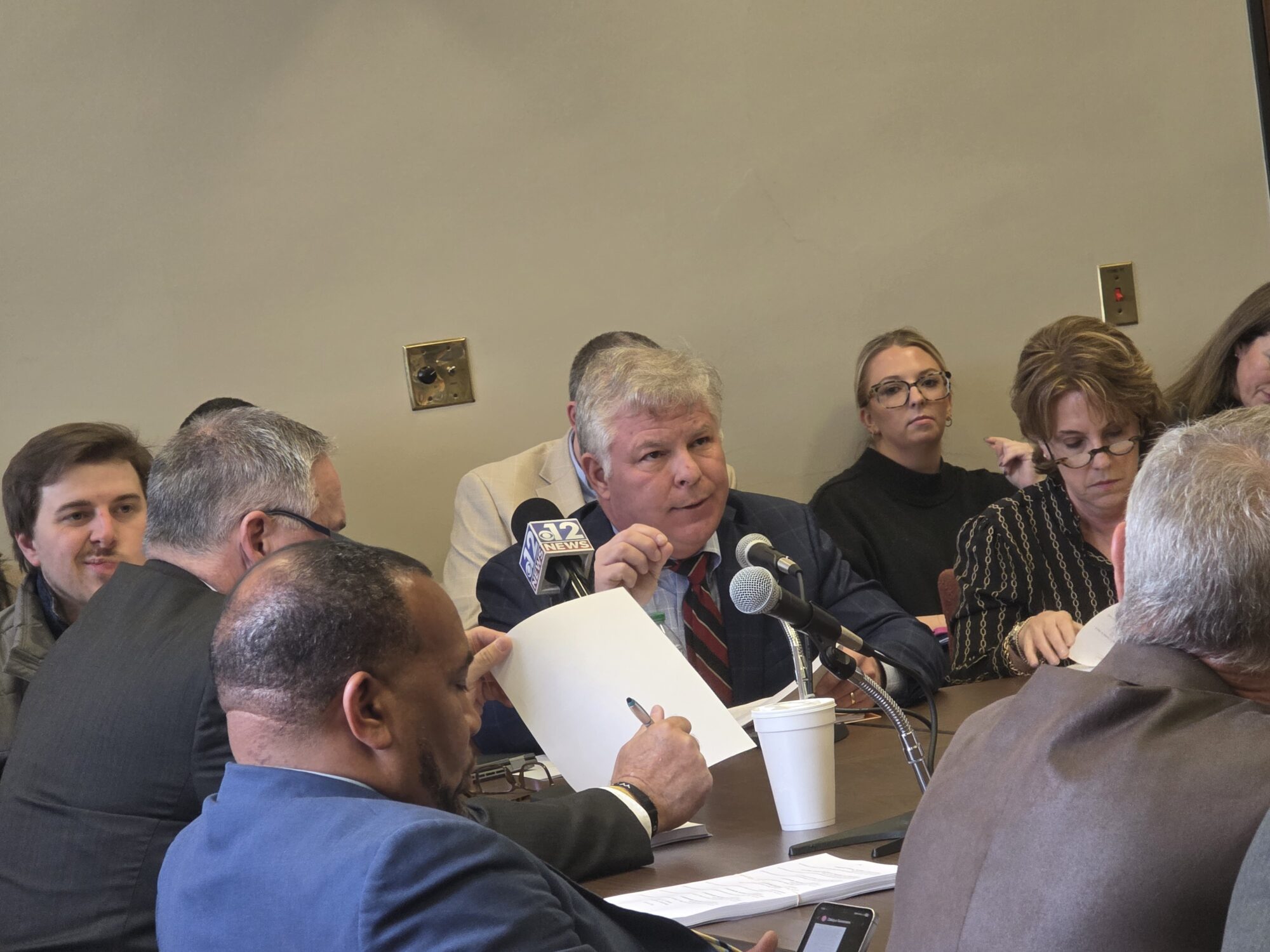
House Education Committee Chair Rob Roberson (R) describes HB 633, which requires public and charter schools to have automatic defibrillators with close reach on campuses and at athletic activities. (Photo by Jeremy Pittari | Magnolia Tribune)
- See what legislation made it out of the Mississippi House Education Committee this week.
The Mississippi House of Representatives passed a number of education-related bills out of committee this week, ranging from requiring schools to have automatic defibrillators on hand during sporting events and practices to requiring parents to use vehicle registration as proof of residency during school registration.
Here is a look at what will be considered by the full House in the days ahead.
Vehicle Registration as Proof of Residency
If you have been in a school pick-up line and wondered why so many vehicles had out-of-state car tags, you are not alone.
To ensure students who are enrolled in Mississippi’s schools are state residents, HB 389 would require vehicle registration as proof of residency during the student registration process.
State Rep. Kimberly Remak (R) said the requirement would apply to all public schools. If the family does not have a vehicle, they can sign an affidavit to that effect and then use other forms of residency, such as utility bills, to provide proof.
Remak said the bill addresses an issue that occurs in counties that border other states. At times, families who live out-of-state attempt to register children in Mississippi schools. There have also been instances of Mississippi residents registering their vehicle in the neighboring state because the car tag rates are lower.
“So, if you live in the district, you need to comply with having the appropriate tag, and I think it will help two problems we have,” Remak told Magnolia Tribune.
Defibrillators in Schools
The Cardiac Emergency Response Plan outlined in HB 633 would require all public and charter schools to keep and maintain an automatic defibrillator within three minutes reach.
Those regulations apply to campuses and athletic events, including games and practice sessions.
“If this saves one life in our schools and gives us a position to be able save a life it’s well worth it,” House Education Committee Chair Rob Roberson (R) said while presenting the bill.
Computer Science
In the booming age of digital devices and artificial intelligence, HB 1035 aims to ensure Mississippi’s children are well versed in the new technologies.
Titled the “Future Innovators Act,” the bill would mandate all students complete one credit hour of a Computer Science class, which should include literacy and concepts in the field of artificial intelligence.
This will not result in the addition of credits required for graduation since it can count as a math or science course, State Rep. Kevin Felsher (R) told the committee.
“The main thrust of the Act is to help ensure every student in Mississippi graduates with a foundation of computer science and AI literacy,” Felsher added.
School Attendance Officers
Committee members also passed a bill that proposes to increase the pay for school attendance officers (SAOs) to a minimum of $32,000 for the first year, with pay raises for subsequent years of experience.
A Committee substitute to the bill, HB 1211, puts all truancy cases under county court.
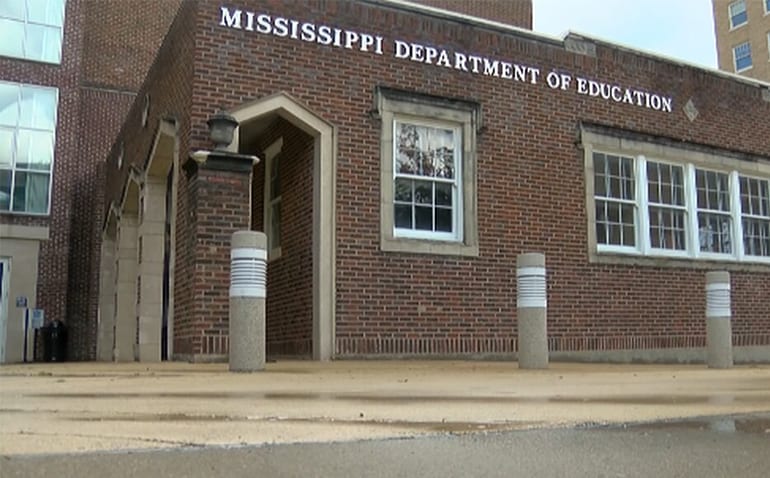
All SAOs would remain under the Mississippi Department of Education’s oversight under the bill, State Rep. Kent McCarty (R) said.
Other bills that passed in the House Education Committee this week:
- HB 632 seeks to set an appropriate pay scale for school nurses. It directs the Office of Healthy Schools to develop a salary schedule for all school districts to use when employing school nurses.
- HB 634 would provide supplements to nationally board certified school therapists and psychologists, with the amount to be set by appropriations.
- HB 752 would establish the Mississippi Young Readers Club pilot program to provide “developmentally appropriate books and literacy materials through participating schools.”
- HB 927 allows the Mississippi School of Math and Science to begin offering 10th grade classes, starting with 10 to 20 slots for enrollment.
- HB 1212 revises the Mississippi Student Funding Formula to ensure the special needs university-based programs are sufficiently funded.