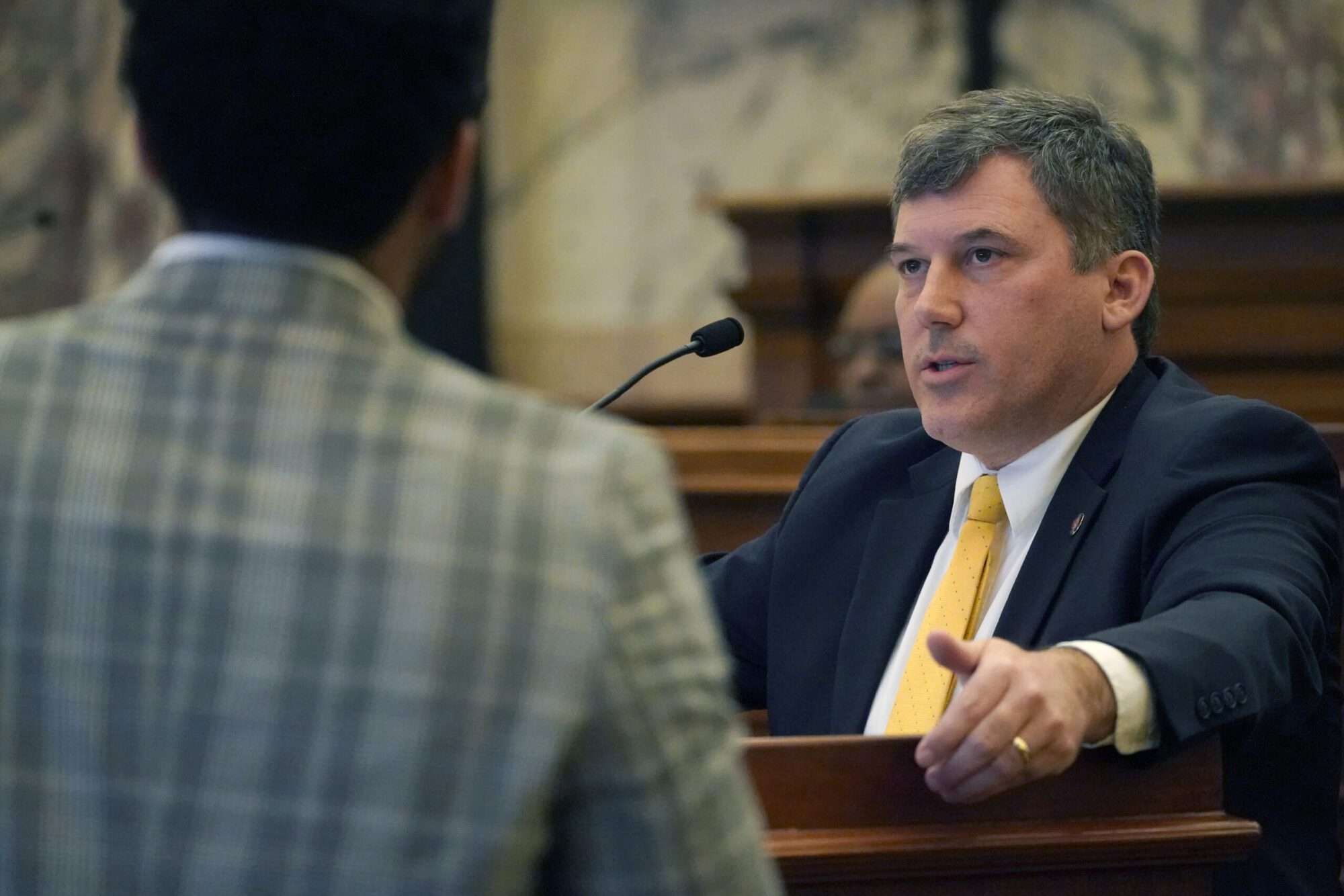
State Sen. Daniel Sparks speaks in the Chamber at the Mississippi Capitol in Jackson, Thursday, March 2, 2023. (AP Photo/Rogelio V. Solis)
- State Senator Daniel Sparks explained on the floor that the PERS unfunded liability is about $26 billion, $6 billion of which has been added since 2020.
The Mississippi Senate passed legislation transferring $1 billion over 11 years from the state’s Capital Expense Fund to the Public Employees’ Retirement System, or PERS, in an effort to buoy the system.
A unanimous vote came after 30 minutes of debate Wednesday.
The bill, SB 2004, would transfer $500 million from the Capital Expense Fund to the PERS account as of July 1. Subsequent transfers of $50 million would be moved from the Capital Expense Fund to PERS each year until July 2036.
The legislation, titled the Mississippi PERS Stability Act, states if the Capital Expense Fund has a balance below $50 million, the State Treasurer, along with the State Fiscal Officer, “shall transfer the balance of the unobligated funds from the Capital Expense Fund and a sum in the amount necessary from the State General Fund so that a total sum of Fifty Million Dollars” is transferred to PERS.
State Senator Daniel Sparks (R) explained on the floor that the PERS unfunded liability is about $26 billion. He said in 2020, the PERS liability was at $20 billion and since then $6 billion has been added due to changes in the rate of return assumption, which dropped to 7 percent.
Sparks said the state is seeing record revenues flowing into its coffers, including the Capital Expense Funds, an account that has approximately $1.5 billion in it.
“I think a billion-dollar commitment from this Legislature goes a long way in stabilizing this system,” he said,
He said senators have shown “political courage” on the issue to make changes to stablize PERS in the last few years.
“We have reformed, and we promised that we’d put money into the system. We are meeting that promise today,” he said. “The easiest thing to do politically is promise a benefit and let somebody else pay for it. We’re the somebody else that’s paying for it.”
He said more PERS bills are forthcoming.
The billion-dollar infusion is on top of the 2.5 percent employer increase the Legislature approved, adding $186 million in perpetuity to the system, and the reform last session that added a Tier 5 to the system.
According to Sparks, 21 percent of participants are county and city employees and 51 percent are school teachers.
“The state of Mississippi has less than 25 percent of the employees, I think, of the total employees. The way I see this is, we are actually paying off the debts of cities and counties,” he said.
State Senator Hob Bryan (D) said he is “very troubled about what we have done.”
“I am very troubled about what we are doing, and I am very troubled about what I think we may be doing in the future,” Bryan said during the debate.
His main concern was the speed at which the bill made its way through the Senate this first week of the 2026 session. It was introduced and unanimously passed by the Senate Appropriations Committee on Tuesday and scheduled for a Senate vote on Wednesday.
He asked did the Senate not learn from the last session’s chaotic tax bill.
Bryan, who was first elected in 1984, said that in the past, retirement bills went to several committees, including the Senate Finance Committee. Recently, retirement bills have “popped up like evasive species” coming out of various committees.
He said the simplest way to fund the retirement system is to have tax diversions that go to the retirement system each year, perhaps from sales tax collections.
“That’s what we should have done years ago,” Bryan said. “We’re still not doing that, and for the life of me I don’t know why.”
A diversion, he said, is not dependent on legislative action year by year.
The bill now heads to the House was consideration. Members in that chamber are sure to have their own view of how to stabilize PERS as bills are filed and committee work begins.