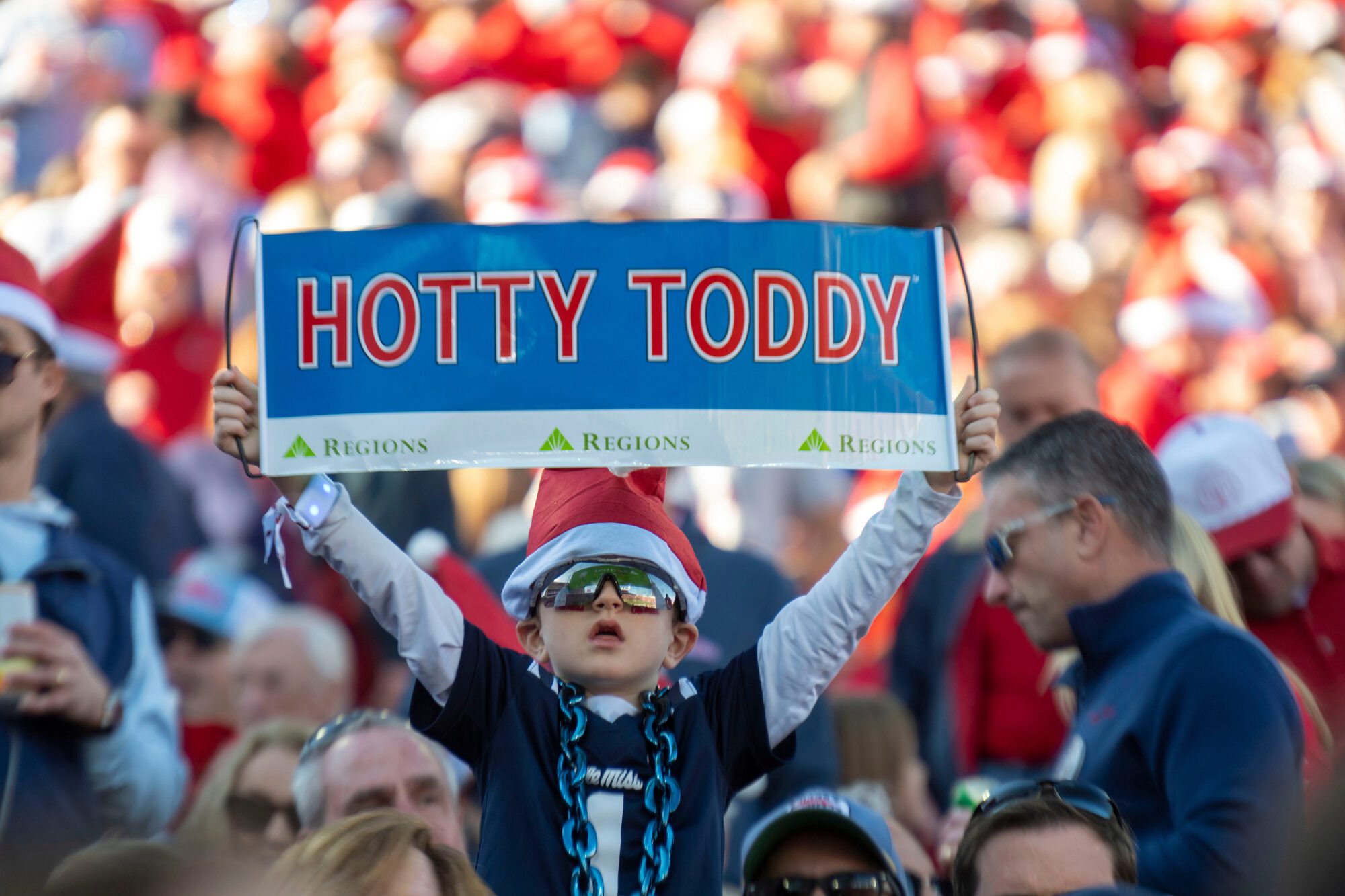
A young fan cheers on the Ole Miss Rebels in the first round of the 2025 College Football Playoff against Tulane. Photo by Srijita Chattopadhyay/Ole Miss Digital Imaging Services
- For a century, generations of Rebels have shouted the words and found their own meaning in beloved cheer.
“Are you ready?” If you are an Ole Miss Rebel, you know the rest.
The beloved cheer is celebrating its centennial this fall at the University of Mississippi. For alumni and fans, the meaning goes far beyond a shared battle cry on game days. It is an identity.
“‘Hotty Toddy’ has no real meaning, but it means everything in Oxford,” wrote ESPN’s Doug Ward in 2012. “For students, fans and alumni, it is a greeting, cheer and secret handshake all rolled into one. ‘Hotty Toddy’ is the spirit of Ole Miss.”
Nobody knows for certain how the chant originated, but its first iteration appeared in the student newspaper, The Mississippian, on Nov. 19, 1926, as part of the “Ole Miss Yells” column.
“The student body was preparing for the upcoming football game against Mississippi A&M, now Mississippi State University,” said Jeannie Latartara, university archivist.
The yell at that time was:
“Heighty! Tighty! Gosh A Mighty!
Who in the h—l are we?
Rim! Ram! Bim! Bam!
Ole Miss, by d—n.”
But what about “Are you ready?”
“The origins have to do with America’s ‘Preparedness Movement’ advertisements between 1915 and 1918 as we entered WWI,” Latartara said.
Additionally, the Norris Candy Co., which sponsored a yearly award for the best athlete at Ole Miss, used the phrase in its advertisements.
The line was also a national catchphrase, thanks to musical group The Hoosier Hot Shots. A band member would ask his brother, “Are you ready, Hezzie?” before a comedic routine.
“Both brands and civic organizations used ‘Are you ready?’ and it seems Ole Miss used the phrase as a call to prepare for the battle taking place between the opposing teams in the 1920s and 1930s, and it stuck,” Latartara said.
A few short years later, parts of the cheer appeared in a fight song called “Ole Miss,” written by music instructor Aileen Tye in 1931. The chorus included:
“Hi-ty Ti-ty Gosh a’mighty
Who the heck are we?
Oh, we come from Mississippi
From Mississippi, ‘Ole Miss.'”
Along the way, the words somehow evolved into “Hotty Toddy.” By the 1940s, the cheer and sentiment were going strong.
“Those words can be seen in 1948 in a Mississippian column called ‘Janie Reb,'” Latartara said.
It was already a popular sentiment.
“I am 98 years old, and Hotty Toddy was yelled when I came to Ole Miss in 1948,” said Wanda Poole (BS 50).
Henry Paris, 97, an Ole Miss cheerleader from 1948 to 1952, agreed.
“I came up in ’48, and it was going full blast then,” he said.
Although it is beloved by generations of alumni and fans, Hotty Toddy had to survive at least a couple of attempts to abandon it, presumably because of the “language.”
Paris remembers when he was called into the dean of students’ office as head cheerleader.
“Dean Malcolm Guess called me into his office, and he said, ‘Henry, as head cheerleader you’ve got to eliminate Hotty Toddy,'” Paris said. “And I said, ‘Dean, it’s bigger than me and you.
“Sometimes the students get on us cheerleaders from the stands that we don’t say it enough.'”
Paris told Guess that even if the cheerleaders stopped leading the cheer, the students would chant it on their own.
“The dean said, ‘Well we don’t have a solution to this, do we?'” Paris said “I said, ‘No, sir.'”
In the early 1950s, the cheer appeared as “Hotty Totty” in the Sept. 13, 1953 edition of The Mississippian.
Then, on Feb. 14, 1958, a column in The Mississippian called “New Yells Wanted” suggested a contest be held “in an effort to get some better and more lively yells.”
Cheerleader Ben Ward suggested the contest in a letter to the editor because “A good many of students feel that Hotty Toddy has been run into the ground.”
Obviously, that sentiment was short-lived.
However, in the Nov. 28, 1961 issue’s letter to the editor, an alumnus called for the chant to be eliminated, calling it “blasphemous.” But in the next issue of the newspaper, on Dec. 6, 1961, editor Jimmie Robertson responded with a column titled “‘Hotty Toddy’ Yell is not Blasphemous.”
“We feel that it is a yell which, better than any other, expresses our pride in the fact that we are from Ole Miss and that we want the whole world to know it,” Robertson said. “It is a yell that expresses our support for our athletic teams in such a manner as to inspire them to perform to the limit of their capabilities.”
And with that, the Hotty Toddy cheer and spirit evolved into meanings different to each individual.
For many, the chant means community or family or a greeting or a bond that unites.
Puffer Thompson (BA 93), admits that it is hard to explain to others.
“If it was a person, or that it was someone’s name, or a nickname or something happened, that would at least explain something,” he said. “But it’s just sort of this ephemeral kind of flame that floats out there, can’t be seen, or touched or tasted, but kind of can when you’re in the Grove; you smell it, you feel it all around you.
“I’d say it’s game day in the Grove, when it’s about 65 degrees and sunny, and there’s the smell of chicken in the air, and everybody’s just waiting to get in the game and ready to go ‘lock the Vaught.’ I mean, you’re just, like, swimming in Hotty Toddy all over the place.”
His words and perhaps one definition of the cheer’s meaning are inscribed on the Walk of Champions.
“Universities have cheers. Ole Miss has Hotty Toddy,” Thompson’s definition begins. “It’s a feeling, ideal, fight song, prayer, verbal handshake and way of life, all rolled into one.”
But to one of the university’s oldest cheerleaders, Hotty Toddy is simple.
“It means Ole Miss,” Paris said. “It really does.”
This article is republished courtesy of Ole Miss.