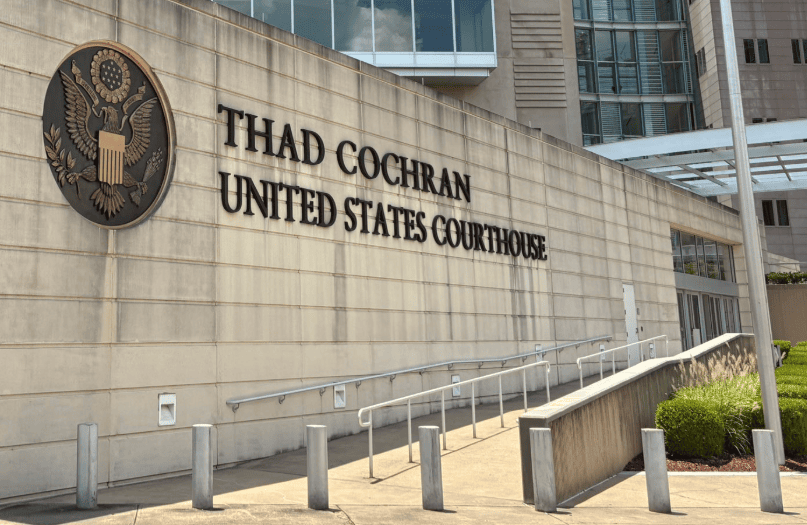
U.S. Courthouse in Jackson, Mississippi
- Judge Sharion Aycock’s latest move comes after the Fifth Circuit Court of Appeals remanded the case back to her court after the U.S. Supreme Court ruling in Callais v. Louisiana.
U.S. District Judge Sharion Aycock is allowing further discovery ahead of an evidentiary hearing in the federal case filed to force redistricting of Mississippi’s state Supreme Court districts.
“Although there was extensive evidence presented at trial in this case regarding the Senate factors, the court finds it necessary to provide the parties another opportunity to present proof on the presence – or lack thereof – of the ‘current intentional discrimination,’” Aycock said.
The federal judge’s latest move comes after the U.S. Supreme Court’s decision in Callais v. Louisiana that struck down deemed racial gerrymandering unconstitutional as it had been practiced under Section 2 of the Voting Rights Act.
After the high court’s April ruling, the Fifth Circuit Court of Appeals vacated the liability order in Mississippi’s state Supreme Court judicial redistricting case, remanding the matter back to Aycock.
Judge Aycock had relied on Section 2 of the Voting Rights Act when she mandated the redrawing of Mississippi’s Supreme Court district lines set in 1987 to accommodate greater black voting strength. Aycock’s decision was appealed by the state.
The 2022 lawsuit was filed by Dyamone White, State Senator Derrick Simmons (D), U.S. Senate candidate Ty Pinkins (I), and others seeking to redraw the judicial districts to increase black voting strength.
This week, Judge Aycock said the predominant concern is no longer holding elections this November, as was the initial plan before the appeal and the U.S. Supreme Court ruling. Now, the judge expects the latest round of discovery to be relatively short-lived with an eye on a trial soon.
“To be clear, the court will not disregard the evidence previously presented during the proceedings in this case. But it does appear to this court that extensive supplementation will be necessary in order for the issues to be fully and adequately developed, so that a decision consistent with the Supreme Court’s directives can be rendered,” Aycock said.
No trial date has been set.