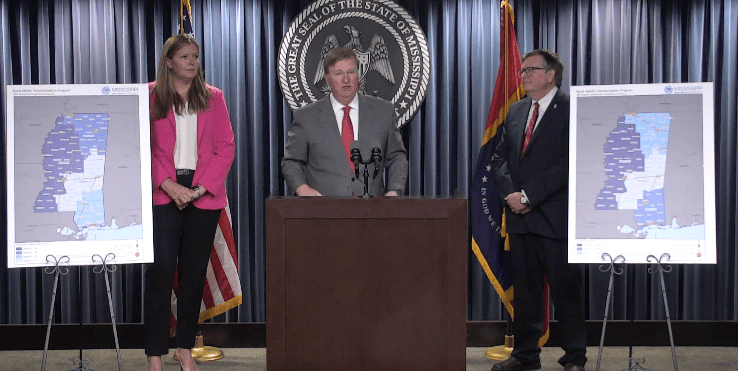
Report: Improper ACA enrollments in Mississippi could cost taxpayers over $600 million

- A study from Paragon Health Institute says Mississippi has the highest proportion of ACA enrollees with unknown race or ethnicity in 2026 of any state in their analysis, “a sign that enrollment intermediaries may be signing up people without their knowledge or consent.”
A new report from the Paragon Health Institute estimates that 47% of all Mississippi sign-ups during the 2026 Affordable Care Act (ACA) enrollment period were improper.
“When we use the term ‘improper enrollment,’ we mean exchange sign-ups where the person enrolled is not eligible for the subsidy they are receiving,” Liam Sigaud told Magnolia Tribune this week.
Sigaud, an Adjunct Scholar with Paragon and a Research Associate at the Knee Regulatory Research Center at West Virginia University, said improper enrollments on the exchange could occur for a wide variety of reasons, but not all instances of improper enrollment are necessarily fraudulent.
However, the report does document several program integrity issues related to the ACA exchanges that make them vulnerable to fraud and abuse.
“These problems are particularly pronounced on the federal HealthCare.gov platform, which Mississippi uses to facilitate enrollment in the exchanges,” Sigaud said. “They include weak identity verification, easy broker access to enrollee accounts, permissive special enrollment periods, and heavy reliance on Enhanced Direct Enrollment platforms.”
He noted that these features systematically deprioritize program integrity in favor of maximizing enrollment numbers, “giving unscrupulous brokers and fraud networks strong financial incentives to violate the law.”
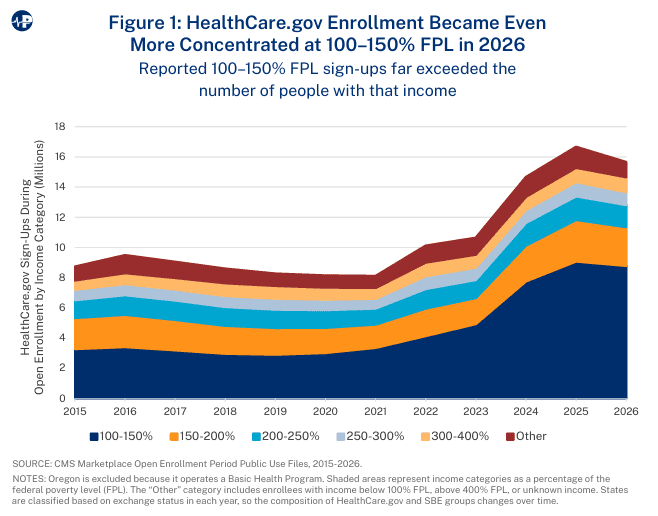
According to Paragon’s data, Mississippi had 313,392 total exchange sign-ups in the 2026 enrollment period, of which 246,766, or roughly 79%, claimed income in the 100% to 150% federal poverty level (FPL) range. That represents the highest share of any state in Paragon’s analysis.
The report notes that given the actual income distribution of Mississippi’s population, it is highly implausible that such a high proportion of exchange enrollees would truly fall in the 100% to 150% FPL range. The group estimates that 98,935 Mississippi enrollees were actually eligible for the exchange.
Sigaud said one major source of improper enrollment “are networks of unscrupulous brokers and enrollment intermediaries that collect personal information from people under false pretenses and enroll them without their knowledge or consent.”
“The fraud networks collect a commission for every month the enrollee stays on the plan,” he explained. “These schemes are increasingly attracting the attention of state and federal prosecutors.”
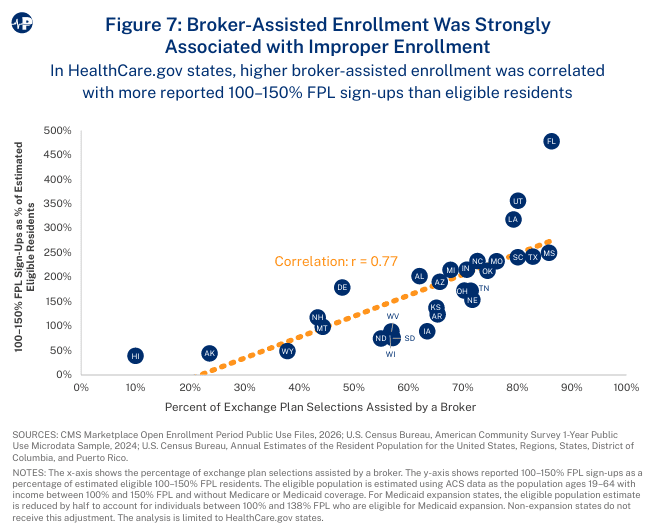
Sigaud referenced a case out of Florida where the U.S. Department of Justice investigated AP of South Florida, LLC (APSF), an insurance brokerage company, in an ACA enrollment fraud scheme.
Prosecutors with the DOJ alleged that APSF, through its highest-ranking executives, preyed on thousands of vulnerable consumers to fraudulently enroll them into fully subsidized ACA plans, for which the federal government awarded $141.5 million in unwarranted subsidies. The DOJ announced in April that APSF had agreed to resolve the criminal charge by pleading guilty and paying restitution of $27.6 million.
Sigaud pointed out that some enrollment fraud networks have been known to visit homeless shelters and soup kitchens, “offering cash or gift cards to induce vulnerable individuals to share their personal information, which is used to enroll them in ACA plans without their knowledge.”
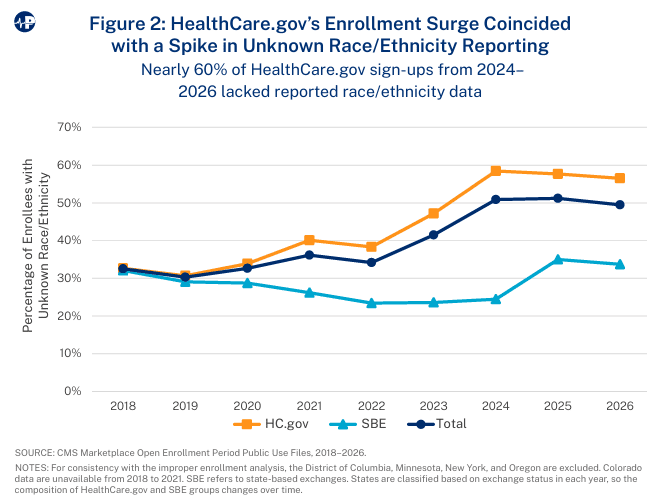
The Paragon report went on to show that Mississippi had the highest proportion of ACA enrollees with unknown race or ethnicity in 2026 of any state in their analysis, “a sign that enrollment intermediaries may be signing up people without their knowledge or consent.”
From 2025 to 2026, the report did state that estimated improper enrollees in Mississippi declined modestly from 157,945 to 147,831, “but problems in the exchanges remain pervasive.”
“Mississippi is constrained here because it uses the federal platform rather than running its own exchange, which limits what state officials can do directly,” said Sigaud.
State lawmakers have sought to encourage the formation of a Mississippi exchange in prior legislative sessions but work on it has repeatedly stalled.
In 2024, the Mississippi Legislature passed legislation that authorized the Commissioner of Insurance to establish and operate a state-based healthcare insurance exchange under the ACA. However, Insurance Commissioner Mike Chaney (R) said he would not move forward without the approval of the governor.
During the recently ended 2026 legislative session, State Rep. Hank Zuber (R) led the charge in the House to require the Insurance Commissioner to establish a state exchange. Despite a 116-0 vote in the House, the measure did not make its way out of the Senate Insurance Committee. State Senator Walter Michel (R) told reporters at the time that he did not bring the House bill up because it lacked the support of Chaney. The commissioner maintained that he would not establish a state exchange without the governor’s agreement, which Governor Tate Reeves (R) has withheld.

Even without a state exchange, Sigaud said there are constructive steps worth considering in Mississippi.
“State officials could engage their congressional delegation to push for stronger federal rules around enrollment in the exchanges,” he outlined. “There may also be an opportunity for the Mississippi Insurance Department to increase scrutiny of brokers and agencies operating in Mississippi, flagging suspicious activity for referral to [the Centers for Medicare and Medicaid Services] or DOJ.”
More broadly, Sigaud said Mississippi could further explore whether transitioning to a state-based exchange would give it more direct control over enrollment integrity.
“In our report, we found much lower rates of improper enrollment in states with their own exchanges, in part because they have stronger verification requirements and more robust oversight,” he added.
Paragon’s report contends that the findings imply significant taxpayer costs. Nationally, the group estimates that there are approximately 6.2 million improper enrollees in the ACA exchanges in 2026 and projects that the federal government will fund up to $25 billion in improper subsidy payments in 2026, about one-quarter of total ACA subsidy spending.
In Mississippi alone, Sigaud estimates that improper enrollments in the ACA could cost taxpayers more than $600 million.
You can read the full Paragon Health Institute report titled “The Persistent Obamacare Enrollment Fraud” below.