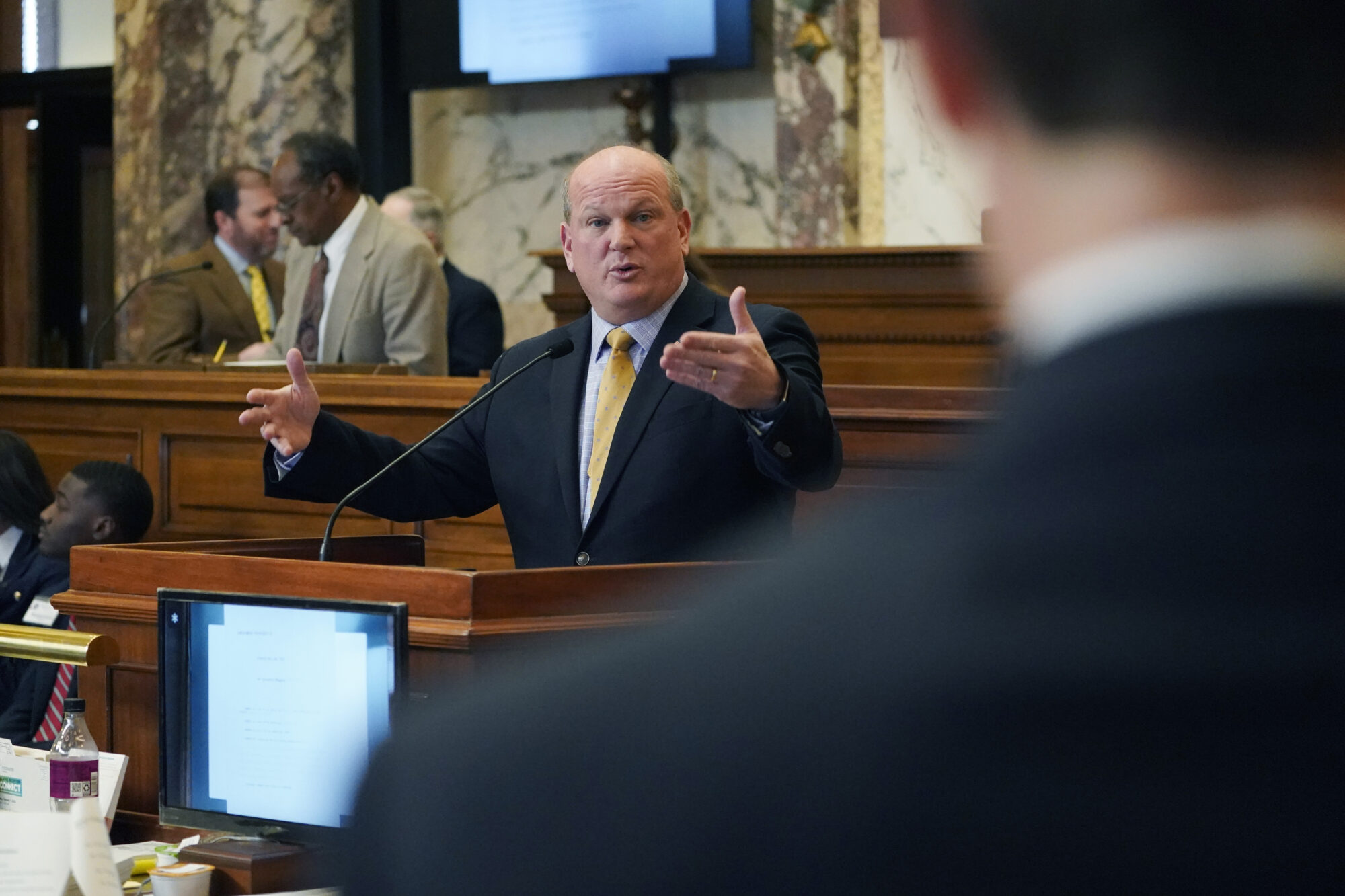
Sen. Brice Wiggins, R-Pascagoula, left, answers a question from Sen. Briggs Hopson, R-Vicksburg in the Senate Chamber, as lawmakers consider bills on their calendar, Friday, Feb. 3, 2023, at the Mississippi Capitol in Jackson. (AP Photo/Rogelio V. Solis)
- A federal judge ruled last year that Mississippi’s Supreme Court districts violated the Voting Rights Act. Instead of redrawing the districts, lawmakers will wait and see what comes of an appeal and a case before the U.S. Supreme Court.
Mississippi lawmakers will not take up redistricting of the state’s Supreme Court districts, choosing instead to wait and see what comes of an appeal as well as how the U.S. Supreme Court rules on a case involving the Voting Rights Act.
Senate Judiciary Committee Chairman Brice Wiggins (R) was the lead negotiator in his chamber on the measure while State Rep. Kevin Horan (R), Chairman of House Judiciary B, took up the matter across the Capitol.
Wiggins’ SB 2138 died in conference on deadline Monday while Horan’s HB 1749 suffered a similar fate.
This came after Wiggins said in a statement last week that “a Supreme Court redistricting agreement has already been reached between the chairmen,” a claim which Horan denied. Wiggins also said at the time that the intent was to use the Senate bill and not the House bill to move the matter forward.
In a request for comment early Wednesday morning, Wiggins took issue with an opinion column questioning Senate Minority Leader Derrick Simmons (D) being a conferee on the House bill while at the same time being a plaintiff in the lawsuit against the state that caused the need for the redistricting debate. After the column ran, Simmons was replaced as a Senate negotiator.
“Despite Magnolia Tribune’s attempt to create controversy where none existed with its most recent column, differences of opinion as to the best way forward existed considering the pending cases in the federal courts, and so a compromise was not reached,” Wiggins said.
In late 2025, U.S. District Judge Sharion Aycock ruled that district lines drawn in 1987 used for the election of the Mississippi Supreme Court violated Section 2 of the Voting Rights Act. Three judges are elected to the court from the Northern, Central and Southern districts.
The challenge was brought in 2022 by the ACLU, the Southern Poverty Law Center and a group of black Mississippians, including state Senate Minority Leader Derrick Simmons (D), claiming black voting strength was diluted under the current boundaries.
Judge Aycock wrote in her order that only four black people have served on the Mississippi Supreme Court and each of those held the same seat in the Central District, having first been appointed by a sitting governor.
Soon after the ruling, Lt. Governor Delbert Hosemann (R), a former Secretary of State, called on the State Board of Election Commissioners to appeal, saying the ruling was “unconstitutional.” He warned that changing the district lines would not only impact the Central District Supreme Court boundaries, but the Northern and Southern district Supreme Court boundaries and perhaps even the districts for the Public Service Commission and the Transportation Commission as well.
The state has since sought to overturn the ruling, filing with the 5th Circuit U.S. Court of Appeals.
In addition, the constitutionality of racial gerrymandering, as has been forced upon municipal, county and state legislatures by courts under Section 2 of the Voting Rights Act, is being challenged at the U.S. Supreme Court in a case out of Louisiana.
Section 2 was also used to force Mississippi lawmakers to redraw legislative districts last year which resulted in the state holding multiple mid-term special elections after new boundaries had already been implemented and used for the 2023 election cycle.
A decision from the nation’s high court on the matter in the Louisiana v. Callais case is expected before the end of the court’s term in June.
Attorneys for the state and those challenging Mississippi’s Supreme Court districts are now required to notify Judge Aycock within seven days of the legislative sine die, informing the court that lawmakers did not redraw the boundaries this session. The possibility remains that the court could draw new boundaries and order special elections for this November.

Frank Corder