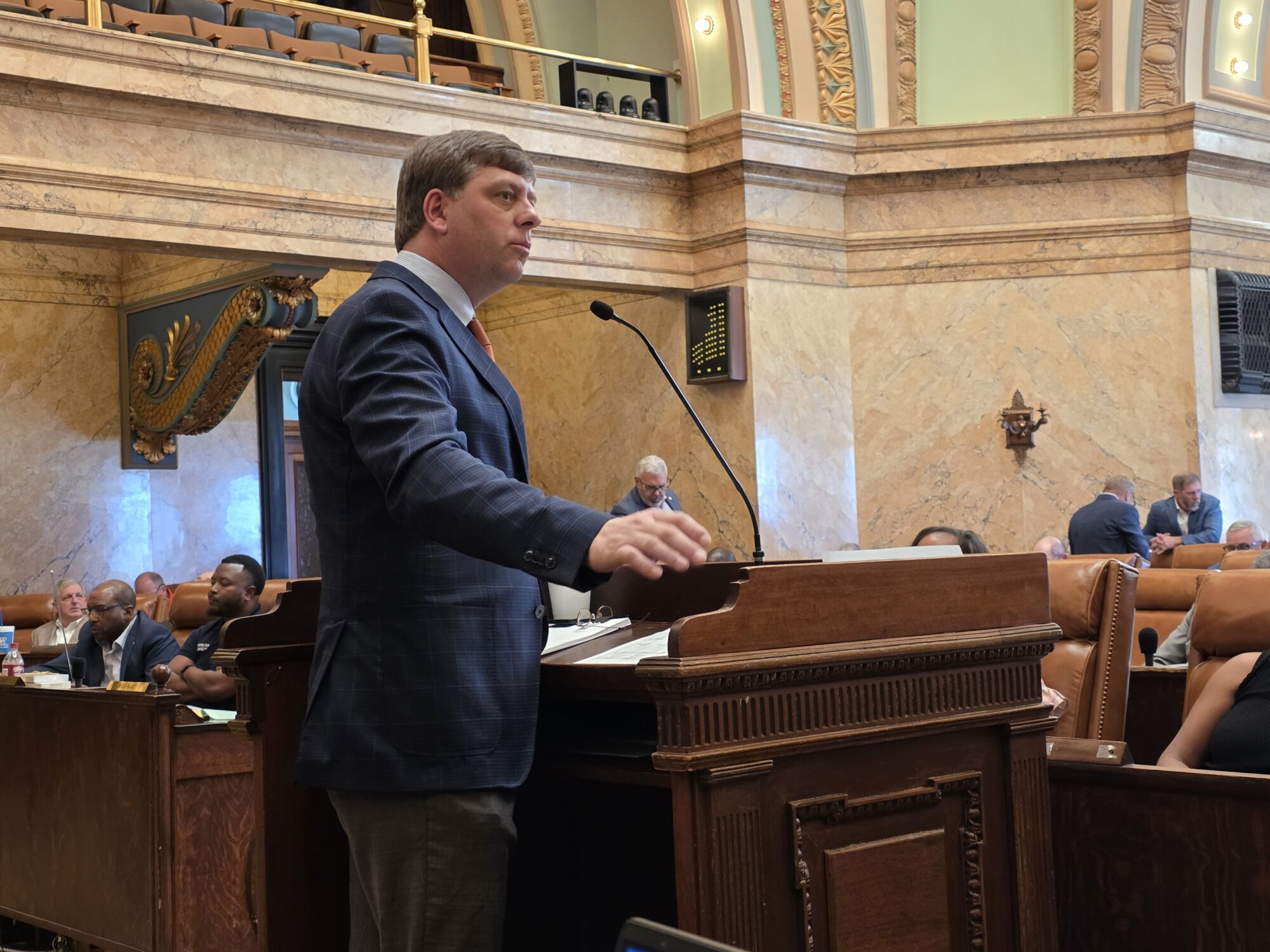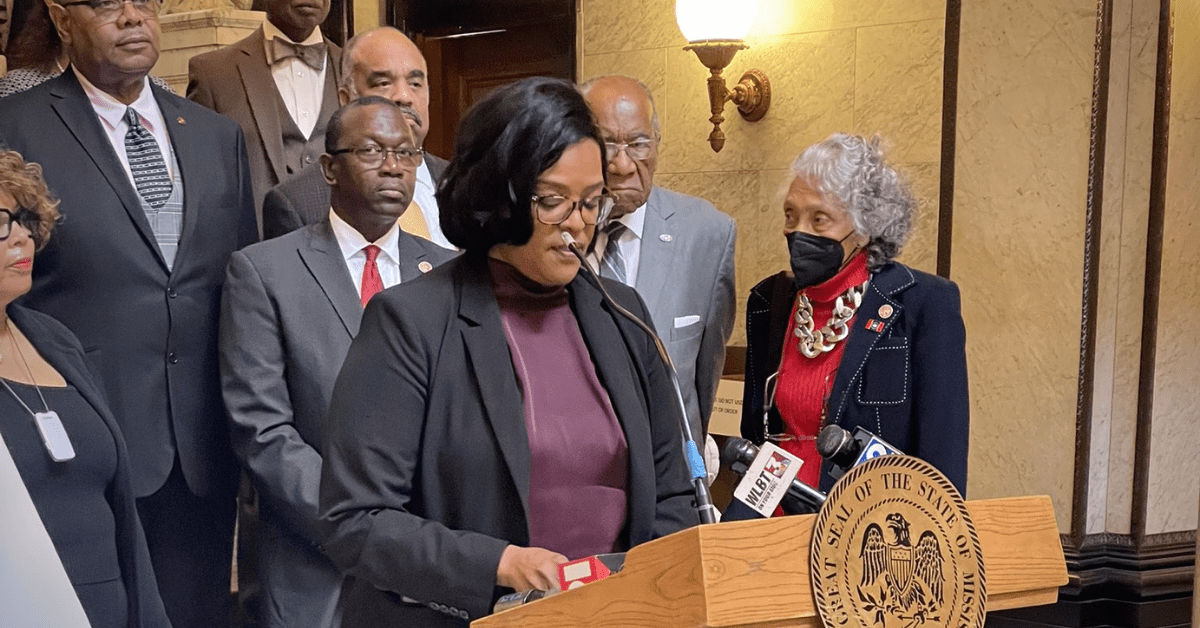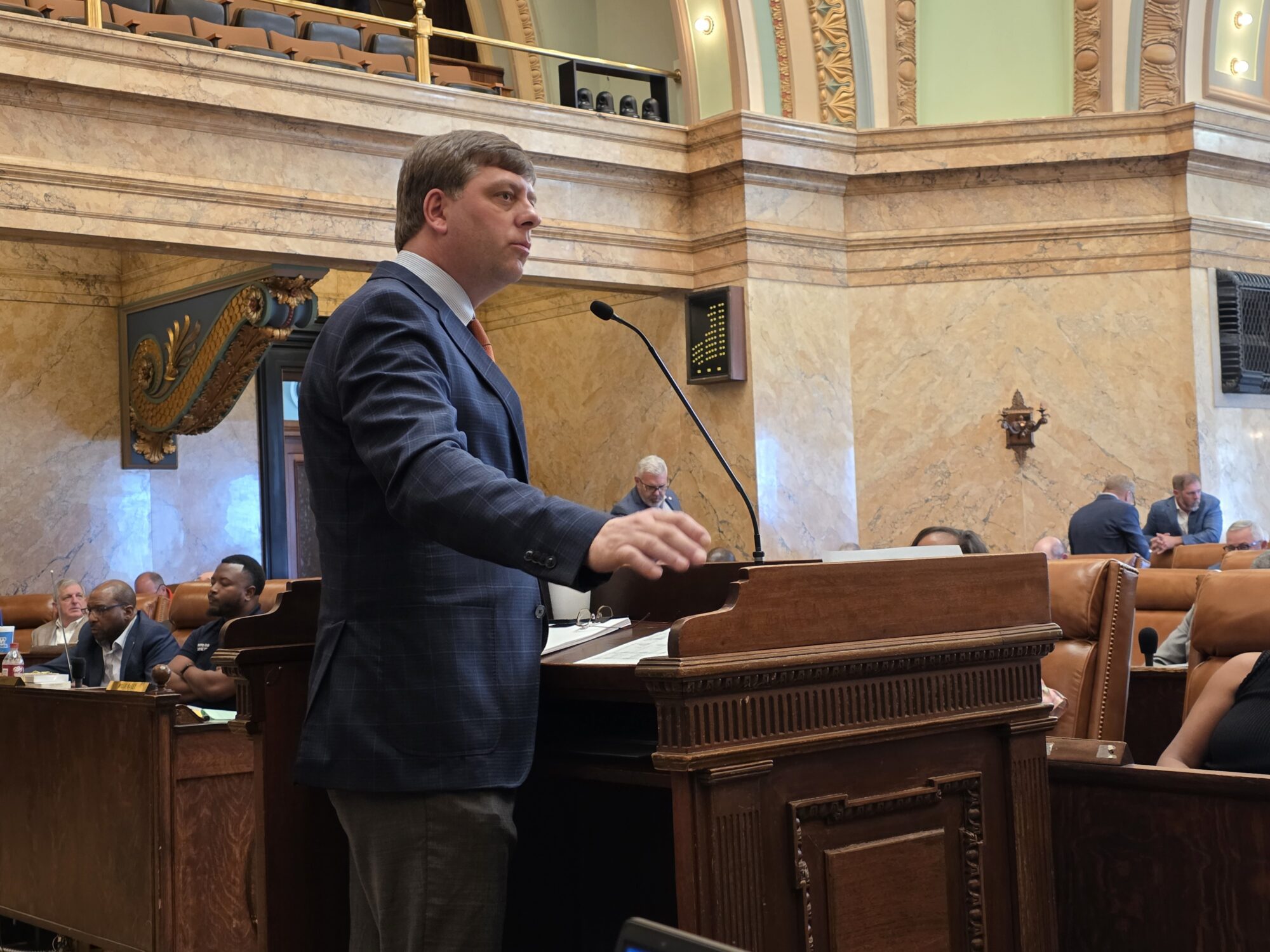
Rep. Clay Deweese (R) describes the appropriation for the Department of Human Services while on the floor of the House on March 29, 2026. (Photo by Jeremy Pittari | Magnolia Tribune)
- Lawmakers also look to provide funding for income verification contracts to help keep SNAP error rates low as higher rates will cost the state millions.
The budget for the Mississippi Department of Human Services was set this week, with legislators agreeing on roughly $94.6 million in state funding for the state agency.
The total budget for the department under the conference report filed for HB 1909, including federal and other funding, totals $1.6 billion.
Within the appropriation is $3.3 million for critical salaries, $8.7 million in vacancy funding, $5.1 million in capital expense funding for the department’s computer program, and $2 million for an “IT success project,” State Rep. Clay Deweese (R) described on the floor of the House.
Compared to the year prior, state funding rose by about $1.7 million for the department.
“We’re honored to receive some level funding, and we’re obviously thankful to the Legislature for the work they did to get us this appropriation,” DHS Chief Communications Officer Mark Jones told Magnolia Tribune.
Other provisions in the bill include allowing the department to demolish cottages located at the Oakley Youth Development Center and create an adolescent offender pilot program.
State Rep. Zakiya Summers (D) asked if this year’s appropriation includes the previous year’s $15 million allocation for childcare assistance, which was to help parents be part of the state’s workforce.
“During conference, the $15 million was shifted to SNAP,” Deweese explained. “We all know that this was some federal money that we had for a long time, and as the federal government has pulled more money away, the state has had to pick up the bill on a lot of this and we’ve got a massive Medicaid issue that we’re addressing with the funds were not there to continue the program.”
Summers noted that more than a dozen appropriations bills passed by the House prior to HB 1909 included millions in additional funding, so to her there was no real reason the state could not find an additional $15 million for that program. She made a motion to recommit the bill for further conference to find that $15 million, but it failed by a vote of 39-76.
“Parents are not going to be able to go to work. Employers will be impacted. Child care providers, you may only have a couple of them in your district, will close because they won’t have enough money to take care of our children,” Summers said while speaking on her motion. “You and I both know that we want Mississippi to be the best state to raise a family and in order for us to have that position we are going to have to support childcare.”
Deweese said that some child care vouchers will still be available.
In the Senate, State Senator Angela Hill (R) also asked if the $15 million for childcare assistance was included.
“We had some last year but last year we were supplanting funds that had been taken out from the federal,” State Senator Briggs Hopson (R), the Senate Appropriations Chairman, explained. “So, there was never, as you may recall, there was never any funding that had originated out-of-state. But last year as part of the step down from federal clawbacks, or pull backs, we put $15 million in, but this year we just had no agreement on that.”
On the Senate floor, there was also discussion about how federal changes concerning high error rates might impact the state financially under the Supplemental Nutrition Assistance Program, or SNAP, which the Department of Human Services oversees. State Senator Daniel Sparks (R) asked what the cost to the state will be based on those error rates.
As previously reported, under the new federal regulations states must provide a cost share for the program if error rates are higher than 6%. Hopson said predictions show Mississippi will be responsible for $40 million if the error rate is between 6% and 8%, $80 million for a rate of 8% to 10%, and any rate over 10% the state will potentially pay $120 million.
Sparks said the Senate inserted language into HB 1772 that would remove the state’s current requirement of using change reporting and instead switch back to simplified reporting pertaining to error rates to help keep them low.
“Which we were never above the 6% designated error rate prior to making that change and we’ve never been below it since then,” Sparks explained in objection of using change reporting.
On Tuesday, when the House passed the conference report for HB 1772, State Rep. Samuel Creekmore (R) said the conference report for the bill removed language pertaining to simplified reporting before it passed off the House floor by unanimous vote. The Senate has not taken action on the conference report on this measure as of press time.
In an effort to keep the error rates low even under change reporting, MDHS has asked for additional funding to cover contracts for income verification services.
Jones said the department will be receiving a deficit appropriation to cover the cost of income verification contracts through HB 1940. That bill has been signed into law by Governor Tate Reeves (R).

Jeremy Pittari