- Policy should not be made in response to very small groups of very loud people when it comes at the expense of everyone else that happens to be too busy living to understand how they are getting screwed.
“This is not PBM reform. It’s a tax increase on every Mississippian.” That’s how one of Mississippi’s largest employers summed up the Senate’s changes to HB 1665 in a conversation with Magnolia Tribune on Wednesday.
Two other employers, speaking on the condition of anonymity, shared with us their benefits teams’ calculation of the effect of the Senate’s plan to create an $11.29 dispensing fee on every prescription filled in the state. One offered a net estimate of between $800,000-$1,000,000 in new annually recurring expense. The second employer offered an even more staggering figure of nearly $2.3 million in new dispensing fees.
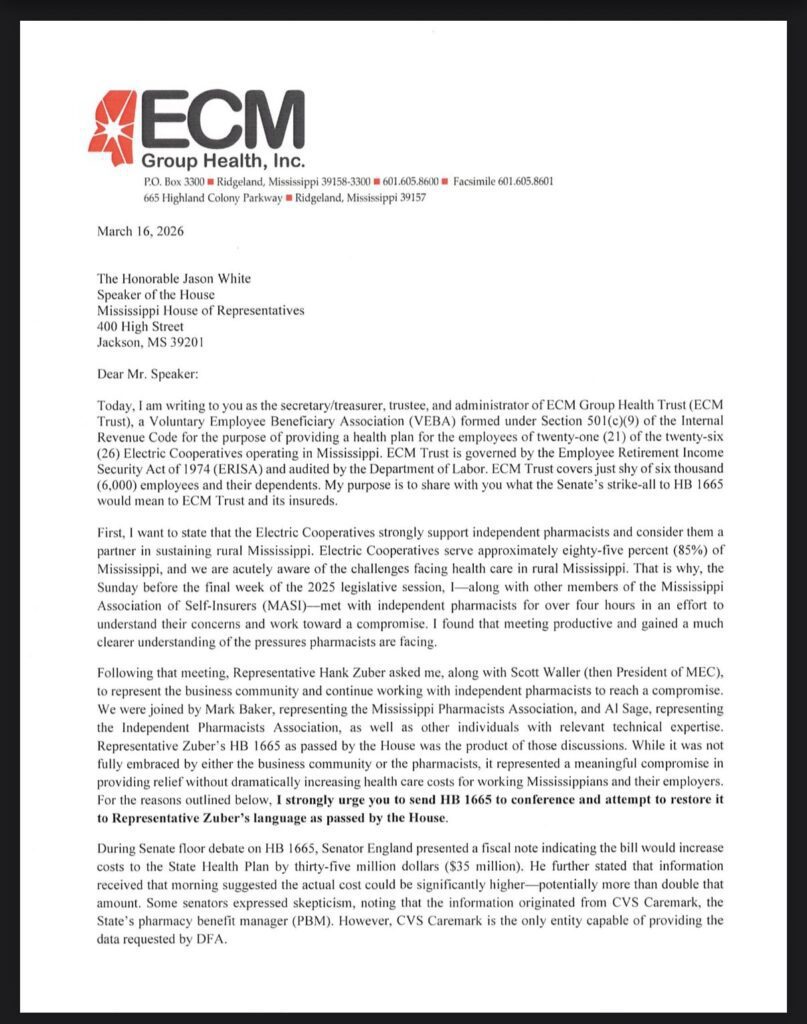
One plan administrator not speaking on the condition of anonymity is Michael Callahan, the CEO of Electric Cooperatives of Mississippi. ECM’s affiliates supply some 450,000 Mississippians with power touching all 82 counties. Nearly 6,000 workers receive health insurance benefits under the plan administered by ECM.
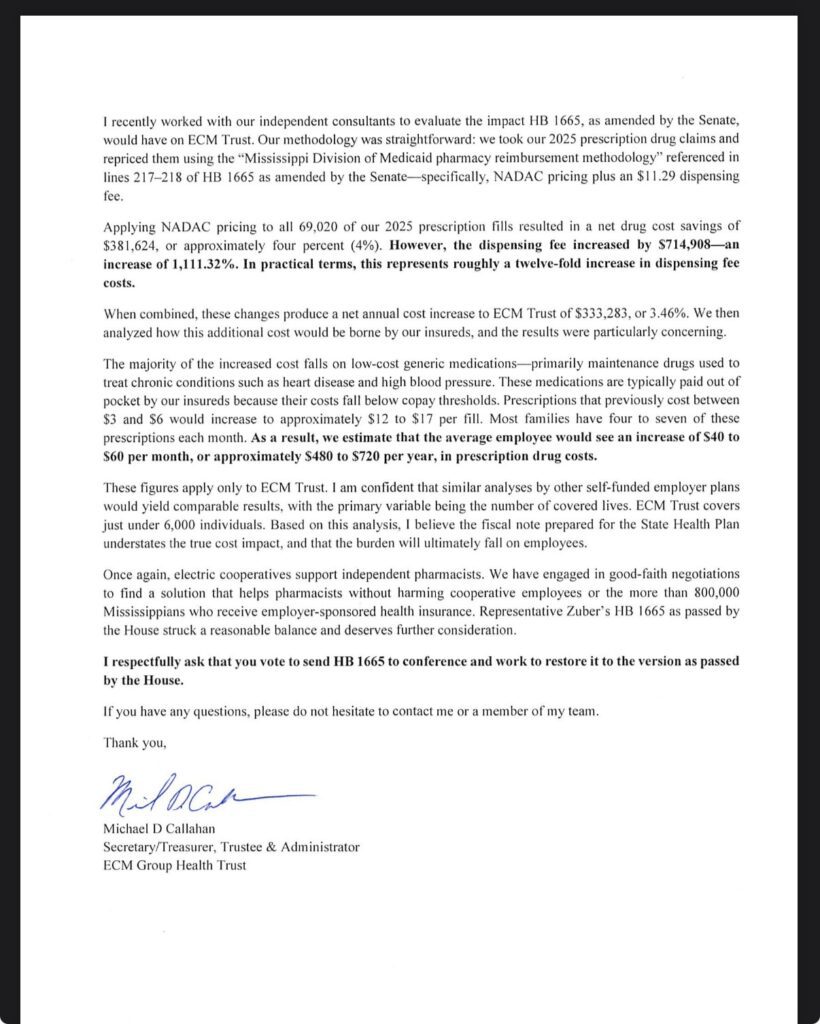
Callahan told Magnolia Tribune he worked with an independent consultant (not a PBM) to evaluate the impact of the Senate’s changes to HB 1665. According to Callahan, while there were some savings on drug prices using the NADAC benchmark used by Medicaid ($381,624), those savings were not enough to account for the massive increase in dispensing fees added to the bill ($714,908).
In total, ECM’s analysis showed a net annual increase in the cost of their prescription drug plan of $333,283. That’s a single employer.
Callahan sent his breakdown to House Speaker Jason White yesterday:
Emotional Nonsense, the Worst of Politics
Multiplied across Mississippi’s entire insured workforce, the cost of the Senate’s new dispensing fee likely reaches into the 9-figures.
Confronted with this reality, there are a number of relatively asinine arguments being peddled by those pushing these prescription drug price hikes.
The first is that PBMs, the entities created by insurance companies to negotiate reimbursement prices for prescriptions, will simply absorb hundreds of millions in the new legislatively created fees. No one with a modicum of sense, or an even remote understanding of economics, believes that. If they do, they should not be in the Legislature. Hell, they might want to invest in Velcro shoes.
For starters, PBMs do not have the profit margins to do so. Consider the cumulative total of 9 to 10 figures of new expenses multiplied by 50 states. For finishers, they wouldn’t even if they could. That’s simply not how the real world works. The customer always pays. In this case, that’s the employer providing the health insurance, the worker paying the premiums and the out-of-pocket expenses, and even the little old lady on a fixed income.
Another particularly specious argument is that the entire business community simply doesn’t understand what’s good for them, or even more laughably, are somehow doing the bidding of their insurance companies.
There are multi-billion dollar businesses in Mississippi. I promise they can do math. If there was a path to save money on their insurance costs, which eat heavily into bottom lines, they’d do it. If it required knee capping PBMs, they’d send unsavory mobs of men in wind suits with baseball bats.
That basically every business sector in Mississippi, apart from the one that would financially benefit from this new fee, is raising alarms should tell you something. They have zero reason to lie about how costly the Senate’s changes will be.
Independent pharmacists argued that PBMs practice of profiting off of “spread pricing” is unethical, so the original HB 1665 created tracking and auditing to increase transparency. They argued that sometimes they are reimbursed at a level below the wholesale cost of the drug, so the original HB 1665 required all insurance reimbursements to be at or above acquisition cost. They argued that vertical integration gave an unfair advantage to pharmacies like CVS, so the original HB 1665 prevented a PBM from “steering” an insured to a pharmacy owned by the PBM’s parent company.
Like or dislike these policies, the House’s original offering was PBM reform. It addressed all the arguments used by independent pharmacists about why PBMs are the devil.
Using the force of government to mandate that I pay an extra $11.29 every time I fill a prescription is not PBM reform. It does nothing to address PBMs’ alleged misdeeds. It does nothing to hurt them. It just raises my cost of living and the cost of living of every Mississippian that relies on medicine to stay healthy and survive.
Policy should not be made in response to very small groups of very loud people when it comes at the expense of everyone else that happens to be too busy living to understand how they are getting screwed.
The overwhelming bulk of politicians I’ve spoken to on this issue understand its bad policy. They even understand who ultimately pays for the bad policy — their voters and the businesses that employ them. They tell me they are just tired of getting bashed online or that they go to church with a pharmacist that could benefit from the fee. They are banking on people not realizing this vote is one reason drug prices go up.
These leaders should grow a proverbial pair, or a spine, if you’re looking for something more genteel. To House Speaker Jason White’s credit, he’s had both to date on this issue, even while taking arrows from folks who haven’t a clue. Others should follow.

Russ Latino